Volunteers Fight Fires for 125 years
Researched and Written by
Ruth Ann Montgomery
A half past midnight on Sunday morning January 12, 1873, the bell of the Free Will Baptist church
began to ring. Someone was calling out for help. At the sound of alarm, people rushed to the scene of
one of Evansville's first documented house fires.
The home of local dentist, Dr. A. H. Robinson, at the northwest corner of Liberty and First Street was in
flames. Those who answered the call of the ringing church bell gathered furniture and other articles
carried them out of the building.
The fire was concentrated in the L-portion of the house. People fought the fire with buckets of water
from cisterns and wells. Some even tried to put out the flames with snow. Men with ropes and chains
tried to pull the burned portions of the house away from the rest of the building to keep the fire from
spreading. When the flames broke through the roof, men with ladders rushed up to the rooftop, while a
bucket brigade formed below and passed up the water to douse the fire. At last the fire was
extinguished. The damage to Robinson's house was repaired within a few months.
The Evansville Review called for the formation of a hook and ladder company. "The fire at Dr.
Robinson's clearly demonstrated a need for a company. Expenses for the company should be
supported by the taxpayers."
No official organization of a fire fighting unit took place. Although the loss of property by fire was always
a threat, Isaac Hoxie, editor of the Review, seemed to stand alone on the issue of an official fire fighting
organization. The taxpayers saw no need for the expense of having a fire department that needed
equipment and an ample water supply to save buildings.
A fire in July 1874, forced citizens to think more seriously about funding a fire department. On July 6,
1874, about five minutes to midnight, the church bells once again sounded the alarm for a fire. People
rushed about to help with the fire at the home of George Palmer.
No one was home and the fire had made good headway before anyone discovered it. The first people
at the scene rushed into the house and saved as much furniture and personal belongings of the Palmer
as they could. However, they were soon forced out of the building by the flames and heat.
The house could not be saved and the volunteers became worried about the surrounding buildings.
The Palmer house was located about fifty feet north of the Methodist Church and north of the Palmer
house was the store of Winston and Bennett. From the Winston and Bennett store there was a long row
of wooden buildings that housed many businesses.
The heat from the burning house was so intense that the paint on the church was blistered.
Fortunately there was only a slight breeze and there were only a few flying cinders.
Fearful that the church and the store would burn, people gathered carpets and carried them to the roof
of the church. Men covered the roof with the rugs that were kept wet by water the bucket brigade
passed up through the scuttle inside the belfry.
Water to fight the fire was obtained from two cisterns with a capacity of 500 barrels each near the corner
of Main and Madison Streets. There were also three wells in close proximity to the fire.
A Babcock extinguisher was used to keep the windows and cornices of the church from burning. (The
extinguisher, sometimes called a fire grenade, was a glass bottle filled with carbon tetrachloride or salt
water. The bottles were thrown at the fire and when the glass broke, the chemicals were released to rob
the fire of its oxygen. Today these bottles are collector's items, but are very rare, as they are destroyed
when they are used.)
North of the burning Palmer House, men also went to the roof of the Winston and Bennett store and
covered it with wet carpets. Others stationed themselves on the top of the bank building, the Review
office, and other stores and houses to watch for flying cinders that might ignite another
conflagration.
The Palmer house was a total loss. Insurance covered $1,000 on the property and $150 on the
furniture.
The primitive and unorganized fire fighting fiasco had nearly cost the town several of its major buildings.
There was another cry for organizing a fire company.
Several young men had offered to join the fire department. The men met and elected officers, which
they presented to the Village Board. W. T. Hall was to be President; D. P. Emery, Foreman; George D.
Potter, assistant foreman; Perry C. Wilder, secretary and Alonzo C. Gray, treasurer. They offered their
services, free of charge, to the Village Board.
The Review reported that "The young men of the village, who have interested themselves in public and
private affairs of the place, since the late fire, have organized a Fire Company and offered themselves
as such to the village board, and ask for the necessary apparatus." Editor Hoxie asked the Village
Board to consider the question: "Shall we accept of the services of the company, and furnish it with an
engine and the necessary equipment, with which to successfully extinguish fires and prevent them from
spreading in our midst?"
The Village Board was reluctant to take criticism for spending money without taxpayers approval. They
did not offer to provide money for a fire department and equipment. Instead, they called a public
meeting to test the question before the taxpayers. Should the village purchase a fire engine and 500
feet of hose at a cost of $1,500?
The Review editor campaigned for the fire department. There were several issues Review editor, Isaac
Hoxie, wanted the voters to consider before making a decision about spending money for the
department.
Hoxie wrote that some insurance companies would not issue policies to property owners in towns that
had no fire department. Some businesses and industries did not want to locate in a village with no fire
protection. Public buildings, such as the school, had cost the taxpayers nearly $20,000, would be a
great loss to taxpayers if they were destroyed by fire.
However, the arguments of Hoxie and those who were willing to become members of the fire department
did not convince enough people that there was a need for a volunteer fire department. Even after the
scare of fire and loss of property, the voters turned down the expenditure. It was the first of more than
120 years of struggle for funding between the fire fighting volunteers, the taxpayers, and the elected
officials of Evansville.
Of the 101 taxpayers attending the special meeting, 61 voted against the $1500 equipment and 40
voted for. "Our people would rather risk fire than pay taxes," Review editor Hoxie told his readers.
The volunteer fire department disbanded immediately. Perry C. Wilder placed an advertisement in the
Review announcing that the fire department as dissolved. "Whereas, this company was organized for
the better protection of the village against fire, and while is has the earnest cooperation of many
citizens, yet a majority have voted against furnishing the necessary equipment for extinguishing fires,
and the services of this company been rejected by a majority of the property holders, therefore,
RESOLVED, that the company be, and is hereby disbanded."
Fortunately, there were no major fires for the next three years. The issue of a fire department rested
until early December 1877 when the Spencer House stable caught fire.
Monday evening, December 3, 1877, a young man left the Spencer House hotel and saw flames coming
out of the crevices of the stable. He shouted the alarm and several men rushed into the barn and found
that a fire had been set in a bunch of hay piled under a carriage. The fire was quickly extinguished and
because of the smoke, the horses were taken out of the building. The men left for their homes.
At four thirty the next morning, the bell on the Free Will Baptist church sounded the fire alarm and
people rushed out from their homes to find the stable once again in flames. The building was beyond
saving and the fire was spreading.
The wagon-making shop of Stephen Baker and William Garfield was nearby and their storage shed was
in flames. Men went into the building and saved the carriages and some of the other merchandise
stored in the building, but it too was beyond help and burned to the ground.
The hotel owner, Martin Case, had insured the barn for $200. The livery had been operated by Ed
Fellows and he estimated his loss at about $1,200, including seven carriages, buffalo robes, feed, and
harnesses stored in the Spencer House stable.
During the fire, there was only a slight breeze and it was blowing flames and cinders away from other
buildings. Many felt the fire could have been much worse if the fire spread to the hotel and other
wooden buildings that housed Evansville's businesses.
The fire in the livery stable convinced the Village Board that they needed a fire engine and a fire
department. They chose a smaller fire engine than many wanted. The machine arrived on February
15, 1878, according to the diaries of James Powles, one of the local men most interested in the
organization of the fire department. "New fire engine came today, a poor tool," Powles recorded in his
diary.
The village board, "with due regard for the purse, did not feel justified in purchasing a larger one at a
much greater cost," the February 20, 1878 issue of the Review reported.
The board appointed Board Trustees, Daniel B. Huckins, Byron Campbell and William Garfield to look
into the matter of forming a fire company. Several local businessmen helped build equipment for the
first fire company. A Mr. Conine built ladders for the hook and ladder company and a hose cart was
built at the local foundry and windmill factory, A. S. Baker & Co. The town hall, which stood on the site
of the present city hall, was remodeled by adding larger doors so that the fire engine could be stored
inside.
When the machine arrived the firemen were anxious to test it. The men set the machine up at the
cistern in back of the bank building and ran out one hundred feet of hose. With the aid of men working
the breaks, a stream of water was thrown one hundred feet on the drug store building at the southeast
corner of Main and Madison Street. Then the men aimed the stream of water onto the roof of the bank
and finally across the street to the Central House on the northwest corner of the intersection.
Within three months, the fire engine was put to use. However, because the Village Board had not yet
officially allowed the volunteers to organize a fire department, the first fire with the new engine was a
fiasco.
In early April, the cry of fire rang out. Those who came to help dragged the fire engine to a small house
on Railroad Street rented by a Mr. Kohlar, who worked for the Lehman Furniture Company. They could
see flames coming from the roof area around the chimney.
Those who arrived to operate the fire engine found that the coupling wrench and hose nozzle had been
misplaced and the men could not get the engine to work. While volunteers searched for the missing
equipment, a bucket brigade worked to try to squelch the flames with water, but the fire was nearly out of
control.
When the engine was fixed, the men used the fire hose to drench the flames, but the water from the
cistern of the house lasted only a short time. The new engine was moved to Allen's Creek. However, in
their haste to get the machine operating, the volunteers dropped the suction pipe into the mud. When
the men began operating the hand breaks to pump the water, the cylinders became choked with the
mud and the fire engine quit.
Fortunately, the bucket brigade had been able to gain control of the fire and it was put out. Although
the roof and joists in the ceiling were badly burned, the house was saved.
The Village Board was now convinced that an official organization of volunteer fire fighters who were
trained to operate the fire engine was necessary. A special meeting was called and officers were
chosen for a Deluge Fire Company and a Hose Company.
The village board appointed James Powles as the chief engineer and fire marshal of the fire department
on April 10. Powles was given power to appoint his own assistant. "Mr. Powles is an old hand at the
breaks and knows a fire engine when he sees one," the Review announced.
By April 17, forty-eight men had volunteered to serve on the fire department. The volunteers elected
the following officers for the Deluge Fire Company: James Powles, foreman; Thomas Wallis, first
assistant; Ray Gillman, 2nd Assistant, John Phifer, Secretary and C. M. Smith, Treasurer. Stewards
were Charles S. Wilder, John Frantz, and Charles H. Powles.
Hose Company officers were John Frantz, Foreman; William Quivey, Assistant; John Frantz, Secretary;
and W. T. Hoxie, Treasurer. Charles H. Powles and Frank N. Shurger were elected pipemen.
Regular meetings of the fire department were to be held on the first Wednesday evening of each
month. The foremen could call special meetings. The firemen drew up by-laws and presented them to
the Village Board.
There were few fires in the early days of the volunteer organization. Chimney fires and cigars carelessly
thrown into saw dust piles caused two small fires in 1879. "Give credit to the fire company for getting
around as soon as they did," the Review reported. In May 1880, the Baker Manufacturing Company
foundry caught fire, but the men at the factory, with help from the fire department, kept the fire from
spreading and causing a lot of damage.
The first fire alarm purchased by the village was a large steel triangle that was hung on the eaves of the
town hall in May 1880. A heavy iron sledgehammer was chained to the triangle and a ladder was set up
against the building so that someone could climb up to ring the alarm in an emergency. Small boys were
cautioned not to be meddling with the apparatus and spreading a false alarm.
For over a year, there was very little need for the alarm or the fire engine. Since the village hall was
unheated, when the temperatures dropped, the engine froze. James Powles placed a notice in the
newspaper on January 24, 1882, "Attention, Firemen and Citizens--Remember, that from this date until
further notice, that our fire engine Deluge is frozen up so it can't be used, so if you hear the Dong take
your pails."
Two days later, the machine was still in a frozen condition when the community was hit with a major fire.
A few minutes after 11 o'clock in the morning on January 26, 1882 railroad company employees were
moving kerosene barrels in the freight room.
Suddenly fire broke out under the floor near the barrels. The men tried to put the fire out with brooms,
but the floor was saturated with oil and the workers realized they needed more help. The station agent,
Mr. Gosselin rushed into the office to save his telegraph equipment, record books, tickets and money.
Meanwhile, a man standing on the corner of Main and Madison Streets saw smoke coming from the area
of the depot and yelled out "fire". Village marshal, W. F. Williams, climbed up the ladder to reach the
alarm on the town hall and rang out the call for help.
At the first sound of the alarm, volunteers responded to the town hall. Wilbur T. Hoxie was the first one
at the engine hall to unlock the doors for the other volunteers. Liveryman John Reilly hitched his teams
of horses to the frozen engine and dragged it to the Lehman Furniture Factory. There, the firemen
thawed the machine by taking water from the factory's boiler and pouring it onto the engine.
Fortunately there was very little freight in the depot, but the combination of the barrels of kerosene and
the oil drenched floor made the contents very flammable. The depot agent gave the inventory as fifteen
barrels of kerosene, five boxes of soap, and a box of castings. When one of the barrels of kerosene
caught fire, it quickly spread throughout the entire storeroom.
By the time the fire engine was thawed and the firemen were on scene, there was no chance to save the
depot. The volunteers concentrated their efforts on saving the coal shed and the Johnson & Stevens
Brothers warehouse. A brisk southeast wind blew most of the day and sparks from depot fire flew onto
both the shed and warehouse.
When the men were sure the other buildings were safe, they turned their hose onto the crumbling walls
of the depot to try to keep the flames from reaching other buildings. As the fire burned itself out, the
firemen kept watch through the night. It was three o'clock the next morning before the volunteers were
able to leave the depot.
The damages were assessed at $3,000, with no insurance. The firemen were praised for their work in
saving the buildings adjacent to the depot. They "no doubt saved property enough to pay all the
expense of purchasing the engine and keeping up our Fire Co. so far," the Evansville Enterprise
reported.
During the next two years, fire losses included a barn on South Madison Street that was struck by
lightening. As with the depot fire, the men struggled to save the surrounding buildings. Although the
barn was lost, the firemen were credited with saving the houses nearby. Another fire was at the home of
George Scoville. The fire was burning around a stovepipe and the blaze was quickly extinguished.
While Evansville residents now had some equipment for fighting fires, people living in the country had
very little defense against fires. Without communication and the ability to travel quickly into the
countryside, the local firemen did not respond to fires in the townships.
Several damaging fires were reported in the countryside. The Van Hise store and home in the village of
Union were totally destroyed by fire in July 1882. In February 1883, the home of John Kennedy in Porter
Township was burned to the ground. The husband was not at home at the time and Mrs. Kennedy
escaped with seven of her nine children. Two little children were trapped in the blazing fire and died.
When neighbors arrived to help, the survivors were found dumping snow on the burning bodies of the
children.
Farmers were warned against storing wet hay in their barns. "Several barns have been destroyed by
the spontaneous combustion of damp hay," the August 7, 1883 Enterprise warned.
Even though there were no major fires, the firemen kept in practice with the engine by filling the town
cisterns with water. They drafted water from Allen's Creek to put water in the cisterns near the school
and the business district. To boost the pumping power of the engine, a force pump manufactured at the
Baker foundry was placed in the cistern near the corner of Main and Madison Streets in December 1883.
The volunteer fire department was tested with one of its greatest challenges when fire started in the
Baker Manufacturing Company at 2:30 a.m., April 16, 1884. This time Ray Gillman rang the fire alarm
on the town hall. When he feared that there would not be enough volunteers, Gillman ran to the
Episcopal Church, groped his way up the belfry tower and rang the bell. The night watchman at Baker's
also blew the steam whistle at the factory.
Townspeople came rushing from every direction at the sound of all the alarms. Fire was leaping out of
the roof of the woodworking shop when the firemen arrived at Baker's. The men immediately placed
their engine on the Church Street bridge and ran out 350 feet of hose to reach the Lehman Furniture
Factory, directly east of the Baker shops. Since the fire had gained so much headway at the Baker
woodworking building there was no chance to save it.
Unfortunately, a section of hose burst just as the firemen were starting to pump water on the Lehman's
building and the remaining hose was too short to reach. The firemen then moved their engine to the
well to the south of the Lehman Furniture factory.
From this area, they were able to protect the tack and match factory to the south and the Lehman's
buildings north of the well. Cinders were flying from the burning Baker factory igniting some of the
phosphorous piles outside the tack and match factory and the buildings of the Lehman's.
When the fire was raging, the firemen made their first request for mutual aid from other fire
departments. Telegrams were sent to the Beloit and Madison fire departments to ask them to send
help. These were the two departments with direct transportation to Evansville on the Chicago and
Northwestern Railroad. Madison had already loaded an engine on the train, when a second telegram
was sent to each company, telling them the greatest danger was past and there was no longer a need
for them to come to Evansville.
People who had rushed to the scene of the fire dragged out furniture and machines from the Lehman
buildings. Others stood by, simply watching the spectacle and some ridiculed those who were trying to
keep the fire under control. Bystanders overheard some call the fire engine a squirt gun and a syringe.
However, James Powles recorded in his diary that the "engine done good work."
The Evansville Enterprise editor praised the firemen and chastised the complainers. "Yes, boys, we say
you did well with what you had to do with, and those who talk the loudest about you are the ones who do
the heavy standing around."
The loss of property was estimated at $25,000. Both Baker's and the furniture factory suffered great
losses. "It is the first fire of any great importance we have ever had, and lucky it was no worse. It will
throw a number of men out of employment, but at a season when industrious mechanics need not be
idle," the Review editor wrote.
The Baker and Lehman fire had created a great respect for the damage fire can do among
businessmen in the community. Observing the destruction, some took action on their own to provide
protection. The Review owner and Dr. C. M. Smith placed barrels of water near the rear entrances to
their buildings and also on the tops of the roofs. "If other barrels were placed along the roofs of other
buildings it would be a grand good thing in case of need," Isaac Hoxie, editor of the Review warned.
On April 25, the Village Board called a special meeting and decided to ask voters to approve the
expenditures of $1,500 for a new fire engine. The voters agreed and at the Board meeting on May 10,
the council approved a motion and a new engine was ordered from the Mansfield Machine Works,
Mansfield, Ohio.
The new engine arrived on Saturday June 14, 1884 and was tested the following Wednesday when
representatives from the company gave the local firemen lessons in its operation. As in previous tests,
the engine was taken to one of the cisterns at the corner of Main and Madison Streets. The firemen ran
out 250 feet of hose and put kindling in the engine's firebox to start the fire in the engine. In six minutes
and thirty seconds from the time the smoke emerged from the stack, the steam engine was ready to
pump water.
For thirty minutes, the engine pumped water out of two hoses. According to the Evansville Review
reporter, the test served to satisfy "the community that with such a piece of machinery in town our
dreadful fire of last April would never have reached such proportions."
When the 500-barrel cistern ran dry, the engine was moved to the Main Street bridge over Allen's
Creek. This time, 1,000 feet of hose was attached and the hose was run up Main Street to see of water
could be pumped to the downtown area. Little by little the stream of water was pumped through the
hose. When the engine was at its full power, a steady stream of water was thrown against the Methodist
Church and over the steeple, eighty feet above the ground. The machine's gauge showed 125 pounds
of pressure to the square inch. People, who saw the demonstration, applauded the little engine's work.
After the demonstration, the Village Board accepted the machine and gave the Mansfield
representatives a check for $1,600, slightly more than they had planned. "Should the necessity
happen, the purchase may prove itself the most economical investment the village has ever made," the
Review told its readers.
James Powles continued to serve as foreman of the fire company. Powles and the other volunteers
practiced with the new engine by pumping and filling cisterns for residents. The only time the machine
did not work was with cisterns that were beneath a building.
The fire company officers for 1885 were listed in the local newspaper. James Powles was chief; Ray
Gillman, 1st assistant; Henry Fellows, 2nd assistant, Wilbur Hoxie Secretary, A. C. Gray, treasurer and
James Powles, steward. Daniel Whaley served as foreman of the hose company and appointed Wilbur
Hoxie, 1st pipeman and Tom McGoverin, 2nd pipeman.
The men also wanted to have uniforms and decided to hold an ice cream social to raise money. It was
the first benefit the men had ever had. The firemen cleaned out their room in the village hall, set up
tables and served strawberries, ice cream and cake. Their total receipts were $50.25. Following the
social, Ray Gillman went to Janesville to purchase the material for the uniforms.
Some people began to agitate for a waterworks system. The Village Board called a meeting to "test the
sentiment" of the taxpayers about installing a waterworks system on Saturday night, September 5,
1885. E. P. Wheeler of Beloit explained that a water works system, with the primary purpose of
providing fire protection, would improve the community's chance to attract industry and businesses.
The water works system could be installed for $19,000, according to Wheeler. The money could be
raised by issuing five- percent bonds, payable in twenty years. The system would include a deep well, a
pump and water tower. Water mains would be laid through the principal streets and fire hydrants
located at convenient points. By the tower pressure, water would be available to any given area within
the system covered by the mains and hydrants.
The annual expenses for the system, once it was installed, were expected to be about $1,000 each
year. The railroad company would pay $700 toward that amount and the water fees for residential and
business use were expected to cover the additional $300 and the payment of the 20-year bonds.
Several prominent Evansville businessmen opposed the water works systems, including Benjamin Hoxie,
C. H. Wilder, and Daniel Johnson. Some felt that a windmill and a well would serve the same purpose
and be much less expensive.
Johnson proposed a resolution against adopting the water works and the voters unanimously voted not
to install a water works system. Once again, editor Isaac Hoxie chastised the people for being
shortsighted. "The people will allow the matter to rest until another decade when our population shall
number 3000 or a sweeping fire shall reduce us to a heap of ashes."
After the meeting, someone proposed that the fire department be disbanded. James Powles resigned
his position as foreman of the department. "Should we have a fire with no efficient, organized company
to handle our fire apparatus, there would be an awful blame for some one or ones to shoulder," one
newspaper reporter noted in October 1885.
On November 7, 1885, the Village Board reorganized the fire company and once again appointed Ray
Gillman as foreman of the fire company and James Powles as Chief of the Fire company. The charter
members of the new company were Ray Gillman, Charles W. Powles, William Campbell, David C.
Johnson, W.M Barnum, George Rodd, H. W. Hamilton, Prentice Call, Henry Rose, John Ryan, Charles H.
Spencer, Dan Whaley, T. F. Shurrum, George Colier, Joshua Frantz, Charles Winship, Thomas
McGoverin, Fred Gillman and Ed Smith.
The Board also voted to buy a Silbie Steam heater for the fire engine to keep it thawed out during the
winter months. Ray Gillman installed the new heater.
In December 1885, the Badger Hook and Ladder Company number 1 was formed. Albert Snashall
became the foreman. The company was to have a foreman, assistant foreman, secretary, treasurer and
a steward. The steward was to keep the "truck, truck house, and every article appertaining thereto,
clean and in good repair," according to the by-laws of the company.
A member of the hook and ladder company had to live within "six squares" of the fire station. On
hearing the alarm, the firemen were to report to the fire house. The first one to arrive was to act as
foreman until one of the officers arrived. The fire engine could not be taken out until there were four
members present. The first one at the tiller remained in charge of the fire engine until it was returned to
the station.
Each fire was recorded as a special meeting of the fire company and roll call was taken of those who
were present to fight the fire. Anyone who missed a fire alarm was required to was required to pay 50
cents and anyone who missed a regular monthly meeting had to pay 25 cents.
At fire practices, the men practiced coupling hoses and pumping water with the engine. By 1886, the
firemen had installed a universal heater in the fire engine and were keeping a small fire in the engine at
all times so that it was ready in case of a call. The men also prided themselves on the fact that they
could make a coupling of the hose in four seconds "in fine style."
More cisterns were added in 1886 in the residential areas. A large cistern was installed on Second
Street near C. H. Wilder's barn and another one near the school. The cisterns were circular pits 20 by
12 feet and 11 feet deep. Each could hold 500 barrels of water. The sides of the cisterns were covered
with rocks held together by mortar. Gravel and sand dug out of the pits were used to fill holes in the
streets.
The village purchased a new fire bell in April 1887. A 36-foot bell tower, similar to a windmill tower, was
put up, with a large sheet metal vane decorated with a steam fire engine and fireman's ladder. The 500
pound bell was put into position with robes and pulleys.
All of the practicing and preparation for fires was put to use when the new fire bell rang out on May 2,
1887. Ray Gillman's livery stable, located behind the bank on North Madison Street was on fire. The
wind was so strong that it blew cinders more than a mile away. It also blew pieces of boards and
cinders onto neighboring houses and at least three houses caught fire and suffered damage.
The Janesville Fire Department was called. Engine Company No. 1 responded and brought an engine
by train to Evansville. The engine was never unloaded because the local firemen had the fire under
control before Janesville's Fire Department arrived.
The merchants along the north side of East Main Street dragged as much merchandise as they could
away from the stores because they were afraid the fire would spread to their businesses. In order to
save the business area a Mr. C. B. Hardin's house was allowed to burn. The stable was lost, but the
businesses along Main Street were saved thanks to the efforts of the firemen.
The work of the firemen brought many offers of help to purchase equipment and uniforms. Fundraisers
were held for the firemen in 1887. The men also raised money for their organization. On November 4,
1887, they sponsored the first fireman's dance at Magee's Hall. Visiting firemen in uniform were
admitted free of charge. A group of women decided to provide a benefit for the fire department and
served a supper. From the proceeds of the supper, the foremen of the two fire companies received
speaking trumpets. They were triple plated silver and cost $18 each.
When the fire department received their new steam fire engine in 1884 they kept their hand engine,
nicknamed the "Maid of the Mist". The hand engine company was frequently the first on the scene of a
fire. This crew was designated Fire Co. No. 2 and the steam engine crew, Fire Co. No. 1.
Although the steam engine was more effective in pumping water, it took fifteen minutes for the
steam-operated pump to start throwing a full stream of water. This seemed like an eternity to the people
who were watching the burning buildings and waiting for the firemen to begin extinguishing the fire.
On April 30, 1888, fire broke out in the City Meat Market operated by William Finn and Addison Barnum.
The building was a wooden structure on the north side of the first block of East Main Street. Frank
Morse, foreman of the Hook and Ladder Company was the first one to ring the bell calling the men to the
fire. The hand engine was set up at the cistern at the corner of Main and Madison and began to throw
water on the fire.
The steam engine was taken to Allen's creek and a line of hose was run up East Main Street until it
reached the building. While the firemen were at work getting the steam engine operating, shop owners
and other helped carry goods out of the adjacent buildings.
Fortunately, there was very little wind and it had rained for nearly 48 hours, so the buildings were quite
wet. Sparks still flew onto the wooden awnings of the Magee theater and other adjoining buildings. The
hose on the Maid of the Mist engine was old and rotting. During the fire, the hose split and firemen tied
their handkerchiefs around the hose in order to keep it functioning. At one point the firemen had to
stop operating the pump while they took out a section of hose that was so rotted that it broke with the
force of the water pressure.
By quick action, the business block was saved. However, there were some injuries to fire fighters and
those helping to remove goods from the stores. President of the Village Board, Caleb Lee, fell and was
injured and Fred McKinney had a badly cut hand.
Ray Gillman, foreman of the steam engine fire company, was overcome by smoke and had to be carried
into Dr. John M. Evans' office.
Gillman's wife was one of the onlookers and when she saw her husband being carried away, she
thought he had died and became almost frantic with grief. Mrs. Gillman also had to be taken to the
doctor's office. After a few hours rest, both Mr. and Mrs. Gillman recovered.
When the fire was over, only one store had been lost and the fire department received high praise from
the townspeople. They were given credit for saving the block that contained the opera house, bank, a
jewelry shop, hardware store, barbershop, harness shop, and bakery.
It took a near disaster for the village board to realize the poor condition of the equipment used by the
Maid of the Mist crew. Before the embers had cooled, the fire department was promised new hose.
In 1891, the village once again considered building a water works system for fire protection. Caleb
Libby, editor of the Evansville Enterprise and Tribune felt there were less expensive methods of
providing protection. The village was also planning to build a village hall and so the water works system
was once again placed on hold as tax payers feared taxes would skyrocket.
However, the new village hall did provide space for the fire engines and equipment used by the firemen.
A special room in the basement of the building was set aside for the fire department with three large
wooden doors that allowed easy access to the fire engines in case of a fire. The fire bell, purchased in
1887, was moved into the tower of the new village hall.
The fear of fire and the hard working fire crews served as an incentive for new members to join the fire
department. By the early 1890s, there were three fire companies, with twelve men in each one.
Fire Co. No. 1 met at the town hall on the first Monday of each month with Ray Gillman as the foreman.
Fire Co., No. 2 met the first Tuesday of each month with Frank Morse as the foreman and the Hook and
Ladder Company met on the first Thursday with Albert Snashall as foreman.
Members of the Badger Hook and Ladder Company No. 1 in March 1890 were Frank Hubbard, C. S.
Moon, Fred Gillman, Henry Fellows, Frank A. Baker, Jr. M. P. Walton, Fred Barnum, Ed Smith, Luther
Frantz, Nate H. Potter, Godfrey Cnare, Frank Spring, Albert J. Snashall, Nay Gillman, A. VanWormer, L.
Vannan, I. A. Libby and N. D. Wilder. On March 5,1890, when the fire company received its tax money
for services given in 1889, each man was paid $4.00 for his services. In addition, the Gillmans owned a
livery and received money for the use of their teams of horses to bring the engine to fires and fire
practices.
Over the next few years, Ray Gillman, foreman of Fire Company Number 1, assumed a greater role in
the fire department and when Evansville changed to a city form of government in 1896, he was given the
office of Chief of the fire department. Gillman was the public's source of safety information and
frequently cautioned people against fire dangers.
One fire was started when a businessman put a box of sawdust out to use as a spittoon. Someone
threw a cigar or other flammable object into the box and after closing time, the sawdust ignited, burning
the box and a hole in the floor of the store. Had the night watchman not come along and seen the blaze,
the fire could have been worse. Gillman "thinks it best to caution everybody relative to using such
inflammable articles for this purpose", the editor of the Enterprise told readers.
There were relatively few fires in the early 1890s. There were occasional chimney fires and sparks from
train engines that ignited grass or shingles on the roofs of nearby warehouses. The Maid of the Mist
was the first crew on the grounds and usually had the fire out or well in control by the time the steam
engine was fired up.
The worst fire of the century occurred in the fall of 1896. "Heaviest Fire Loss in the History of This City:
thirteen buildings burned with a total loss of at least $25,000 with scarcely any insurance," the headlines
of the Evansville Review declared. People had been predicting for years that the long rows of wooden
buildings in the business district were a fire hazard. The night of September 29 the predictions were
fulfilled.
About 9:15 in the evening, Chief of Police, Charles Brink, saw the fire in the hayloft of a livery stable
owned by John Broderick. The barn was located on land that is today part of the Grange Mall building.
The livery stable, like the neighboring buildings, was all built of wood, with no firewalls for protection.
Brink gave the alarm but since the hay and many of the other contents of the barn were flammable, the
fire moved quickly east and west of the stable. The Maid of the Mist hand engine fire company, the
steam engine fire company and the hook and ladder company all responded to the fire. Before it was
over, volunteers had resorted to the old fashioned bucket brigade.
The hook and ladder company worked on the three small houses owned by Flora Winston, on the area
that is today occupied by the Eager Free Public Library. They were only able to save one of the houses
and St. John's Episcopal Church, directly south of the Winston property.
The hand engine and the steam engine worked on the buildings to the east of the Broderick barn.
According to one reporter, the streets were filled with water and at times the firemen had trouble keeping
their footing while handling the heavy hoses.
Word was sent to the Madison and Janesville fire department asking them to respond to help, but they
were delayed in making the railroad connections.
In the early hours of the fire, many thought that Evansville was doomed to loose its entire business
district, homes and several churches. Men went into the burning buildings to rescue furniture and store
goods.
David Stevens climbed to the top of the Cummings and Clark store on the southeast corner of Main and
Madison Street and poured buckets of water onto the west side of the roof of the building. A bucket
brigade worked below to keep him supplied with water. The Cummings and Clark building was saved by
a brick firewall that had been built in 1871 and the efforts of David Stevens and his bucket brigade crew.
Gale winds blew all during the fire and the men worked to keep the buildings to the south of the fire
soaked with water. Some feared that flying embers would ignite buildings on the north side of the street,
but as the fire reached the west wall of the corner store, the flames began to die down.
Janesville arrived on the scene at this point and began to give some relief to the overworked local fire
department. Madison also arrived in the railroad yards, but did not have to unload their equipment.
During the fire, the city mayor asked hotel owner Frank Kendall to prepare suppers at the Central House
hotel for the firemen. Kendall served the meals and at their next meeting, the City Council agreed to
pay Kendall $15 for the suppers he served during the fire. Other businessmen also received
compensation from the City Council for their work. Nearly every livery stable owner, except Broderick,
brought horses to transport the engines from cistern to cistern. C. Fuller, Abram Searles, A. M. Van
Wormer and John Reilly all received pay for "draying engine". Charles J. Pearsall, head of the D. E.
Wood Butter Company, was also paid $1.40 for the coal that was used to run the steam engine during
the fire.
After the fire, the City Council passed an ordinance that livery barns or stables could not use candles or
other light unless it was secured in a glass lantern. Other fire codes were passed in the same ordinance
regulating the depositing of ashes, bonfires, and maintenance of buildings.
At their budget meeting in October 1896, the City Council allowed the fire department $500 for the next
year's expenditures. It seemed a small amount in comparison to the loss of property that a major fire
caused. Rebuilding just seven of the twelve structures that were burned cost $14,500. It was more
money than the fire department had cost in the nearly 20 years of its existence.
Despite the heavy loss of property, even small purchases had to be referred to a City Council committee
responsible for determining expenditures for the fire department. The fire committee reported that they
approved the purchase of two three-gallon Champion fire extinguishers in December 1896. However,
when the department wanted an extension ladder, the City Council referred the matter to a committee so
they could determine that they were getting the lowest price possible. The committee was asked to
report back at the next meeting.
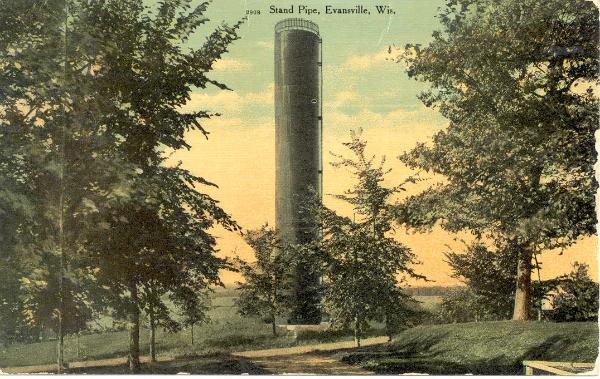
Sixteen years after a water works system was proposed, the voters of Evansville approved the building
of a 100-foot standpipe that was 12 feet in diameter, digging a deep well, and installation of water mains
and 50 fire hydrants with 2 1/2 inch hose connections.
Ray Gillman, the city's fire chief was a strong advocate for the new system because the system would
prove very valuable in protecting property from fire. Gillman noted that the city had good fire
equipment but lacked water. Many of the cisterns built in the 1870s and 1880s were deteriorating and in
1900, William Stevens had purchased the mill pond property and had let the dam go so that there was
no water in Lake Leota.
In the late 1890s, the mill race was dry and there had been a drought. The fire chief estimated that if a
major fire broke out, the water in Allen's Creek would last about 20 minutes.
The water system project was no different than any other major building project that had ever faced a
Village Board or City Council in Evansville. There was a major controversy about the whether the cost
of the system was worthy of taxpayer support.
A waterworks system proposed by W. H. Wheeler, J. P. Miller and John H. Brown was expected to cost
$44,425. The system included an electric plant. Since Baker Manufacturing Company had been
supplying electricity to Evansville since the late 1880s, the company officials also decided to offer to
build a water system at cost of $26,000, including the electric plant.
The major difference in the two waterworks proposal was that the Brown system covered a greater part
of the city with water mains and hydrants. The Brown proposal was accepted. The voters approved the
waterworks system by a two to one vote in a special election held in late July 1901 and the council
signed the papers with the Brown Company the following month.
The City hired its own engineer, F. E. Green to oversee the Brown Company's installation of the water
works. The City had purchased three new fire hoses from the Chicago Fire Hose Company for $24.
The firemen tested the hydrants on January 22,1902 and found them all in working order. The firemen
were able to have four hoses working simultaneously from two hydrants. In the business district, the
streams of water went 80 feet high. Hydrants in all parts of the system were tested. The hydrants at
Church and Madison threw a stream over the towers of the Methodist Church.
One newspaper reporter said the tests satisfied even the worst skeptics. Caleb Libby, who several
years earlier had opposed the waterworks system, signed up for water service to his residence as soon
as it was available and praised the water as some of the purest available from any private well in
Evansville. Libby also noted that those with city water did not have to maintain their own wells and
pumps.
Like Caleb Libby, most people were satisfied that they now had a fire protection system as well as a
safer water system in their homes and businesses. In March 1902, the citizens voted to purchase the
waterworks system and the electrical plant from the Brown Company for $51,000.
The first real test of the system for fire protection did not come until a year later. On April 23, 1902, a
restaurant on East Main Street caught fire when a gasoline stove exploded. According to observers, the
restaurant building was an "old, dry all wood building and nothing more combustible could be built."
The Magee Theater was directly west of the burning building and when the alarm was given, the theater
was filled with people, including several of the firemen. The theater was quickly evacuated.
The millinery store operated by a Miss Snowden, to the east of the burning building, was also in danger.
Volunteers quickly took the contents of that building to a safe place across the street.
When the fire engines arrived on scene, the men found the lower story of the building was completely
engulfed in flames. The restaurant was saturated with gasoline from the explosion." The firemen
attached four hoses to fire hydrants and within a short time had streams of water trained on the burning
building. With the pressure available from the standpipe, there was no delay in getting water, as there
had been when the steam fire engine was used.
Clarence Baker who was in charge of the Evansville Water and Light Department reported that 18,390
gallons of water was used to extinguish the flames. While the water was being pumped onto the fire, the
water system's two pumps were pumping water into the standpipe to replace what was being used at the
hydrants.
"There was no apparent effect upon the wells as they seemed to have an unlimited supply of water,"
Clarence Baker told the Evansville Review. Baker estimated that if it had been necessary, he could
have supplied the fire department with nine streams of water.
The fire was extinguished within five minutes and the building was saved. Although the damage to the
building and loss of contents was estimated to be $1,500, the people were satisfied that the water works
system had helped the firemen save the adjacent theater and millinery store. "What might have been a
serious blaze, was quickly put out by the efficiency of the service and alertness of the fire boys," the
Evansville newspaper reporter noted.
At the council meeting a month later, Ray Gillman, the fire chief asked for 500 more feet of hose for the
department. The matter was referred to committee number 5, the City Council's fire committee. The
firemen were pleased and surprised that the committee gave them twice as much as they had asked for
and ordered 1,000 feet of hose.
Although there was now an improved fire protection system in many parts of Evansville, there was still no
protection for rural residents. When the home of John Robinson, a farmer living less than four miles
from Evansville, caught fire in late January 1903, the Robinson family was forced to fight the fire with
what few resources they had on the farm. Fortunately the farm house was saved, but several valuable
paintings created by Theodore Robinson, a brother of John, were lost.
There were also sections of the City of Evansville that were not covered by the water system. Just a few
months after the restaurant fire, a home on South Madison was a total loss by fire, because the water
works system did not extend to that area of the City.
In 1899, the City of Evansville purchased a used LaFrance, third class, steam fire engine from the City
of Edgerton. They paid $800 for the machine and it was described as "a beauty". They continued to
own the Mansfield steamer, and a small hand engine. Other equipment included 3 hose reels, a hook
and ladder truck, 1,200 feet of 2 1/2 inch hose and 500 feet of 2 inch hose.
For several years, Evansville was free of major fires. Then, a Chicago fire made Evansville firemen and
city officials take a closer look at safety features of buildings, especially those where there were large
public gatherings.
On December 30, 1903, a fire at the "absolutely fireproof" Iroquois Theater in Chicago killed nearly 600
people. Many were trapped by inward opening doors. The crowds rushing to exits pushed against the
closed doors and were trapped by those following behind them.
Some tried to exit from the upper stories of the theater by escape doors that had fire escapes or exit
stairs. People trying to get out through these doors had no idea that there were no stairs and plunged
onto the hard cobblestones in the alley below. The only ones who survived were those who fell and
were cushioned by the bodies of those who had already fallen to their death.
Four people, two women and two children who perished in the fire had relatives and friends in
Evansville. Miss Grace Tuttle, Mrs. Fred Pond and her two children died in the fire. The two women
were sisters of Mrs. George Clark.
As in other cities throughout the United States, the fire made local firemen and city officials anxious
about the safety of Evansville's Magee Theater and the Evansville Seminary. The City Council asked
Committee Number 5, the fire department committee, to do an inspection of the theater and school.
After the inspection by the committee, theater owner, George Magee, was required to add another
stairway on the west side of the theater to serve as an exit. At the Seminary, the inspectors found that
the exit doors were hung so that they opened inward. The school was forced to rehang the doors so
that they would swing out.
When rumors persisted that the Magee Theater was unsafe, George Magee ordered an independent
inspection by William Meggott, a local carpenter-contractor, and Isaac Brink, a brick mason. The Magee
Theater floor and walls were found it to be sound. According to Meggott and Brink the floor was capable
of handling a crowd of 800 people, 200 more than the seating capacity of the theater. The stairways
were examined and also were capable of handling a crowd of people.
For its own protection, the Baker Manufacturing Company asked the City Council to allow Baker to have
access to the city's water system with one-inch taps. The Baker employees were allowed to practice
fighting fires under the supervision of the Superintendent of the Water and Light Department. Having a
prepared fire fighting crew at the plant proved to be very valuable for quick response to fires at its own
buildings and those of neighboring industries.
Fred Gillman was appointed as assistant chief of the Evansville Fire Department at the April 1904
meeting of the City Council. His father, Ray Gillman continued to serve as chief.
Others who were paid for services to the fire department in 1903-1904 were James Heffron who served
as steward of Fire Company No. 1 and Chris Hanson served as secretary of the same group. Others
who were paid for services on the fire company were Nate H. Potter, W. H. Griffith, John Bly, Bert Baker,
H. O. Walton, Calvin C. Broughton, George Dell, Clyde Babcock, Ace Fellows, George Powers, and E.
M. Cole. Liverymen who drew the horse-drawn engines and hose carts to the fires included S. M.
Gammon, Charles A. Fuller, Gill VanWormer, and John E. Reilly.
Once a year, the men attended a state fireman's tournament that was held at various locations
throughout the state. The firemen demonstrated their skills in coupling hose, racing fire engines,
climbing ladders, and relay races.
For several years, the firemen were called out for small fires that did little harm. They continued to
practice with their steam engine to keep it in working order. The Review noted in June 1905, "About the
only time the engine gets any chance to show off is when out on dress parades."
In November 1905, the fire department was called for its first mutual aid service. The village of Brooklyn
had a disastrous fire that threatened to wipe out the entire business district. A tank of gasoline in one of
the stores had exploded and in a few moments the adjoining wooden buildings were in flames.
The Brooklyn firemen sent out a call to Evansville. The Evansville fire department loaded an engine and
hoses onto a special train and went to the scene of the fire. Brooklyn had no water system and what
water could be obtained from wells and cisterns was inadequate for fighting the fire. The firemen,
including those from Evansville, were only able to halt the fire saving the buildings across the street so
that the fire was confined to the buildings on the north side of the street. Every building on the block
was burned to the ground except the bank.
Then on Friday, May 25, 1906, Evansville had two serious fires occur within hours of each other. The
engine purchased in 1899 was finally called into use for its first major fires.
The first call came at 2 a.m. from a neighbor who saw flames shooting through the roof of the house and
called the telephone office. He then went to alert the sleeping occupants of the Wilson residence on
South Madison Street.
The women at the telephone office took the call and alerted Fred Gillman, who was also a policeman.
Gillman rang the bell at the city hall to alert the firemen. The firemen answered the call as quickly as
they could, but the fire was already burning out of control when the fire engines and volunteers reached
the house.
The men trained their hoses on nearby residences in order to save them, while other volunteers helped
drag furniture and clothing from the Wilson home. Only a few items, including an organ and some
furniture were saved before the smoke and flames became too intense for any further rescue.
The men had barely put away their engines and hoses when the next call came. At 4 p.m. that same
day the fire bell rang once again alerting the men to the news that the D. E. Wood Butter Company
building on Enterprise Street was burning.
The fire was started by hot tar being used during the construction of a new addition to the building.
Within a few minutes the entire wooden part of the building was in flames.
The three-story structure and the basement were engulfed in flames that spread between the walls, the
ceilings and the floors of the building that had been remodeled several times. Firemen tore away
sections of the exterior siding so they could reach the fire with their streams of water. The fire was also
very difficult to fight, because the burning butter produced dense smoke and a terrible odor.
Everyone watching the fire worried that it would spread to the nearby Baker warehouses. Workers at
the Baker shop were able to help fight the D. E. Wood Butter Company fire with the equipment that had
been installed several years earlier.
The firemen sent telegrams to the Janesville and Madison fire departments to respond to the fire.
Janesville responded by sending some of their best equipment and firemen by a special train and
"performed valuable assistance", according to newspaper reports. The Madison department was told
not to respond when the fire seemed to be under control.
During the several hours that the firemen worked to save the brick portion of the D. E. Wood Butter
Company and the other nearby buildings, several women volunteered to make coffee and feed the
men.
Years later, Fred Gillman and other firemen who fought the D. E. Wood Butter Company blaze would
recall this fire and the great fire of 1896 as the most difficult to fight. The men had no protective gear to
wear and fought the fire in whatever they were wearing when the call came. Before the battle with the
fire was ended, their clothing was soaked and their faces were covered with soot and smoke.
In the aftermath of the fire, the firemen contemplated their lack of proper equipment to fight major fires.
The hose had proven insufficient in quantity and some of it was old and rotten.
The Sanborn Map Company from New York City created a map of the city in January 1907. Insurance
companies used the maps drawn by the Sanborn Company to determine fire hazards when underwriting
policies for buildings.
According to the 1907 map of Evansville, the fire department included about 40 men. The fire
equipment included three fire engines. The old hand engine, first purchased in the 1870s; the old
Mansfield steamer, which was seldom used; and their newest engine, a La France steamer with a
capacity of 800 gallons per minute (later maps read 700 gallons per minute).
Although motor driven vehicles were becoming popular with fire departments in large cities, all of the
vehicles owned by the fire department were horse-drawn. There were three 2-wheel hose carts and
one hook and ladder truck. The fire department had 2,000 feet of 2 1/2-inch cotton hose, 500 feet of 2
1/2-inch rubber hose (noted as being old, by the Sanborn mapmaker); 350 feet of 2" rubber hose. The
department also had 6 five-gallon chemical fire extinguishers.
New members added to Fire Company No. 1 from 1906 to 1913 included John Van Patten (1906); Max
Fisher, Jay Brink, Clyde Fisher and Fred Blakeley (1907); D. L. Grabill, the Congregational Minister,
(1908); Burr Jones (1910) and Bruce Townsend (1913).
By 1910, more water was available for fighting fires. The Baker Company improved their fire fighting
equipment by installing a 500-barrel water tank on their new three-story warehouse in 1910. They also
added a 750 gallon-per-minute pump. That same year, the city extended their water pipes to Longfield
Street. In 1912, the city added feeder pipes in the wells to increase the flow of water.
Fire calls to residents and businesses often produced unexpected income for the fire department. C. J.
Pearsall, manager of the D. E. Wood Butter Company and Marilla Andrews, former editor of the Badger
newspaper donated money to the fire department.
Other sources of income for the fire fighters were their annual dance and a portion of the city tax
revenues. The firemen were also generous with disaster victims. They donated the entire proceeds of
the 1911 dance, $15.75, to the victims of the November 11, 1911 tornado in Rock County.
One of the first country fires that the fire department responded to was at the Dan Finnane farm (at the
corner of Elmer Road and Hwy. 14) north of Evansville. The farm was rented to Henry Jorgensen and a
crew of men was threshing grain when a motor powered blower started on fire. The flames were blown
into the barn and stacks of straw stored in the barn caught fire.
Although large numbers of people from Evansville and the fire department went to the aid of the farm
workers there was little that could be done to save the barn. There was no water supply, except the
well. Mayor C. J. Pearsall and a group of men picked up a chicken house and moved it out of the way of
the fire, but the fire fighters could not save a new dairy barn, silo, a cattle barn and a horse barn.
In September 1914, the Sanborn Map Company once again produced a map of Evansville. The
volunteer fire department, with thirty-six members still had the LaFrance Steamer as their principal
machine.
There was now 3,000 feet of cotton and latex hose, 1 hook and ladder truck, 6, 1 1/2 gallon chemical
extinguishers and 2, 5-gallon extinguishers. The men were called to a fire by the ringing of the alarm
bell on the city hall.
In 1915, barrels were also placed in Allen's Creek to allow the fire department to suction water from the
creek, without taking mud into their hoses. The firemen listed in the records of Badger Hook and Ladder
Co. No. 1 records of 1915 included Bruce Townsend, Max Fisher, Bert Baker, Jay Brink, Clyde Babcock,
Arthur Thornton, A. F. Fellows, Walter Apfel, Nay Gillman, E. M. Cole, Clint Scofield, E. H. Libby, Callie
Winston, Calvin Broughton, Fred W. Gillman, H. O. Walton, and Roy Reckord.
A lumberyard fire was considered one of the worst to fight because the burning lumber created sparks
that were carried great distances even with the slightest breeze. Evansville's fire department was called
to the Paulson Lumber Company, located at the corner of Maple and Church Streets on September 17,
1915.
The fire started in the southeast corner of the lumberyard and spread through the storage sheds.
Sparks from the fire flew two blocks away, even though there was only a gentle breeze.
The volunteer fire department had six streams of water on the fire. Then the Baker Company
employees brought out their hoses and trained two more powerful streams of water onto the burning
buildings. The fire burned from 7 p.m. on Friday the 17th until nine o'clock the following morning.
Only the lime house and the office building of the lumberyards remained once the fire was finally
extinguished. A house directly south of the lumberyard also caught fire, but with the exception of the
siding and roof next to the yard, the building was saved.
The destroyed lumberyard, owned by M. L. Paulson, H. D. Thomas and their wives, was valued at
$25,000. Mr. Paulson expressed his gratitude to the fire department and the Baker Company
employees for their "heroic work in fighting the fire."
By the following year, the City Council had agreed that they should purchase a motor-driven fire truck.
The Council approved the purchase of a Studebaker chassis from the Evansville City Garage and
fire-fighting equipment was built by the Peter Pirsch company of Kenosha.
The new truck had 2 extension ladders, 1,000 feet of 2 1/2 inch fire hose, and a forty-gallon chemical
tank. On the running board were two hand chemical extinguishers. There were two axes in brass
holders, four New York City fire department style lanterns, hook and pike pole, crow bars, door openers
and hose shut off. The total weight of the truck and equipment was 5,500 pounds.
There was a black steel railing the full length of the body of the truck and down to the rear foot board.
The truck had electric lights and an electric starter. It was painted red with gold stripes and had a
twenty-inch bell to warn motorists, pedestrians and horsemen to get out of the way.
City Councilman, Forrest Durner and Nay Gillman, went to Kenosha to get the truck in March 1917.
They stopped in Janesville so that the residents of that city could see the truck. "It was the object of
much admiration, especially with the members of the fire department," the men reported back to the
Evansville Review.
Another motor truck was purchased in January 1919 to use as a hose truck. This was a Ford truck with
a siren horn. The truck carried 1,000 feet of hose and was smaller than the Studebaker so that it could
get into alleys and other places that the larger truck could not reach. As they had with the first truck,
when the Ford hose truck arrived "the boys of the fire department were very proudly displaying it around
town," according to the Evansville Review.
Now the department could readily respond to country fires. One of the first calls for the new trucks was
on January 29, 1919. Fred Gillman received a call for the fire department to respond to a barn fire at
the Cram farm, five miles east of Evansville on what is today Highway 14. The farm was rented to
Charles Taylor.
Although the fire department arrived too late to save an old barn and small sheds, with the assistance of
the chemicals on the Pirsch built fire truck the firemen were able to save a large new barn.
A newspaper reporter praised the work of the new equipment and the fire department. "Here the
chemical engine was in its glory and the boys worked like Trojans, and by the use of the long ladders of
the fire truck managed to protect the roof and keep the fire away from the new barn."
Following World War I, gas masks that had been used in the European war were available for protective
gear for firemen. In April 1920, the City Council voted to purchase six gas masks.
Evansville's first reported case of arson occurred in May 1920 when the Bellman-Williams Co. garage,
located on Madison Street caught fire. At first it was thought that an explosion of gasoline vapor was
responsible for the fire, but it soon became evident that one of the owners, J. S. Williams was
responsible. A month later, Williams was sentenced to five years in Waupun prison.
By 1920, there were many Evansville residents who owned their own automobiles. Where people had
once rushed to a fire on foot, they now used their automobiles and in their haste endangered
themselves and the firemen.
As soon as the alarm was sounded, residents would call the local telephone office to find out where the
fire was located. Then they would get in their cars and try to beat the fire trucks to the scene of the fire.
Those without cars ran or jumped onto the running boards of passing automobiles. It was during one of
these frenzies in August 1920, a citizen was injured.
The firemen were called to a grass fire at the corner of Brooklyn-Evansville Road and Highway C.
People on foot and in cars rushed down West Main Street and bunched together so that it was almost
impossible for the fire truck to get through. Albert North tried to jump on the running board of a moving
car and was thrown onto the street. Fortunately, he had no broken bones, but was badly bruised.
Fire Chief Ray Gillman thought the incident was cause for a warning and placed a lengthy article in the
Evansville Review cautioning motorists against getting in the way of the fire trucks. "All cars, as soon as
they hear the alarm, should pull for the right hand curb and stay there till the fire truck gets by and then
if they just must go to the fire to go there at a decent rate of speed." Gillman also warned motorists that
if a fire truck hit their cars, no damages could be collected.
From 1920 to 1924 fire damages were kept to a minimum through the early intervention of the firemen.
House fires in the city and in the country brought a quick response from the firemen and their
equipment.
In 1922, there was only one fire reported in the Evansville Review for the entire year. The furnace at
the Biglow & Roderick Furniture store at 10 East Main overheated and started the floor on fire. The fire
department's quick response kept the loss on building and contents to $450.
The Biglow & Roderick fire occurred in January and the temperature was 12 below zero, making it very
difficult for the firemen to handle the fire hose. It was the coldest temperature, the firemen had
experienced in fighting a fire.
Leaky gasoline stoves, chimney fires, grass fires, and overheated furnace and stove pipes were the
main causes of fire calls in the 1920s. However, city residents knew that even the smallest fire could get
out of control.
Citizens generally appreciated the volunteer work of the firemen and the annual fireman's ball was an
opportunity for the townspeople to show support for the organization, as well as to have a good time. In
advertising the dance, which was held in November of each year, the Evansville Review noted that
Evansville residents should express their appreciation by purchasing tickets to the event. "The money
taken in at these dances in the past has been used to buy something that the fire boys need to make
their service to the city more efficient which the council is not able to furnish. So virtually every dollar
contributed goes back into the city equipment for fire protection."
Some fires were more difficult to fight than others were and feed mills fires were very difficult to
extinguish. In January 1924, the Evansville Grain & Feed Co. building caught fire. The fire already had
a good start before it was discovered. Baled hay and other feed made the fire difficult to fight from
inside the building and the corrugated steel siding could not easily be cut to make openings for the fire
hoses.
Volunteers were able to haul away hundreds of sacks of flour and feed. The salvaged feed was stored
in a warehouse away from the fire and water damage from the fire hoses. Regular train service was
suspended so that the fire hose that was run from hydrants on East Main Street and across the railroad
tracks to the burning building did not get cut.
It is possible that there was some theft of the feed that was transferred out of the building, because a
few months later, at the urging of the Commercial Club, Fred Gillman organized the fire police. The
purpose of the new organization was to protect property that was taken from burning buildings, so that it
did not get stolen. The fire police were also to stand guard over the fire hose laid across streets, so that
motorists did not drive over the hose and break it.
Gillman was recognized as a natural leader and in addition to his work as Fire Chief and Police Chief, he
was also voted Chief of the Fire Police. All of the other members of the Fire Police were local
businessmen and members of the Commercial Club, including L. B. Cummings (partner in the Evansville
Grain & Feed Company), Bert Holmes, Robert Antes, Fred Brunsell, Bruce Ford, Wm. Flemming. H. H.
Loomis, Arthur Devine, H. A. Langemak, Grant Johnson, Cy Montgomery, Ray Smith, R. L. Collins, Willis
Decker, Arthur Dake, Charles Doolittle, Phil Pearsall, Arthur Tomlin, Paul Pullen, Dr. H. M. Fogo and R.
E. Acheson.
In December 1926, Evansville lost it's first fire chief. Ray Gillman died at the age of eighty-four. The
Evansville Review editor eulogized him. "In the passing of Ray Gillman Evansville loses one of her most
loved citizens. One who has always had the best interests of his town at heart. It was through his efforts
that the first fire company was organized." Gillman set a record for length of service as chief. He was a
member of the department for fifty years and served as chief for thirty-eight years.
Following in the tradition of his father, Fred Gillman was the second person to serve as chief of the
Evansville Fire Department. In his dual role as fire chief and police chief, Gillman used the newspaper
to give safety tips to homeowners and businessmen. Being prepared for fires was often the focus of
news items. A small fire at the Grange Store in December 1926 caused Chief Fred Gillman to issue a
warning to businessmen to recharge their fire extinguishers.
Grange owners had prepared for an emergency by placing barrels of water and boxes of sand at
various places in the building. They also purchased soda and acid extinguishers, but had not followed
the instructions to keep them recharged.
Many other businesses had also neglected their fire protection devices, according to Gillman. Although
businessmen had purchased chemical fire extinguishers for their stores, they failed to keep them in
good working order. Using the Grange Store fire as an example, Gillman warned others: "It is a waste
of time and money for one to purchase fire extinguishers if he does not intend to recharge them
regularly," Gillman told businessmen.
No disastrous fire were reported in 1927 and 1928. Nay Gillman, Fred Gillman's brother, served as
secretary of the Evansville Fire department in 1928. He recorded 16 fires that were put out by the local
firemen. Most were small fires, but occasionally even small fires resulted in smoke and water damage.
This was the case when the department responded to the D. E. Wood Butter Company on October 29.
The small fire was extinguished quickly, but the smoke from the fire tainted all of the dairy products,
causing a $13,633.54 loss to the company.
Fire Chief, Fred Gillman warned residents that carelessness was the major cause of fires and asked that
they take more precautions against chimney fires. "Every fall and winter the fire department is called out
to numerous chimney fires, all of which could easily be prevented if Evansville residents would see to it
that the chimneys to their homes are cleaned before any fire in a stove or furnace was started."
He also warned that furnaces and smoke pipes could rust during the summer months when they were
not in use and cause dangerous fire hazards. "It is much easier and less expensive to prevent fires than
it is to extinguish them."
Although chimney fires rarely caused serious damage, it was a big expense to the city to have the fire
department respond. Gillman estimated that every time the trucks left the fire station for a call that it
cost the city an average of $50. "The city might be relieved of this expense if more precaution was
taken in guarding against fires," Gillman responded.
The Sanborn Map Company made another survey of Evansville in 1928 and reported that the fire
department had 24 men, a fire chief, and an assistant chief. They were operating with the Studebaker
chemical fire engine, the Ford hose truck, a hose cart, and 4,000 feet of 2 1/2 in hose. The water
system consisted of 66 hydrants in the City of Evansville, 1 1/2 miles of 8 inch water pipe, 2 1/2 miles of
6 inch water pipe and 4 1/2/ miles of 4 inch water pipe.
The City increased its fire protection ability and built a new pumping station 1929 and it was in operation
by January 1930. A new reservoir with a capacity of 400,000 gallons of water was built. The power
station had electric pumps that could be supplemented with a gasoline driven pump so that in case of
electrical power outages there would still be water pressure for fires.
"When this work is completed, Evansville will have a water supply and pumping equipment of which it can
be proud and of sufficient quantity and quality for Evansville's needs for the next 50 years," E. S. Cary,
superintendent of the Water and Light Department told the Evansville Review readers.
The City Council also increased their fire protection equipment and voted to purchase two new fire
trucks in late 1929. One was for city use and the other for country use.
The country truck was ordered from the Chevrolet dealer, Heffel and Jorgensen and the additional fire
apparatus was built onto the chassis by the Boyer Fire Apparatus Company of Logansport, Indiana.
The new vehicle was called a triple combination community fire truck.
The new truck cost $5,500. The Evansville City Council agreed to pay $1,500 and the $4,000 additional
money needed was to be raised by subscription from farmers living in the townships of Magnolia,
Center, Union and a "few representative farmers living west of the county line in Green County". The
farmers who were asked to cover the cost of the vehicle were connected to the Evansville telephone
system and could easily call in a fire alarm.
The new community fire truck had two 40-gallon chemical extinguishers, two 5-gallon water pumps, 75
feet of extension and roof ladders, spot lights, hand extinguishers and an electric siren. It also carried
1,000 feet of 2 1/2 inch hose.
When the new truck arrived, it was subjected to a battery of tests by the local firemen. Because it was a
state-of-the-art country fire truck, it was the object of much attention as fire department personnel and
government officials from other villages and cities came to view the new truck.
Within a few months after its arrival, local firemen gave demonstrations to twenty delegates from
Orfordville and the surrounding townships. The visitors wanted to inspect the new fire truck, as they
were making plans to purchase a similar vehicle. Six members of the Belleville City Council and their fire
chief also came to Evansville to see a demonstration of the truck.
The second truck was a hose truck with a booster pump. The chassis was made by the Ford Motor
Company and ordered from the local Ford dealer, L. L. Thompson. The new hose truck had a booster
pump and 500 gallon tank.
It was fortunate that the two new trucks arrived in 1930 as the city and surrounding farm community were
plagued with serious fires that year. The first fire actually occurred before the arrival of the new hose
truck.
A barn at 457 East Main Street, owned by C. L. Montange, burned to the ground and the fire rapidly
spread across the alley to the tobacco sheds and cattle barn of E. H. Libby. Water mains on the east
side of town were a great distance from the water tower and the water pumps did not provide a sufficient
water supply to fight the fires. All of the structures burned to the ground.
The loss was estimated at $4,000. Fire chief, Fred Gillman claimed that had the city's new fire truck with
booster pump been available, the barns could have been saved.
The next major fire occurred in July 1930 and was at the old abandoned mill on Mill Street. The
three-story building was owned by Mrs. Charles Van Wart and leased to Eugene Williams. He was a
junk dealer who had rented the building for 18 years and had filled the structure with old newspapers,
tools, and other items he had collected. The old mill and its contents burned to the ground and firemen
stood watch for several hours over the fire.
The following a week a large barn near Union, rented by the Torfin Hatlin burned. It was already half
burned when the Evansville Fire Department arrived so they concentrated on the large tobacco shed
and other buildings on the property. The barn contained forty tons of hay and it was thought that the
fire started from spontaneous combustion caused by the fermenting hay. Firemen were at the scene
from 12:30 in the afternoon until 3:30 the next morning.
Fred Gilman praised the work of the new fire engine and stated, "this fire alone, the new pumper payed
for itself." However the loss was estimated at $3,000 for the property owner, Blanche Harper and her
renter, Torfin Hatlin.
There were four more fires within the next week. Another barn fire, a grass fire, and two house fires. All
were easily put out with little damage, but the firemen hoped they would not have to respond to so many
calls again.
However, in September there were two more barn fires within one week. The first was at the Kerin
Brothers farms near Cooksville, where the Evansville Department helped the Stoughton Fire
Department. It was 25 minutes after the call that the Evansville Fire Department was able to travel to the
scene of the fire. The barn was a total loss.
The second call in September was at the Paul Gransee farm, south of Evansville. The fire started in a
straw stack from a spark from a gas engine being used to fill the silo. Although the fire was under
control 30 minutes after the firemen arrived, it had consumed the barn, silo, and milk house, as well as
50 tons of hay, and several hundred bushels of oats and barley.
The men who fought the fires were paid a small fee annually, based on the number of fires that they had
responded to during the year. There were 12 men on the hose company, but the records for that
company, if they exist, have not been located.
The records of the Hook and Ladder Company's twelve men for 1930 showed that Fred Gillman, Nay
Gillman, and Clyde Babcock had responded to the most fires. They were paid $24 each for the year.
Officers of the fire department were often paid a small fee for their services during the year. H. Lee and
Ed Sperry were listed as stewards of the fire department and paid $7.50 for their services during 1930.
The stewards were responsible for keeping the fire trucks and other equipment in working order.
Other hook and ladder company members who received compensation for fire fighting were Leo
Brunsell. E. W. Cole, H. B. Durner, Leslie Giles, E. S. Cary, Jay Brink, Bert Baker, Arthur Huseth and H.
O. Walton. Walton also served as the fire department's inspector and checked buildings in the business
and industrial district for fire hazards.
The efficient fire department, the new fire trucks and the city's new well and pump house lowered the
insurance rates of homeowners and businessmen. The city's insurance rating was changed from a
seventh grade rating to a sixth grade rating by the Wisconsin Inspection Bureau of Milwaukee, who set
the fire ratings for Wisconsin cities. "The purchase of the new community fire truck and its booster
pump, has lowered the insurance rate here from seventh to the sixth grade, and has given Evansville
one of the best volunteer fire departments in the state of Wisconsin," the Review editor boasted.
Several fires over the next few years were easily controlled by the local fire department. It was not until
December 1935 that the firemen were faced with a major fire. On a bitter cold day, the Fleming Ice
Cream factory burned to the grounds. Because they had little protective gear, many of the firemen
suffered from frozen hands and feet.
Many of the firemen were attending the annual school meeting when the alarm sounded at 8:30 p.m. on
Monday, July 13, 1936 and they were called to a fire at the Brunsell and Fellows warehouse on north
side of East Main Street.
Nearby were the company's fuel trucks. Directly east was the Meyers Lumber Yard with stacks of lumber
in the sheds. West of the burning warehouse and across the railroad tracks was the Green & Company
grain storage.
Men were able to get the fuel trucks away from the burning building and when the firemen arrived, the
put lines at the fire hydrants and into Allen's creek and soon had six lines of hose putting water on the
fire. This time the firemen were faced with sweltering heat and it took two hours of heavy battle to get
the fire under control.
At times, flames shot into the air 100 feet and were visible for miles around. It was estimated that 1,000
people came to watch the fire. Tons of hay, straw, twine and coke coal fueled the fire. The volunteers
fought the blaze all through the night, constantly putting out small fires in the lumberyard and watching
the smoldering hay and glowing coal so that the fire did not start up again.
The fire was one of the first to be documented with pictures in the Evansville Review. The photographs
showed the flames rising high into the air, the front of the building with fire ladders leaned against the
second story windows and the charred skeleton of the building. Only the cement brick front of the
warehouse remained. The loss was estimated at $30,000.
Fire losses, whether in the city or in the country were devastating to the property owners. In 1939, two
rural areas formed their own fire-fighting groups, in cooperation with the Evansville Fire Department.
Although they had no equipment, the men could be on the scene of the fire in their area, before the
Evansville Department arrived.
The two farm areas, Pleasant Prairie and Butts' Corners, elected officers and telephone informers. The
foreman of the Pleasant Prairie group was John F. Golz. Mark Brunsell was elected assistant foreman.
Mrs. Hugh Robinson, Mrs. Grace Brunsell, Mrs. Elmer Allen and Mrs. Austin Hunt were designated
"informers" and were to telephone farmers to let them know where the fire was located.
Charles Maas was elected foreman of the Butts Corners group; George Krajack, assistant foreman and
Mrs. Ed Turner, Mrs. Charles Maas, Mrs. Ed Ellis and Mrs. Arthur Ellis, informers. All farmers in the two
areas were members of the fire brigades.
Within two weeks after the groups formed, the Butts' Corners group was called to assist at a house fire
on the Paul Christensen farm in October 1939. The volunteers confined a blaze in a bedroom on the
second floor of the house until the Evansville Department arrived with their fire equipment.
The late 1930s was the end of an era for the Evansville Fire Department. By 1938, only two members of
the original fire department were still living, Frank Hubbard and A. M. Barnum. In March 1939, Nay
Gillman, who had served on the Evansville Fire Department for 52 years, turned in his resignation at the
annual meeting. He served as the secretary of the hose company at the time of his retirement.
Fire Chief, Fred Gillman, died in 1940. He had served on the department for 53 years. Several times
during his tenure as chief he was asked to name the most memorable fires. Gillman always referred to
the great fire of 1896 and the D. E. Wood Butter Company of 1906 as the hardest fires to fight.
For more than 50 years the City of Evansville had depended on a member of the Gillman family to serve
as Chief of the Fire Department. Fred Gillman, described as one of Evansville's outstanding civic
leader, was one of the first to arrive at the scene of a fire and one of the last to leave, once the flames
had been extinguished. Gillman was 72 when he died unexpectedly of a heart attack.
Following Fred Gillman's death in March 1940, Ben Bly was appointed Fire Chief at the reorganization
meeting of the City Council held on April 16, 1940. Leslie Giles was appointed assistant fire chief. Bly
was employed at Baker Manufacturing Company for many years and later opened his own plumbing
business.
In 1941, the firemen voted to test the fire siren every noon. This was already the practice in many
villages and cities that had volunteer firemen and Evansville firemen decided to adopt the practice also.
The alarm was activated at the City Hall each noon and in case a fire did break out at noon, the siren
would sound for a longer period of time, and the fire bell in the tower of the City Hall was also to be
rung. In addition to the siren and bell, the telephone operators also called firemen to respond to fires.
These calls were referred to as "silent alarms".
At the sound of the siren, the telephone operators received many calls asking for the location of the
fires from people who were simply curious. These calls tied up the operators time so that they could not
efficiently get their calls out to the firemen who needed to respond quickly. Several warnings were
issued over the years that telephone operators would not give out the locations of fires to anyone but
firemen or police officers. The warnings often were not heeded.
Firemen were rarely called to fight fires at their own homes, but in April 1941, an alarm sent the fire
department to the home of fireman Ed Erpenbach. They found a fire in a log-cabin playhouse Ed had
built for his children at their home at 21 School Street. The small structure could not be saved.
Deaths from fire were rare in the Evansville vicinity. However, in July 1940, the Evansville Fire
Department was called to a car accident. Three young Evansville men, Ervin Jorgensen, Eddie Trebs
and Robert Allen were riding in a home-built racing car when it collided with a truck and burst into
flames. Allen and Trebs were dragged from the burning vehicle but Jorgensen was trapped in the
wrecked racer. When firemen arrived on the scene they extinguished the flames, but could not save
Jorgensen.
A storm in late July 1940, brought firemen to the Louis Benash farm near Leyden. Together with the
Janesville fire department, the men fought a barn fire and kept water streams trained on other buildings
to prevent the house, machine shed, garage, corn crib and milk house from burning. Water was
pumped from wells at farms near the Benash property and carried on trucks to the fire scene.
A new fire truck was purchased as a community fire truck to serve the City of Evansville and the
townships of Union, Porter and Center. It was delivered to the Evansville Fire Department and tested for
the first time on Monday, January 5, 1942.
Peter Pirsch and Sons of Kenosha built the truck in 1941. The pumper and the fire fighting equipment
were built onto a Chevrolet truck chassis. The new truck had a 500-gallon tank, as compared with the
100-gallon tank on the old pumper, and could pump 500 gallons per minute. The new truck also carried
1,000 feet of 1 1/2 in hose. The new truck and equipment was considered to have about five times as
much fire fighting power as the old community fire truck.
Don Whitmore, Secretary of the Union Mutual Fire Insurance Company, had also arranged to purchase
new water tanks to supplement the water the fire trucks could carry. The portable tanks were filled with
city water and transported to the scene of the fire on the flat bed trucks.
The new water tanks increased the water available to fight country fires. Drivers and the trucks were
supplied by several local businesses including Brunsell and Co., Evansville Feed & Fuel Co.,
Laufenberg Lumber Company. The purchase of the water tanks by the insurance company, as well as
the donation of the trucks and the drivers by the businessmen were hailed as a display of community
spirit.
The tanks were three galvanized stock watering tanks. Each had a metal cover with a removable cap so
that water could be poured into the tanks. On the end of each tank was a 2 1/2-inch opening with a
removable cap for emptying the water out of the tank.
The three tanks were stored on racks with metal rollers located on the east side of Enterprise Street,
across the road from the Water and Light Department building. When the tanks were needed, the
trucks were backed up to the racks and the empty tanks were rolled onto the flat beds. Then the
drivers drove the trucks across Enterprise Street to the water pipes at the Water and Light building,
where the tanks were filled. The water was then transported to the scene of the fire.
In April 1942, the Evansville fire department was asked to assist the Janesville fire department in one of
the worst fires in Janesville's history. Firemen Ed Erpenbach, R. Gallman, Leslie Giles and Alvin Olson
took the new Evansville truck to Janesville and stayed at the Janesville fire station in case a fire call
came in from some other part of the city.
Although the fire department was called out several times in 1942 for minor fires, more routine annual
activities also occupied their time. During the early months of the summer, the firemen held practice
sessions and invited auxiliary firemen to practice with the equipment.
In 1942, auxiliary firemen were listed as Herb Coyne, Leslie Patterson, George Winter, Bob Fish, Wilbur
Patterson, William Gibbs, Charles Shelby , Otto Guse, William Brown, Roy Sarow, Lyle Taylor and
Donald Whitmore. Several of these men later became full members of the fire department.
The firemen and their assistants took the two pumpers and the hose truck to Allen's Creek and
practiced pumping water into the tanks and then pumping it out, as they would for a country fire or an
unusually large city fire. Each week during the six weeks of practice sessions the men took the trucks to
the Water Street Bridge, the Main Street Bridge or the city park for training on the equipment.
The annual fireman's dance held each November was suspended for several years during the 1940s
because of the World War. When the dances were stopped in 1942, it was the first time in more than 60
years that the annual fund raisers had not been held. Instead the men chose to hold a raffle with the
prizes being war bonds. The dances were resumed in 1946.
Cooperation between neighboring fire departments was important during major fires. Several
departments also began to share training sessions. In 1943, the local firemen hosted training sessions
at their room in the basement of City Hall. Twenty four members of area fire departments were given
instructions by Janesville fireman, William Murphy, on ladder use and rope tying. The local men also
went to other fire stations for training sessions.
The firemen were frequently called together to fight fires. A typical fire that required cooperation
happened in November 1944, when Brooklyn's fire department and Evansville's firemen were called to a
fire in a cow barn at the Austin Hunt farm north of Evansville.
Both departments responded with men and equipment. The barn could not be saved, but they were
able to protect nearby buildings from burning. The Brooklyn fire department stayed on the scene from 7
p.m. until 2 a.m. the following morning, and Evansville's department stayed all through the night.
Water was supplied from the Evansville water tanks that were delivered to the scene by William Bewick,
driving the Evansville Feed & Fuel truck; Earl Schwartz, driving the Union Implement Truck and Vern
Laufenberg with the Laufenberg Lumber Company truck.
Fire Chief Ben Bly, like his predecessor, Fred Gillman, issued warnings to people to safe guard their
homes against fire. Cleanliness and attention to keeping stoves, furnaces and electrical appliances in
proper working order were always stressed. In addition, Bly issued warnings at Christmas time about
flammable Christmas trees, ornaments, toys, clothing. Some people were still using candles on
Christmas trees, or faulty electrical cords and Christmas tree lights. Bly also warned churches and other
public places where Christmas decorations were used to be especially cautious as "the danger perhaps
is greatest in public places because of the inevitable panic should fire occur."
The Union Mutual Fire Insurance Company also issued warnings to farmers to be cautious about
overheated hay. The company's secretary, Don Whitmore, offered to test the hay's temperature. The
company also had equipment to treat the hay so that it would not burn. The service was free to policy
holders, who only paid for the chemical used in the treatement. "Do not wait until your barn burns. If
there is danger proper steps can be taken before it is too late," Whitmore warned.
In April 1946, the firemen were called out to find the body of a child who had drowned in Lake Leota.
Orville Jones, Clifford Wood and Donald Weaver responded to the call to find Margaret Mary "Peggy
Dalton", a five year old child. Together with Police Chief, Lorenzo Cain and Rock County Sheriffs
department, the men dragged the lake and found the girl's body in about 10 feet of water near the
brick-walled edge of the lake.
Most calls were very short in duration. Each fire call was referred to as a "special meeting" of the fire
department. In the Hook and Ladder Company minutes recorded in the 1940s by secretaries, George
Mattakat and Clyde Babcock, the fire calls listed the members of the company who responded, the time
the alarm was sounded and the time the fire trucks and men returned to the station.
For a small chimney fire, the length of time the men were out could be as short as five minutes.
Sometimes the fires had already been extinguished by the time the men arrived and they checked the
walls and other hiding places for fires that might go undetected.
In 1948, the fire department began performing emergency medical services for the community. The city
purchased a resuscitator for the fire department. The Red Cross also donated $100 toward the
purchase of the machine. It was to be used to take to local homes or other places where someone who
was ill or injured might be having difficulty breathing.
The resuscitator was said to be especially helpful for burn or near-drowned victims. Assistant fire chief,
Leslie Giles and R. H. Gallman demonstrated the life saving machine to several civic groups so that
people would know it was available.
In 1948, the townships also purchased a new fire truck, a 1948 Chevrolet, 1,000 gallon tank truck. The
first practice with the new community truck was held in August 1948, according to Hook and Ladder
Company records written by the secretary Clyde Babcock.
Following Ben Bly's term as fire chief, assistant chief, Les Giles took over. Giles, who was an auto
mechanic also served as the fire department steward, whose responsibility was to keep the trucks in
good mechanical order.
In January 1950, the department was called to the home of one of its volunteers. The furnace at Clyde
Babcock's residence exploded and the cause was thought to be from accumulated coal gas. The front
door of the furnace was blown off by the blast and flames shot out of the basement windows. Leaves
that were piled beside the houses of the Babcock's neighbors caught fire and the exterior of the homes
were scorched.
Babcock responded to the fire as did fellow Hook and Ladder Company volunteers, Robert Olsen,
Lester Patterson, Richard Shea, Clifford Wood, Leslie Giles, Howard Becher and Vern Laufenberg. The
firemen had to use gas masks so that they could enter the basement of the home.
By 1951, the fire department did not have enough volunteers and Giles placed an article in the
Evansville Review asking for able-bodied young men to apply to join the department.
The department's most serious fire in years occurred in May 1953 when the Green Brothers Grain
Elevator on East Main Street burned. The fire started in the drier in the grain elevator and the first
alarm was sounded at 10 a.m. in the morning. Within an hour the fire seemed to be under control.
Several hundred spectators gathered to watch the firemen as they worked on the roof of the grain
elevator, pouring water on the two to three thousand bushels of burning corn.
The City Council had been negotiating for a new fire truck during the spring of 1953, but the decision to
purchase a new truck did not come until after the disastrous fire at the Green grain elevator.
The new truck had a GMC chassis with fire equipment built by the Pirsch Company of Kenosa. The
truck cost nearly $9,000 and could pump 500 gallons of water a minute. The truck carried four hoses,
including two 2 1/2-inch in diameter and one each of 1 1/2 and 1-inch diameters. There were ladders,
including a 32-foot overhead ladder mounted on the truck.
The truck was not ready until January 1954. When it arrived, the men took the truck to Leota Park and
tested its pumping apparatus at Allen's Creek. Using four hoses of three different sizes, the engine
passed the test and was accepted by the department and the insurance inspector.
With the new truck, the City now had the lowest insurance rating class a community with a volunteer fire
department could have. The insurance inspector gave the city a class 6 insurance rating and some
claimed that the savings in insurance premiums would pay for the new truck in two years.
The new engine was put to use the very first day when a small fire was discovered at the Baker
Manufacturing Company. The fire was in a pile of wooden forms and was under control within a half
hour after the firemen arrived.
Leslie Golz, Lawrence Skoien, and Phillip Montgomery, three men who would become chiefs of the
Evansville Fire Department, signed on with the Hook and Ladder Company in the 1950s. They joined
Chet Jorgensen, Richard Shea, Les Patterson, Clifford Wood, Howard Becher, Clyde Babcock, R.
Gallman, M. D. Fish and Verne Laufenberg. In addition to the Hook and Ladder Company, there were
also 12 members of the Hose Company.
In addition to fighting fires, the fire department was also asked to take part in the Civil Defense programs
that were being organized throughout the nation. Responding to fears of a Communist invasion, or
sabotage, citizens began preparing a defense system, including stock piling food, designating or
building bomb shelters, establishing an observation corps for spotting enemy planes, and training
emergency personnel.
The Fire Chief, Les Giles and volunteer firefighters, Bob Olson and Ed Erpenbach served on the
committee to establish a Civil Defense Ground Observer Corp in Evansville in 1953. The purpose of the
organization was to identify planes as they flew over the City and to report the planes to a central office
in Chicago. This was a volunteer effort that required many hours of time from people in the community.
Les Giles went to work for a Madison truck dealership, but continued his office as Chief of the fire
department. Chester Jorgenson served as assistant chief of the fire department and acted as head of
the department during the day when Giles was out of the city.
Two members of the fire department retired in February 1953. Clyde Babcock and Ray Hubbard were
honored at a special program at the high school auditorium. Babcock had served for fifty-five years and
Hubbard for 45 years.
Clyde Babcock had served as foreman of the hook and ladder company, and also was secretary of the
department. Hubbard was a member of the hose company and had been the city fire inspector.
Babcock remained active as a fire inspector.
The City Council minutes occasionally listed the payment of the volunteers who responded to fires.
Firemen receiving pay in the July 1953 bills paid by the City were Earl Schwartz, Maurice Bly, Donald
Persons, R. Hatlevig, H. Seguine, William Erbs, Don Turner, Don Graham, Robert Albright, Wayne
Hatlevig, L. George, Orville Jones, R. Jorgensen, Larry Skoien, Richard Shea, R. Peterson, C. Wood,
Leslie Giles, Chester Jorgensen, Howard Becher, John Whitmore, Les Golz, Reinhold Gallman, M. D.
Fish, and Robert Olson.
State law required that the fire department conduct regular fire inspections in the business district every
six months. The inspections in Evansville were conducted by Clyde Babcock. In 1954, when it came
time to pay Babcock for his work, a minor difference of opinion developed between the City Council and
the fire department.
Chief Les Giles requested a $15 payment for Babcock's work but the council refused until they had a
chance to discuss exactly what it was the Babcock did as a fire inspector. The matter was not resolved
until the following year, when the Council and Babcock met and all of the cancelled checks paid to
Babcock were laid out on the Council table. The parties finally agreed that Babcock had received $15
more than he had earned, but considered the matter settled.
There was also much discussion at the City Council over the payment of the firemen for answering calls
and taking part in training sessions. Each year, the City received approximately $500 from the State of
Wisconsin from a tax levied by the State of Wisconsin against insurance companies. The payment
represented about two percent of the fire insurance premiums paid by Evansville residents.
In order for Evansville's City Council to receive the money from the state, the City's fire department had
to meet a set of standards, including training sessions for the men in the use of fire equipment and fire
fighting techniques. The Evansville fire department's equipment met the standards and they had met
the requirements with their annual series of training sessions in the spring and early summer.
In the past, this money had been distributed to the firemen but some on the council felt that the money
should be used to purchase new equipment. After several months of discussion, the money was given
to the fire department to be distributed among its members "as compensation for drills in which they took
part during the course of the year."
In the spring and summer of 1954, the weather was unusually dry and the fire department battled many
grass fires. In one week in early March, the department responded to seven grass fires. Chief Leslie
Giles warned people against carelessly starting fires to burn rubbish or garden and yard waste. Winds
and the dry conditions could easily spread the fire out of control.
Giles sent a letter of resignation to the Evansville City Council in January 1955 and his assistant chief,
Chester Jorgensen was appointed the fire chief of the Evansville department in April 1955. During
Jorgensen's first year as chief, the volunteer fire department responded to 40 fire calls, 22 in the city
and 18 in the country.
Most years, the fire department responded to many calls, but the fires resulted in relatively minor
damage. However, in 1958, the department fought several major fires. In January, firemen from
Evansville and Footville battled a house fire on the William Lawrence farm on Dohs road. The family,
which included seven children, was asleep when the fire was discovered and barely escaped before the
house was consumed by flames. The fire departments were able to save several other building
surrounding the house.
A few days later, the Evansville Review and Antes Printing Company building, on East Main Street,
caught fire. Members of the local public works crew were working on a sewer when they saw the fire
and called in the alarm.
The firemen were called out at 6:45 in the evening on January 19, 1958. The printing company owner,
William Sumner, Jr. and several firemen were attending a Lion's Club meeting in a restaurant about two
blocks from the building.
The firemen responded quickly, but the flames were already shooting out of the top of the building. It
was reported that the fire could be seen as far away as Brooklyn. Many feared that the entire downtown
area was in danger.
The fire was still out of control a half-hour after the firemen arrived and because of the building's
location at the east end of the business district, other buildings were in danger. The Evansville fire
department called for assistance from the Janesville and Orfordville fire departments.
There were hundreds of spectators gathered to watch the spectacle as the fire burned out of control for
nearly three hours. Several members of the Antes Printing Company staff tried to help the volunteer
firefighters.
The fire seemed to be shooting up the elevator shaft and one of the employees, Gene Thompson, tried
to show the firemen the location of the elevator. He became disoriented and was injured when he fell
from the first floor down to the basement through the elevator shaft.
Bob Antes, former owner of the Antes Press, rescued the old files of the Evansville newspapers, that
went back to 1866. Some of the papers that were later given to the Evansville library still show the
scorch marks of the fire. Unfortunately, the papers from 1890 to 1910 were not saved.
Dense smoke, darkness and cold temperatures made the fire very difficult to fight. The mid-January
temperatures were below freezing and the water spray from the fire hoses froze on ladders and ropes,
making it difficult for the firemen to fight the fire.
The third story floor collapsed and the roof fell onto the second story floor. One printing press on the
third floor was later found on the first floor of the building. All three floors were considered unsafe.
There was also great concern that the fire in the walls of the building would cause the brick structure to
collapse. Even after the fire was under control, the firemen stayed on the scene until the following
morning.
Firemen were able to save the brick structure, but the interior and the printing machinery were badly
damaged. The entire three story building was damaged by the fire and it was estimated the loss might
reach $200,000.
The Review editor praised the Evansville Janesville and Orfordville fire departments. "They did a great
job. Watching, I realized again it takes a lot of gumption and sometimes raw courage to do a fireman's
job and these fellows have it."
The day after the fire, the department was called back to the building. Someone had mistaken blowing
snow for smoke and called in another fire alarm.
The department also fought two large barn fires in 1958. The first occurred in May at a farm owned by
Fred Brunsell and operated by Corvin Neuenschwander. The loss was estimated at $50,000.
The following July, lighting caused a fire in a barn and machine shed on the Harlin Hermanson farm east
of Evansville. A large 120 x 140 foot barn, the 50 x 60 foot machine shed, and a smaller shed were
destroyed. Janesville firemen were also called out and the two departments were able to save the
house and another small building on the property. Hermanson estimated his loss as about $75,000.
The fire department's annual meeting was held each March and the men elected a fire chief , which was
always confirmed by an appointment of the man by the Mayor. In March 1959, the firemen reelected
Chester Jorgensen. His assistant chief was Reinhold Gallman. Wayne Hatlevig, Les Golz and Robert
Gallman served on the board of inquiry. The board of inquiry was established to find men to fill
vacancies on the department.
Other officers elected in 1959 included Lawrence Skoien, foreman, William Morrison, Assistant foreman,
William Erbs, treasurer, Phil Montgomery, steward and Howard Becher, secretary.
A new fire truck was built by the Peter Pirsch company in Kenosha for the Evansville department in
1959. The chassis was purchased from Thompson Motors in Evansville and featured a F850 Ford with
a 401-cubic-inch motor, the equivalent of 226 horsepower.
The truck had a 500-gallon booster tank, a 500-gallon-per-minute Hale two-stage centrifugal fire pump
with vacuum power controls. The pump could be used at a hydrant or drafting from a lake, stream, or
cistern.
There were compartments for boots, rain coats and other fire fighting equipment that the department
now owned. The truck also carried 1,500 feet of 1 1/2-inch fire hose and 2 1/2-inch hose and 200 feet
of high-pressure hose on a reel at the back of the truck.
For the first time, the department was able to communicate by radio. The new truck had a two-way radio
which could communicate with its home-base at the police department in City Hall or with other
departments in the area who owned radio equipment. Howard Becher was designated as the radio man
for the department and was stationed at the police department radio during each fire in case there was
a need for a doctor, ambulance or other equipment.
The new truck was owned jointly the City of Evansville, and the townships of Union, Porter, Magnolia and
Center. It was cost nearly $15,000, but considering the potential property loss when a major fire
occurred, the cost of the fire truck was a bargain.
Chief Chet Jorgensen told the Evansville Review reporter that he was "very grateful for the fine fire
equipment now furnished by the city and the four townships. I am proud of this fine group of firemen.
He especially praised the work of Phil Montgomery, the steward and custodian of the department's
equipment.
The department now owned three fire trucks. However, the new truck was too wide to fit through the old
doors to the fire department room at City Hall. The Council replaced the original doors with one wide
overhead door to accommodate the trucks.
By 1961, each fireman also had boots and a raincoat. There were fire fighting helmets and asbestos
hoods carried in the fire trucks. Additional equipment the fire department owned included hay nozzles,
foam equipment, adjustable nozzles that could shoot a stream of water or a finer spray.
In addition to the annual training by the local department, several fire department personnel remained
active in training for civil defense. Chester Jorgensen, Robert Gallman, Charles Nordeng, Richard
Meyers, Kenneth Gallman, Richard Jorgensen, R. H. Gallman, Howard Becher, Donald Graham, Leslie
Golz, Lawrence Skoien, Norman Pierce and Donald Weaver attended a ten-week training session in
Janesville. They trained for radiological detection and decontamination. When the training was
completed the department also purchased civil defense equipment.
Firemen were called to fight another large dairy barn fire in November 1961. The fire destroyed the
John Spanton barn and one of the silos. It started in the hayloft and had a good start by the time the
firemen arrived. The cattle were rescued from the barn and taken to a nearby field.
Both Evansville and Footville departments were on the scene. Five trucks also carried loads of water to
the fire. Two milk trucks and three flat bed trucks were used to transport the water to the fire, in addition
to the water carried by the Evansville Fire Department tank trucks.
Strong north winds threatened the other buildings on the farm and the firemen concentrated on saving
the buildings to the south of the barn. Before the fire was out, in addition to the barn, the Spantons had
lost 3,500 bales of hay, a tractor and plow, 600 bales of straw and several other pieces of farm
machinery.
The following January, the Heacox family home on West Main Street was destroyed by fire. The family
rushed from their home in freezing temperatures. For more than four hours the firemen battled the
blaze as the fire got in the walls and was very difficult to extinguish. When the fire was finally under
control, the walls of the structure were still standing, but the house was considered a total loss.
In 1963, the fire department was called to three major conflagrations as well as an epidemic of small
fires. In the first two weeks of April, the department responded to eight fires, including grass fires,
burning leaves and a telephone pole fire.
At 4:30 a.m. on April 20, 1963, LaVerne Gallman, the night policeman discovered a fire in the offices of
the Pruden Products Company. The fire department was at the plant within a few minutes and found the
two story-brick portion of the building on fire. The gas valve that led into the building was shut off
immediately, to prevent the gas from fueling the fire.
When the fire was still out of control a half-hour after they arrived, Evansville firemen called the Brooklyn
Fire Department to assist them. The manufacturing portion of the plant, as well as nearby were tanks of
LP gas and gasoline owned by other businesses and the fire were endangered by the fire.
The firemen and other volunteers carried office furniture and many valuable papers out of the building
as others kept streams of water trained on the burning structure and the adjoining buildings. It took
nearly four hours to get the fire under control. The firemen were able to save the manufacturing portion
of the company's buildings, but the office was a total loss.
When investigators could get into the office building, they determined that the fire was probably an
electrical one that had started in the company's mailroom. The loss was estimated to be nearly
$200,000.
The following July, the May Brothers Hatchery on Maple Street caught fire. Once again, night
policeman, LaVerne Gallman, spotted the fire, as did the neighbor across the street, Lyle Wickersham.
The fire raged for three hours and endangered buildings in the business district. Two cement block
buildings were damaged in the blaze, as well as several incubators and a large egg-coddling machine.
The third major fire in 1963, occurred at the Green Brothers Grain Warehouse on East Main Street.
Firemen were called out at 6:30 p.m. on Saturday evening, August 3rd. Flames at times reached a
height of 35 feet and could be seen for miles in every direction.
When they could not get the fire under control, the Evansville department once again called on the
Brooklyn Fire Department for mutual aid. The 8 p.m. southbound passenger train of the Chicago and
Northwestern Railroad was stopped because of the fire hoses stretched across the track.
Firemen fought the blaze throughout the night as smoke and flames consumed the contents of the grain
elevator. The building had more than 6,000 bushels of soybeans and 10,000 bushels of shelled corn.
The three major fires in one year had fostered cooperation and friendships between the Evansville and
Brooklyn firemen. In September 1963, the two groups joined together for a social evening at the Union
Mutual Fire Insurance Building.
Howard Becher, who had served on the fire department for 20 years announced his retirement at the
meeting. In reviewing his volunteer fire fighting career, Becher considered the Pruden fire to be the
biggest he'd ever fought. At the time of his retirement, he served as secretary of the department and as
the fire company's radio man.
Fire Chief Chester Jorgensen had been on the department since 1940. New equipment and several
changes in personnel had occurred during his time on the department. When Jorgensen was
interviewed in 1966, he considered the three major fires to have been the ones fought in 1963,
Pruden's, The Antes Press and Green's elevator.
During his time as chief, Jorgensen had sometimes struggled to convince the City Council and the
taxpayers of the financial needs of the department. In 1965, Jorgensen had ordered fire hose at a cost
of $500. Although the money for the equipment was budgeted, Jorgensen had not asked the Council's
permission to make the purchase.
They objected to the bill and questioned the chief about why he had ordered the new hose. Jorgensen,
offended by their actions, offered the Council his resignation. The differences between Jorgensen and
the Council were mended and a week later he withdrew his resignation.
Over the years, the fire department personnel stressed safety and prevention of fires. The fire chief
regularly placed news articles in the local paper during Fire Prevention week and during special
promotions of safety programs.
In the fall of 1966, the firemen initiated a safety program called the "Helping Hand". They offered to
donate stickers that could be placed on a window in the home indicating there was a person who was
disabled and could not easily be evacuated during a fire. Lawrence Skoien, Leslie Golz and Charles
Nordeng were the contact people for the program. Mrs. Alvie Scoville and Mrs. Earl Courtier were the
first two people to participate in the program.
Chief Jorgensen and the firemen began a campaign for a new fire station in 1966. At their October
1966 regular meeting, they discussed ways to present a plan for a new building to the City Council.
The three fire trucks, all of the hoses and other equipment were crowded into the basement of the City
Hall. The same room that had housed the horse-drawn steam engine and hose carts.
There was so little space in the basement room that the firemen had been holding their regular monthly
meetings at the Union Mutual Insurance Company building. "There are twenty-four men that make up
the fire department and the space in the fire station is so small that there isn't room to sit down without
using the fire trucks as chairs," one of the firemen explained in a letter to the editor in the Evansville
Review. There was barely enough room for one man to move between the wall and the equipment.
Finding room for the equipment was also a problem. Whenever hose was used at a fire, it had to be
drained and dried. If it wasn't dried properly, the fabric covered-rubber hose developed weak spots and
could burst under pressure during a fire. After it was dried, the hose was stored on the trucks or hung
on hooks attached to pipes around the perimeter of the room.
Because they had so little room, the firemen had placed the hose over boards for drying or strung it
from the fire escape on the City Hall. Some feared that the weight of the hose on the fire escape would
cause it to collapse. On the "wish list" for the new fire department building was a hose tower, to properly
lay out the hose for drying.
Other deficiencies included an inadequate warning system. The old fire bell, which could be heard for
miles, had not been used since 1952 when the weights went down too fast and cracked the frame. A
siren on top of City Hall did not have enough volume to be heard two or three blocks away. On windy
days the sound did not carry that far. Some suggested that there should be more than one siren, and
the new sirens should be placed at several locations in the city.
The poor warning system was improved through a Civil Defense program and a new 3-signal warning
siren was installed in June 1967. A steady 3-5 minutes tone was a storm alert and the fire siren was a
3-5 minute high-low tone. Another wavering tone was to be used in case of attack. The sirens were
tested on a regular basis so that the public would recognize the signals.
Letters to the editor of the Review questioned whether the fire station's location in the City Hall was a
safe place for the fire trucks. "The varnished, tinder dry rooms upstairs in the City Hall would burn like a
torch should fire start there. The floors could burn through and fall on top of the trucks or debris could
block the doors, thus preventing the removal of the equipment," one observer noted.
In May, the firemen held a week-long open house to show their crowded space. Only 15 people
attended and three of those were members of the City Council. The following week, when there was a
fire a short distance outside the city limits, many people came to watch the firemen at work. The Review
reporter facetiously remarked, "Many of them walked several blocks to watch the blaze, some of them
even using canes, others arrived in automobiles, but when an open house in the fire station in the
center of the city was held recently few showed up to look over the situation and discuss the need for a
new fire station. Perhaps the firemen should have blown the fire whistle the evening the open house
was held."
Despite the lack of enthusiasm from the general public, the City Council and especially Evansville's new
Mayor, Ida Conroy, recognized the need for a new fire station. The townships were proposing that
another truck be purchased and there were plans to purchase a rescue truck.
The City public works, fire and policy and finance committees met for several months before they made
the decision to build a new structure. They chose the vacant lot directly west of the City Hall, that the
City already owned, as the building site.
A drawing of the new building appeared in the March 30, 1967 issue of the Evansville Review. The
building was to be 80 feet deep, 70 feet wide, 16 feet in the center and 14 feet high on the sides. Three
exit doors for the fire trucks faced Church Street.
The cost of the construction was expected to be approximately $50,000. The plans included space for
six trucks, the city ambulance and a meeting room for the firemen. The design also included a small
kitchen, rest rooms, and shower facilities.
Construction for the new building began in August 1967 with the excavation for the foundation. Four
large trees were removed from the lot. The committees decided that the building would be locally made
at Pruden Products. Almarco Engineering of Madison designed the building and Helgesen-Pruden
Sales of Janesville, owned by Donald and Robert Helgesen, received the contract to construct the
building.
Fire Chief Chester F. Jorgensen died unexpectedly on August 15,1967, just as the project he had
dreamed about was getting underway. A tribute to Jorgensen appeared in the department minutes. "His
passing has put sorrow in the hearts of all people in the Evansville Community. He will long be
remembered for his having developed one of the most efficient fire departments in the area. May he
rest in peace." The fire department established a scholarship in his memory. Kaltenborn studios,
Evansville, also donated a portrait of Chester Jorgensen to hang in the new building when it was
completed.
Lawrence Skoien was named acting chief until Mayor Ida Conroy made an appointment of the new chief
at the September 1967 City Council meeting. One of the first orders of business for the new chief was
to properly equip the men with fire fighting gear.
When an inventory of the special clothing was taken, the report showed that the department needed 3
helmets, 5 pair of long boots, and insulated coats.
A clothing allowance had been put in the fire department budget and the men decided the greatest need
was for new coats. Some of the men purchased their own equipment, for protection while they were
fighting fires. At least one fireman had been injured during a fire, when he was hit in the head with an ax
swung by a fellow fireman.
Without much fanfare, the fire department moved into their new building on January 20, 1968. In their
spare time, the firemen completed much of the interior work on the kitchen and restrooms.
News articles described the spacious interior of the new fire station. The meeting room of the fire
department was also used as a city voting place so that people would not have to climb the steps to the
City Hall, the original voting place.
The department responded to 37 fire calls in 1967. There was a seasonal rhythm to the type of fire
call. In the winter, overheated space heaters and furnaces dominated the calls. In the spring, there
were many grass fires, some that threatened buildings. In the summer, when farmers were putting hay
in the barns, there were several barn fires and during the harvest season, there were calls to put out
fires in tractors and other machinery.
Fire Chief Larry Skoien emphasized training for various types of fires. Spring practice sessions found
the men training on pump operations, laying hoses to hydrants and opening hydrants to check to see
that they were operating property. Practices for fires in the country included practices for country-fire
hook-ups and drawing water from creeks and lakes when hydrants were not available.
The men were also kept informed about training sessions available through other fire departments.
These included arson detection and Civil Defense training. The men were also given tours of the
industrial and business buildings in the community, including Bakers, Pruden Products Co., and the
Wyler School.
The department instituted new by-laws in 1967, combining the Hose Company and the Hook and Ladder
Company into one unit. One requirement of the new by-laws was that men had to retire on their 60th
birthday. After one of the spring practice sessions, the men went to Sperry's restaurant for a farewell
dinner for Rheinhold Gallman, who had reached the age of retirement.
At the same meeting, they presented the owner, Mrs. Stanley Sperry with a photograph of the
department in their new uniforms. Mrs. Sperry had helped raise money to purchase the new uniforms
for the men.
In 1968, the department instituted two new programs. The first was a fee schedule for rural fires. There
was a $25 per hour charge for each truck that went out to township fires. The townships were billed to
pay for the equipment used.
A second new program was started responding to tornadoes. If all of the trucks were kept at the station,
they were vulnerable to being wiped out during a storm. The firemen decided to move the trucks out of
the station when there were tornado warnings.
On June 30, 1968, they received a notice from the Chicago weather bureau that there was the
possibility of tornadoes in the area. There were two tornadoes reported that day. The fire trucks were
driven to three different locations at the outskirts of the city.
One truck was stationed at the home on Ken Ellis on the west side of Evansville. Another was stationed
at the root-beer stand on the east side of Evansville (today's police station location) and the third was
stationed at the south edge of town near Turner's Service Station.
Fireman Bob Miller used his mobile radio as the communications for the tanker. Two men were in each
truck. A tanker truck and the rest of the personnel waited at the fire station. Nearby homeowners also
gave permission for the firemen to go to their basements, in case they were endangered by a tornado.
The following week Charles Babler, the Civil Defense Director for the City of Evansville, issued a list of
procedures for storms. In addition to the firemen's responses, the police, ambulance and city workers
were also stationed at various locations in the city whenever the tornado siren sounded.
In September 1968, the firemen held their first open house in the new facility. The women's auxilliary
prepared refreshments and the men cleaned the station and trucks and other equipment in readiness
for the expected guests. Many local businesses sent flowers or made cash donations to help offset the
cost of the event.
The following year, the firemen donated money and their time to build a new fire truck. Each man
agreed to donate the $24 he would have received for the six practice sessions held each spring.
The "Brush buggy" built by the men was to be used to fight grass fires. Pruden Products donated a
250-gallon water tank to be mounted on a used 3/4 ton four-wheel drive pickup truck the men had
purchased from the Wisconsin Conservation Department.
A 150-gallon per minute pump was installed on the new truck. Other equipment included two five-gallon
backpacks for carrying water, brooms, shovels, an axe and 100 feet of 3/4 inch booster hose, and a fire
extinguisher.
The new truck was used for the first time on October 8, 1969 at a grass fire in Center township. It was
designated as the first truck to leave the station for a fire. It could easily get into soggy areas in fields
and other areas where the larger trucks would get stuck.
The entire cost of the new truck was $1,627 and was funded by proceeds from the fireman's annual ball,
the fire department and donations from the firemen themselves. Helgeson's International Implement
Company donated the spot lights for the vehicle.
A seniority list of firemen was published with the news of the new "Brush Buggy" in the fall of 1969.
Robert Olsen had the most seniority, having been on the Department since November 1947. Richard
Jorgensen was next with a service date of 1-8-51. The current chief, Lawrence Skoien, became a
member on October 1, 1951. Others in order of seniority were Leslie Golz, 1-7-52, Ronald Hatlevig,
2-4-52; Donald Graham, 8-4-52; William Erbs, 4-13-53; Phillip Montgomery, 3-14-55; Donald Olsen,
11-12-56; Donald Weaver, 12-9-57; Robert Gallman, 2-10-58; Richard Meyers, 2-1-59; Kenneth
Gallman, 5-9-60; Robert Miller, 6-4-62; Russell Thompson, 6-8-63; John Edwards, 6-21-63; Edd
McCaffrey, 4-12-65; Richard Golz, 2-14-66; Larry Elmer, 6-14-68; Donald Janacek, 4-14-69; Kenneth
Grenawalt, 5-1-69; Rolland Propst, 3-20-67; James Swartzlow, 10-20-69.
An arsonist appeared to be at work in the Evansville area in the late winter of 1970. Within a four-day
period, there were three fires. One was at the high school, where the language room was burned.
The fire started near a bookcase and storage cabinet. Fires can hide in between walls and other
openings and this was the case at the high school. The firemen were forced to remove ceiling tiles to
get at the blaze. The fire had spread into the ceiling insulation and through the walls into nearby
classrooms and before it was extinguished had caused more than $40,000 in damage.
The school fire was followed by two barn fires, one at the Clarence Grundahl property west of
Evansville, adjoining the school property and one at the Charles Dunphy farm, west of Evansville. The
state's Deputy Fire Marshall, Frank Roberts, was called in to investigate the fires, but could not
substantiate that the three fires were caused by an arsonist.
New equipment for the department was an ongoing program for the Fire Chief, Lawrence Skoien. In
April 1969, the City Council approved the purchase of a $31,260 fire truck. The townships served by
the Evansville Fire Department, Magnolia, Union, Porter Center and Brooklyn, agreed to pay half of the
cost of the new truck. However, the new fire truck was not delivered until May of 1970.
The truck was built on an International chassis by the Howe Company of Anderson, Indiana. There was
a 1,000-gallon-per-minute pump and a 1,500-gallon tank. With the new truck, the fire department could
now carry a total of approximately 4,500 gallons of water to a fire located in an area without hydrants.
Getting water to a fire quickly gave the fireman an advantage in halting the fire or to keep the
conflagration from spreading to other structures. One barn fire at the Harlan Hermanson farm in 1971
was estimated to have used 250,000 gallons of water.
The new truck had a five-man cab and carried 2,000 feet of hose. Phil Montgomery, who had
developed the specifications for the new fire truck, delivered the truck to the department. Montgomery
went to Anderson, Indiana to take delivery of the vehicle. Montgomery drove the new truck to the fire
station in Evansville and was greeted by members of the fire department who had kept vigil for many
hours.
The department had requested that five more men be allowed to join the department, bringing the total
membership to 30. The City Council approved the additions to the department because there were now
six trucks to man.
In May, the firemen were given instructions on operating the new pumper. Since any of the men might
be required to drive the trucks in case of a fire call, Chief Skoien insisted that all of the firemen learn to
drive the new truck and operate the pumps.
Some of the men were not experienced in driving a truck that weighed 32,000 pounds and was 31-foot
long. Most needed driving lessons on the new vehicle. Regular practice sessions were held so that the
men could be given instructions on the pump operation.
Firemen never knew when the call came in what kind of an emergency they would be covering. As they
began to respond to more accidents, the department pursued more training in life-saving techniques
using resuscitators and other equipment.
Personal safety for each fireman was a goal set by Chief Skoien and the fire department officers. As the
department acquired more equipment, each man was required to be trained in its use. At their practice
sessions, the men received instructions in using the smoke ejector, generators and air masks.
Firemen were sometimes required to enter a building wearing air packs and masks to put out a fire,
there was a possibility they could become disoriented and have trouble exiting. Practices included how
to use the hose they had carried into the building, as a guide to exiting. Practices included a simulation
of such a situation. The face masks were covered so the men could not see and then they tried to
follow a 50' length of hose that had been laid out in the meeting room.
Other organizations also helped the department acquire or share new equipment. The Jaycees donated
a new resucitator to the fire department.
The Civil Defense program also owned a practice dummy, called "Resusci-Anne" that was used to
practice mouth-to-mouth rescuscitation. Charles Babler, Civil Defense Director, assisted in the
training. Babler and fireman, Phil Montgomery, took the dummy to the schools and held training
sessions with the students and teachers so that more people could be instructed in life-saving
technqiues.
Chief Skoien emphasized preplanning for emergencies. He requested that the firemen go with the fire
inspector so that they could become familiar with the commercial and industrial buildings in the City.
Don Weaver was the fire inspector for the city. Many local businesses were interested in having the
department personnel familiar with their fire prevention plans. The Wyler School requested assistance
in holding fire drills and the volunteer firemen sometimes assisted in the public school drills.
Regular practices were held at the Evansville Manor nursing home so that the patients could be quickly
taken outside in case of emergency. The department also received floor plans for the houses that had
invalids and Skoien requested that the men become familiar with these plans so that they could easily
evacuate people in case of a fire.
One new member of the Fire Department who received a great deal of publicity was Rev. Joshua L.
Crowell. He was voted in as a member of the department at the regular May meeting on May 1, 1970.
The news media was especially interested in Crowell because of his dual role as minister at the
Congregational Church and as a fireman. He remained an active fireman until he left the church five
years later and moved to the East Coast. There he received national publicity in a Sunday newspaper
supplement, in his dual role in his new location.
The department was called to responded to two unusual accidents in May 1970. That month there were
two plane crashes in fields just outside Evansville. The first was for a plane at the Disch farm, piloted by
Wayne Disch.
On May 6, 1970, the department received a call for a plane that was on fire. According to Wayne Disch,
the plane lost power just before it crashed. Then it caught fire. The fire consumed most of the plane,
leaving only the tail section. Disch escaped with burns to his hands.
A second plane crash occurred a few days later, on May 23, 1970. This time, a plane crashed on the
Norman Krumwiede farm, east of Evansville. The pilot, his son, and another passenger were killed.
Working with the Sheriff's department and the Evansville Police department, the firemen blocked the
area with ropes so that the area could be secured for investigators.
Better communcations was a constant goal of the deparment. A base radio was put into the fire station
and five walkie talkies were available for use in the trucks and at the scenes of fires by early 1973.
A movie projector for showing training films was purchased by the firemen in 1973.
In 1973, another truck was ordered for the department. The specifications were out to potential bidders
in February 1973. The new truck arrived in 1974.
Chief Skoien encouraged the men to receive training from Blackhawk Technical College. Some of the
courses were offered in Janesville and others at fire departments in the area. Better education was
considered a must for both safety and efficiency.
At meetings, the department officers also tried to keep the men informed about new fire fighting
techniques and safety precautions. The men were also warned about potential dangers in certain types
of buildings.
Many farmers in the area were buying Harvestore silos and the men were warned of the danger of
entering the silos during a fire. The life expectancy inside the silos was a matter of seconds. Skoien
warned the men that it was better to let the fire burn-out, rather than risk losing a life by going inside the
silo to extinguish the fire.
Fires in stores in the business district were always a big concern, because of the loss of valuable
property, and the potential for the fire to spread to other buildings. On December 28, 1973, firemen
fought a blaze that threatened Evansville's business district.
The Auto Parts Store located on the north side of West Main Street (today's Evansville Family
Pharmacy) caught fire at 6 p.m. and firemen responded . The store, the former Rex Theater, had
recently been remodeled.
The fire was believed to have started in the furnace room because of defective wiring. It quickly spread
to the roof of the building. When the firemen were informed that 1,000 gallons of fuel oil had just been
delivered to the store, they became especially concerned that the oil would fuel the fire and it would
spread to other buildings. One small building was only four feet from the burning structure.
Skoien called for assistance from the Janesville Fire Department. Janesville responded with a truck,
George Danz, the fire chief, and six men. Twenty-one Evansville firemen fought the fire. The firemen
used foam to extinguish the fire in the furnace room and the attic. The men were on the scene for 5 1/2
hours.
Skoien thanked volunteers from the spectators who helped remove merchandise from the burning
building. "At a fire of this size it takes a lot of help," Skoien said. "While the firemen were busy fighting
the fire, the spectators were asked to help haul hose and to help remove the flammable materials and
other products from the store."
Just weeks after the Auto Parts Store fire, the new township fire truck arrived. The truck was funded by
Union, Magnolia, Porter, Center and Brooklyn townships and the township officials were invited to
inspect the truck.
The tank and other fire fighting equipment had been built by Marion Body Co., Marion, Wisconsin on an
International chassis purchased from Verona International Trucks, Verona. The cost of the truck was
$18,170, including a $900 two-way radio that had been installed in the new fire truck. The truck was
designated as Truck 63
The City also replaced a 1953 500-gallon per minute pumper. The older truck was sold to the Village of
Yuba in Richland County.
The new pumper was built by Pierce of Appleton was designated as Truck 61. The new 1,000 gallon
per minute pumper had double the pumping capacity of the old truck. The pump operator could
individually control four hoses from the instrument panel. The City Council had budgeted for the new
truck by placing $5,000 into a replacement fund over a four-year period.
Both trucks were used extensively during their first year in operation. The firemen handled 34 calls in
1974. Sixteen were in the City of Evansville, and 18 were in the townships.
The following year, on August 9, 1975, the fire department responded to an explosion at the First Street
School. When they arrived, they found the entire north end of the building destroyed and rubble
covered the school grounds. The kitchen and multi-purpose room of the Elementary building were
destroyed.
Leaking LP gas tanks and an electric spark from an appliance in the school's kitchen were determined
as the cause of the explosion that destroyed the Elementary School on South First Street. Windows in
what is today the J.C. McKenna middle school were blown out and homes in the area also received
damage from the blast.
Skoien remained on the scene for 13 hours and other firemen also stayed until the following day to
secure the area. Skoien called in Deputy State Fire Marshall Frank Roberts to investigate the cause of
the blast. Phil Culp, director of the state Arson Bureau was also called in, but he ruled out arson, in
favor of LP gas explosion theory.
In 1975, the department responded to 59 calls. Twenty-two were in the city and 37 in the townships.
Several of the men also received training in arson detection at the Blackhawk Technical College.
In March 1976, the department responded to several unusual requests for assistance. During a period
of very unusual weather, the department was called to help people during an ice storm that snapped
power lines and left people without electricity for days.
On March 4, the firemen received a record number of requests for help and the officers had to split the
department into several units to respond. Within a short period of time the department received five
calls to residences in the city because of downed power lines and a call from the water and light
department.
A transformer exploded at the city's water substation, threatening the City's water supply for fire
fighting. Police called radio stations to issue warnings to Evansville people not to use water because it
would be needed in case of an emergency. Several hours later, the water and light department was
able to restore power to the pumping station.
The men were also called to the Brunsell farm on Wilder Road for a fire in a hog house. A tractor and
the shed were destroyed. Over the next few days, farmers also called the department to haul water for
their dairy operations, because their electricity was out and the wells were inoperable. The men
responded with the tankers over hazardous roads to help the distressed farmers.
Another major fire in the downtown area occurred in April 1976. Many of the men were in church for
Palm Sunday services when they were called to respond to a fire at the Ben Franklin Store at 7 East
Main Street at 10:30 a.m..
The fire was believed to have started from an electric wire on a clock in the store. It was first notice by a
passer-by, but by the time the firemen were called, the heat of the fire had already caused one of the
front windows to blow out. Heavy black smoke was billowing from the front of the store when the men
arrived. Some said later that had the fire gone undetected for 15 minutes longer, the entire building
would have been consumed.
Three businesses were housed in the dime store building. To the east of the dime store was Richard
Eager's law office and the Wisconsin Gas Company. There were also five apartments on the second
floor of the building. There was no one in the stores and offices and all of the apartment dwellers were
successfully evacuated.
Twenty five of Evansville 30-man department responded to the blaze. Janesville's fire department sent
a truck, three of their officers and three men to help Evansville fight the fire. The firemen used their air
packs and went into the building with hoses to fight the fire. The fire got between the walls and ceiling
of the building and the men were on the scene for four hours before they felt confident the fire was out.
All of the merchandise in the store was destroyed by fire, smoke and water damage. Several nearby
businesses also suffered smoke damage, but were saved by firewalls between the buildings.
In December 1976, the department received a new tool for helping to extricate people from vehicles in
an accident. The machine was called a Hurst tool and was manufactured by the Hurst Company of
Pennyslvania.
The tool looked like a giant pair of scissors, powered by its own five-horse power engine. It could be
used to pry open a jammed door on a crushed car, to lift up a steering wheel trapping a victim, to
remove a roof, to cut through steel posts or push the front car seat back to rescue a person. When the
scissor-like parts of the tool were spread apart, they exerted 6,000 pounds per square inch to force
apart the crumpled metal.
John Radke of J & G Salvage generously donated wrecked cars so that the department could practice
using the tool. The cost of the tool was split between the townships and the city. It was nearly $5,000,
but Chief Skoien said, "if it saves one life, its $5,000 price tag will be justified." Skoien recalled that over
the preceding year, the department had responded to two accidents where the tool could have been
used to get someone out of a crushed vehicle quickly.
As he had done when other new equipment arrived, Skoien immediately scheduled practice sessions
with the new tool. A representative of the company was called in to assist with the training.
Fire fighting in Evansville has often been a family affair. In the early years of the department, Ray
Gillman and his sons, Nay and Fred fought fires together on the Evansville Department. In February
1977, Chief Lawrence Skoien's son, David, joined the Evansville Fire Department. For the next few
years, until Larry's retirement, the two Skoiens worked together at fires.
The following month, the officers of the department were elected and once again, Lawrence Skoien was
named Chief of the Department. The appointment as Chief was officially made by the Mayor with
approval by the City Council. The Mayor nearly always followed the recommendations of the fire
department.
Other officers elected in 1977 were Les Golz, Assistant Chief; Charles Nordeng, Captain; Don Olsen,
Lieutenant; Bill Erbs, Secretary-Treasurer; Phil Montgomery, Steward; and Bob Gallman, Assistant
Steward. Dick Meyers was given the responsibility for publicity and Bob Gallman, Phil Montgomery and
Mike Cufaude were to recruit new members, as they were needed.
The department responded to 65 fire calls in 1977. Chief of Police, Richard Luers was head of the
ambulance crew and he and Fire Chief Larry Skoien worked together to coordinate the work of the two
departments during accidents and other emergencies.
On May 27 of that year, the ambulance crew and the firemen responded to a plane crash at the Mel
Janes farm on Cemetery Road. The pilot and his three passengers were killed instantly. Many people
in the area heard the plane's engine sputter and stop, just before the crash and the Federal Aviation
Administration investigators determined that the fuel tank was empty, as there was no fire and no odor
of fuel at the scene.
When the plane crashed, the engine was forced into the cockpit. A tractor and chain were used to pull
the engine away from the passenger seats, then the firemen cut the plane's fuselage and freed the
bodies. One Rock County Sheriff's deputy said it was the worst crash he had seen in 10 years. It was
one of many times that the firemen together with the police and the city's ambulance worked with skill
and professionalism at an accident scene.
Another of the 79 calls the department responded to in 1977 involved a fire started in what is today the
Baker Block Apartment building. Over the years, children playing with matches and cigarette lighters had
brought the firemen to many homes. Sometimes the fires were in garages, play houses or grass fires.
On July 16, 1977, two small children were playing with matches in a vacant room in one of the
apartments on the second floor of the building. The children tried to put out the fire, but it spread into a
stairway and attic before the fire department arrived.
Fortunately, both children and all of the other occupants of the building escaped unharmed. The
building included several businesses and residences including, Rowley's Tavern, The Evansville
Auction House, Graham's Shoe Repair and two apartments.
The firemen first fought the fire in the stairway was quickly knocked it down with water from the hoses.
The fire concealed in the attic and walls was more difficult and the men had to chop holes in the roof to
get at the attic fire. There was great potential for damage with this fire, but because of the quick action
of the firemen there was relatively little damage to the building.
Chief Skoien credited his men for their work in keeping the fire risk to a minimum. He was quoted in the
Review, "It could have been a major fire because of the size of the building and its downtown location,
but the firefighters hit the center of the fire on their first entry to the building and so stopped the blaze in
its early stages."
Although they were always prepared to help in case of emergencies, the firemen also loved to display
their equipment. Evansville's Fourth of July celebration offered the perfect opportunity to put the fire
trucks and the men on the fire department on parade. Firemen also volunteered their time and
equipment for school events, including homecoming parades and escorts for music, drama, and sports
champions.
Three firemen who had served the city for many years retired in 1978. The volunteer time of the men
was accumulation of more than 50 years of service to the residents of Evansville. Bill Erbs retired after
25 years of service to the fire department and Don Weaver retired with 20 years as a fireman. Don
Janacek retired after eight years.
In the winter of 1978-79, there was an unusually large amount of snow that fell and remained on the
ground. The snow was so deep that it covered many of the hydrants and Fire Chief Larry Skoien issued
a plea for help from residents in the city to try to find the hydrants near their homes and shovel them
out. He warned people that if a fire occurred and the firemen had to try to find the hydrants it would
delay their work.
Several times in the late 1970s, the fire department was called because of bomb threats in various
public buildings, including the schools. Although there were never any bombs found, and the threats
were probably the result of pranksters, the men continued to respond and developed special
procedures for protecting the trucks as well as the firemen.
The firemen also trained in handling hazardous materials. In the early months of 1979, a Blackhawk
Technical College instructor held classes at the fire station to prepare the men for handling spills of
various kinds of chemicals. Vehicle accidents, ruptured gas lines, and farm equipment malfunctions had
become more frequent. There was always the danger that a fire call would involve hazardous materials
and the men would need to know the safety precautions to take for the public, as well as their own
projection.
The fire department also began to campaign for people to install smoke alarms in their houses. Chief
Skoien attempted to convince the City Council that installation of smoke alarms be required in the City's
building code. The Chief's suggestion was not acted on because the councilmen thought it would an
ordinance that could not be enforced.
One family living near Evansville was convinced of the value of the smoke alarms. The Gerald Lange
family had received a smoke alarm as a Christmas present and was still sitting on the dining room table.
On December 28, 1978, the back porch of their home caught fire while the family was asleep. The
smoke alarm alerted the Langes so that they were able to exit the house safely and to save some of
their household goods. The house was nearly destroyed by fire.
In the spring of 1978, the firemen undertook a project to bring the old fire bell down from the tower in
the City Hall and move it to the front of the fire department. The committee for the project included
Scott George, Dave Turner, John Rasmussen and Dennis Cooper.
The men drew up plans for a platform for the bell and received approval from the City Council for
removal of the bell from the tower. The bell, purchased by Evansville's Village Board in 1887 had first
been installed on a special wood frame and later was hung in the City Hall during the construction of the
building in 1892-93.
When the bell was rung, the weights dropped and the bell rung until the weights reached their lowest
point. Each time, the fire bell was rung, the weights had to be wound back to the top. Many years after
it was installed, a mechanism was attached so that the bell could be rung from the telephone office when
the operaters received an emergency call.
The bell of last used in February 1952 when Larry Skoien and Maurice Bly were winding the weights and
through a malfunction, the weights were dropped. The weights went down so fast that the support frame
of the bell collapsed and the bell could no longer be used.
When the firemen decided to remove the bell from the tower, they found that it weighed 490 pounds and
was 28 inches in circumference. A crane was needed to remove it from the tower and the firemen hired
Helgesen Crane Services of Janesville to lower the bell from the tower at a cost of $70.
Once it was on the ground, the men could see that many coats of grime and dirt had accumulated over
the years. They could barely see the inscription on the bell "Vandezen and Tift, Cincinnati--The
Buckeye Bell Foundry--1887", the year the bell was made and purchased.
The volunteers, including Chief Larry Skoien, Dave Turner, Scott George, Les Golz, Edd McCaffrey,
Dennis Cooper, John Rasmussen and Kevin Endres worked for many hours trying to restore the
beautiful brass sheen on the bell. It was several months later that the department hired a brick
contractor to build a frame on which the bell was mounted in front of the fire station. Dee Losey and
Iona Gray planted flowers in the bell stand.
It was a very busy year for the firemen in 1979. They responded to 83 fire and rescue calls, an all time
high. Nine days into the new year, they were called out for a major barn fire.
January 9, 1980, the Emanuel Helmuth on Ahara Road had a barn fire with losses estimated at
$100,000. The fire started from a diesel engine powering a barn cleaner. Helmuth tried to put out the
fire with an extinguisher, but the flames spread too quickly and got into the hay.
There was no phone on the farm but a neighbor had seen the smoke and called the fire department.
Helmuth and his children moved the cows out of the barn. The fire competely destroyed the structure,
as well as 4,000 bales of hay, 3,000 bales of straw, a ton of feed, and some livestock that did not make
it out of the burning structure.
At their annual meeting in March 1980, the firemen elected Skoien as their chief; Les Golz, Assistant
Chief; Pete Olsen, Captain; Jay Blum, Lieutenant; Edd McCaffrey, Secretary-Treasurer; Bob Gallman,
steward and Scott George, Assistant Steward. Dennis Cooper was assigned to handle publicity for the
department.
The department received a new fire truck in 1980 to replace the 1959 Ford which had been sold to
another fire department. Designated truck 62, the new pumper was built on a 1979 Ford chassis,
powered by a 636 cubic inch Caterpillar diesel engine. Pierce Fire Apparatus of Appleton built the fire
fighting equipment unto the Ford truck chassis.
The new truck cost $59,265 and was paid for by the City of Evansville and the townships of Porter,
Union, Magnolia, Center and Brooklyn. It had a 1,000 gallon per minute pump operated from a control
panel, directly behind the cab. The pumper also had storage compartments for air tanks that were used
when the men had to enter a smoky building.
The department also had a new "Brush Buggy" built on a 1980 Chevrolet 1 ton pickup truck. This
vehicle had cost $15,000, and was used as the earlier brush buggy had been to get into areas that the
larger trucks could not.
The "Brush Buggy" proved most useful in fighting grass fires. It was also equipped with a winch that
could help remove larger trucks that got stuck in fields or other muddy areas. The equipment was used
to respond to 79 fires in 1980.
In January 1981, the firemen were summoned to another large barn fire. The dairy barn at the David
Viney farm on Highway 59 caught fire and Evansville and Edgerton trucks responded. It was a bitter
cold night and the men had to try to keep warm, as well as to keep their footing when the water they
were using to put out the fire froze in rivers of ice all around the barn.
Another large fire in April 1981, killed 120 pigs and consumed the hog house and automatic feeder on
the Phil Woodworth farm. Twenty-six of the thirty firemen responded to help fight the fire.
Several firemen retired in 1981, including Chief Skoien. The first to retire was Richard (Dick) Golz after
15 years of fire fighting service. Chief Lawrence Skoien retired on October 12, 1981, after 30 years on
the department and the last 14 years as fire chief.
Mayor Robert Olsen, who had also served as a fireman, attended the October 12 meeting of the fire
department. He praised Chief Skoien for the great job he had done as chief of the Evansville Fire
Department, and thanked him for his dedication. He presented Skoien with a resolution of thanks from
the Evansville City Council.
In an interview with the Review, Skoien listed two top qualifications for a fireman. "You have to want to
be one and you have to be dedicated. When the fire whistle blows you have to want to go," Skoien
said. He also credited his employer, Baker Manufacturing Company, for their cooperation in letting the
volunteer firemen leave work whenever there was an emergency call.
During his 30 years as a fireman, Skoien noted many changes. The new fire station was built and there
had been many new trucks and equipment purchased to aid the firemen in extinguishing various kinds of
fires. Skoien noted that the department had replaced all of the fire trucks that had been used at the
time he joined. In addition to the fire trucks there was also new equipment, including the Jaws of life, two
brush buggies and an old ambulance that had been converted into a rescue truck.
Mayor Robert Olsen, realizing Skoien's talents for leadership in emergencies, appointed him the Civil
Defense Director for Evansville. Olsen also appointed Assistant Chief, Leslie Golz, as the new
Evansville Fire Chief.
Golz was a thirty year-veteran of the department and had served as Assistant Chief for the 14 years that
Skoien had been Chief. Golz was also employed by the Baker Manufacturing Company. Don Olsen
became the Assistant Fire Chief.
Less than a month after Golz's appointment, the Evansville Fire Department responded to a house fire
on Water Street. Twenty-three volunteer firemen were on the scene and although the men had the fire
knocked down within a few minutes, heat prevented them from entering the house.
Two small children, ages 6 and 3, were trapped in the burning house and perished from smoke
inhalation. The children were the first fatalities from a fire that any of the men could remember. It was a
tragedy for the children's parents and the firemen who were at the fire.
Saving lives and property, as well as preparing for emergencies had long been the goal of the
Evansville Fire Department. The department had often helped plan school fire drills, with both the public
and private schools in the city. The firemen also worked with local businesses and industries to prevent
fires and save lives.
In December 1981, the Evansville Fire Department held their first fire drill with the Evansville Manor
staff. There were 83 residents and staff at the Manor who would have to be quickly evacuated in case
of emergency. The fire drill allowed the firemen to become familiar with the floor plan of the nursing
home and to help plan for evacuating bed-ridden and wheel chair bound patients. The drill went
smoothly and became a regular practice session for the department and the Manor staff.
In 1981, the department handled 59 calls, and the following year 60 calls. The number jumped
dramatically in 1983 to 83 calls. The department responded to fire calls and accident calls. The fire
department personnel frequently assisted the ambulance crews and in some cases the University of
Wisconsin Med-Flight helicopter crews in removing victims from vehicles and getting to the transport
vehicle. Because Evansville was on a major truck route, the vehicle accidents ranged from semi-trailers
to motorcycles.
By the early 1980s, most of the men had pagers so that they could be called to a fire by a police
dispatcher. Most of the men carried the pagers wherever they went so that they could be called from
any location within the pager's range.
The townships had participated in purchasing the pagers that had cost $8,400. It was a great move
forward in communications and in getting the firemen to quickly respond to fires and accidents. The
pagers could also be used for communicating with firemen during a fire.
In March 1983, Chief Les Golz retired from the department and Charles Nordeng was elected the new
Chief. Edd McCaffery was named assistant chief; Jay Blum, Captain; John Edwards, 1st Lieutenant; Ken
Fuchs, 2nd Lieutenant; Phil Montgomery, First Steward; Bob Gallman, Second Steward; Ron Peckham,
Secretary Treasurer and Dennis Cooper, publicity.
In December 1983, the Fire Chief, Charles Nordeng, asked the townships to consider purchasing
another tanker. Representatives from Magnolia, Center, Union, Porter and Brooklyn townships attended
the meeting to consider a 2300 gallon water tanker that was expected to cost over $31,000.
Nordeng explained that many of the dairy buildings in the rural areas were larger and housed more
animals, creating the need for more water at barn fires. However, several of the township
representatives, including those from Union, Magnolia and Center voted against the proposal.
Union Township representative, Wayne Disch, explained that they already paid 34.47% of the Fire
Department budget. "This is too much money and too big a cash out-lay", Disch explained as his
reason for voting against the new truck.
Two large city fires occurred in the 1980s. On September 9, 1984, the Evansville Fire Department
responded to their 68th call of the year. A fire started in some refuse stored at the rear of the Ben
Franklin store on East Main Street. Many of the firemen had fought a fire at the same location just eight
years earlier.
The call came in just after midnight and by the time the firemen and trucks arrived, the fire had spread
up a wooden stairway and to the roof, engulfing the rear of the building. Residents in the apartments
were able to escape the burning building in their nightclothes.
Martin's Inn, across the street from the building remained open throughout the night and provided a
place for the people who were evacuated from their apartments. The restaurant and bar also provided
coffee and sandwiches for the firemen throughout the night.
The fire officers called for assistance from 11 area fire departments, including Albany, Brooklyn,
Oregon, Juda, Brodhead, Janesville, Orfordville, Edgerton, Fitchburg, Monticello, and Footville. With all
of the fire equipment, the city's water system could not keep up with the demand for water. Milk tankers
filled with water were brought in and the water was dumped into portable tanks to increase the supply of
available water to fight the fire.
Firemen were on the scene throughout the night and the next day. Several businesses in adjacent
buidlings were warned that the fire could spread. Madison Bookkeeping and Coldwell Banker moved
their office furniture out of their buildings that were located directly west of the burning building.
The three businesses housed in the building suffered losses of their inventory, as well as their place of
business. A clothing store known as Boots 'N Britches, The Shoe Store and the Ben Franklin Store
suffered, smoke, water and fire damage. Chief Nordeng called in state fire inspectors to check for the
cause of the fire, as the fire's origin suggested that an arsonist might have been involved.
At the regular meeting of the fire department the following week, the Chief praised the work of the
twenty-three local firemen who fought the fire. The men who were present at the fire were Scott Nimz,
Todd Sperry, Jerry Tilley, Dean Fuchs, Jim Gallman, Ken Nehls, Dean Hermanson, Gary Fuchs, Lee
Dammen, Dennis Cooper, Larry Ringhand, Scott George, Dave Turner, John Rasmussen, Mike
Cufaude, Ron Peckham, Jay Blum, Ken Fuchs, Jim Schwartzlow, Ken Grenawalt, Rollie Propst, Art
Harnack, Edd McCaffery, Bob Miller, Phil Montgomery, Robert Gallman, and Chief, Charles Nordeng.
It had become the practice of the volunteers to honor their members who retired with a dinner and a
gift. In 1984, the department honored John Edwards, who had served on the Evansville Fire
Department for 21 years. Edwards had held the office of First Lieutenant at the time of his retirement
and had also served in other offices. The firemen gathered at the Evansville Golf Course for the
retirement party to honor Edwards for his work with the department.
New equipment and services were offered to assist the Evansville area in April 1985. The University of
Wisconsin Hospital initiated the Med Flight program which served an area within 200 miles radius of
Madison.
When the Evansville ambulance and fire department responded to accidents, they could call on the Med
Flight helicopter to provide rapid transport for critically ill patients. There were landing pads at
Stoughton Hospital and University of Wisconsin Hospital. The critical care personnel aboard the flight
included physicians and flight nurses.
A new truck was also ordered in 1985. Monroe Truck and Equipment built a 1750 gallon tanker onto a
Chevrolet chassis. The truck was designated Truck 67.
At the annual meeting in March 1986, a new chief was elected. Phillip Montgomery,who had served for
several years as the department's steward, the chief mechanic, was elected the Chief. The assistant
chief was Ed McCaffery; Captain, Jay Blum; 1st Lieutenant, Ken Fuchs; Secretary-Treasurer Ron
Peckham; and 2nd Lieutenant, Dave Turner.
In his first statement to the City Council, Montgomery commented that Evansville was one of the few
small cities that were fortunate enough to have so many firemen working in town. At any fire call, the
department could expect a good turnout of volunteers because so many of the men were available.
For many years, the water pressure on the eastside of Evansville was lower than in other parts of the
city. This was because the water mains in this area were a great distance from the water tower.
Montgomery recommended that the city consider putting in a water tower on the eastside for protection
of the existing homes and businesses as well as potential growth in the industrial park.
As in past years, grass fires dominated the calls during March and April when people were in the midst
of spring clean-up. In the fall, a similar problem occurred with the burning of leaves and yard debris.
Sometimes a recently driven car, with the engine still hot, would be parked in a pile of leaves and the
leaves and car would both catch fire. Barn fires, gas leaks, car accidents, and several false alarms at
apartment buildings where children pulled the fire alarms were recorded during the seven months that
Montgomery served as chief.
Montgomery resigned as Chief in October due to a work schedule that often required that he be out of
the city. He continued to serve as a fireman as he had for the past 31 years. Assistant Chief, Edd
McCaffery, was appointed to serve as the new Fire Chief and all of the other officers moved up one rank.
In 1986, the Evansville Fire Department answered 75 calls for assistance. The new chief and his
officers continued the regular practices with the fire equipment so that the men would be prepared when
they were called to a fire. Regulations for nursing homes in the 1980s required that they have 12 drills
each year, including one with the Evansville Fire Department assisting in a mock evacuation of the
residents.
McCaffery began his first full term of two years as Fire Chief in March 1987. Other officers elected for
1987 were Ken Fuchs, Assistant Chief; Dave Turner, Captain; Dennis Cooper, First Lieutenant; Ron
Peckham, Secretary-Treasurer; Scott George, First Steward and Russ Hall, Second Steward. The men
also had a "sniffers" committee, a group of three or four men who found replacements to fill vacancies
when men retired from the department.
The new chief worked for the Baker Manufacturing Company and responded to nearly every call that
came into the fire department. The department responded to a record 97 calls that year. One call, in
December 1987, was to the City Hall, where a lighting strike had shorted out the police and fire
department radios. There was also smoke in the building.
Fire calls often came in groups and in November 1988, there were two major fires within two days. The
second devasting city fire of the 1980s occurred in the early morning hours of November 15. The fire at
the East Side Steak House destroyed one of Evansville's oldest buildings. The wood frame structure
was built in the 1850s and had been remodeled several times.
Edna Meissener, a tenant in one of the three apartments in the building, woke up shortly before 4 a.m.
and saw smoke in her apartment. Edna, her husband, Richard and their 11-year-old daughter,
Candice, pounded on the doors of the other apartments and all of the residents were able to escape the
burning building.
The fire department received the call at 3:50 a.m. and responded immediately. The fire was the 99th
call for the year. Six trucks and twenty-nine local firemen helped fight the fire.
Chief McCaffrey also asked for assistance from the Monticello Fire Department. Edgerton Fire
Department also brought trucks, including their aerial ladder truck to help reach the burning roof of the
two-story building. Orfordville sent a truck to stand-by at the station, in case another fire call came in
during the course of the restaurant fire.
Water pressure from the hydrants could not meet the demand for water for the fire. There were only
four-inch water mains on East Main Street. Monticello pumped water out of the creek using a drafting
method they had practiced.
The firemen were not able to control the fire and eventually the roof collapsed. The best efforts of the
four area fire departments were in vain, as the building was in ruins after burning for more than 20
hours.
Over the next two days, the men were called back to squelch several small fires that re-ignited in the
rubble. The loss from the fire was estimated at $175,000.
On November 16, the men were called out once again for a fire. This time it was a country fire at the
Duane and Jodi Hartzler farm in Porter Township. Chief McCaffery and his officers asked for assistance
and the Edgerton Fire Department responded with a pumper and a tanker for mutual aid. Footville's
Fire Department brought a tanker and Orfordville once again manned the Evansville Station with
personnel and equipment.
A high wind fueled the fire. One of the Evansville trucks set up a drafting station at Gibbs Lake to
supply water and others returned to Evansville to fill up the tankers at the city hydrants. Although the
departments used more than 23,000 gallons of water, the barn was a total loss. The Hartzler's lost 27
Holstein milk cows, several calves, 2100 bales of hay and 1,000 bales of straw. The cows alone were
valued at $57,000.
Most fires were easily controlled and did not have such disasterous results. However, the firemen knew
that there was always the danger that even small chimney fires, grass fires, or other small fires could
become unmanageable. The men always tried to keep the trucks in good repair and the equipment
ready for quick action.
A new fire truck, was delivered in 1989. Designated as truck #64, the new truck was ready for service
by the April meeting. Captain Scott George warned the firemen who drove the truck to fires, not to take
it off the road, because the ground was so soft and the truck so heavy, that it could get mired in the
mud. Rescue equipment, including the Hurst tool, was kept on this truck.
Four retiring firemen were honored in May 1989. The three represented 73 years of fire fighting service
to the Evansville community. Kenneth Grenawalt retired with 20 years; Robert Gallman served 31 years;
Dean Hermanson and Kevin Endres each served for 11 years.
Jay Blum, a fireman and officer of the fire department for many years, was killed in a motorcycle accident
on June 29, 1989. The Blum family donated a set of air bags to the Evansville Fire Department in Jay's
memory. The new equipment could be used at accident scenes to raise a heavy object, as in the case
of a car accident or tractor roll-over, where a person was pinned beneath the vehicle. A memorial
plaque was placed on the fire truck that carried the air bags.
By 1989, the Fire Department was regularly responding with the Evansville Ambulance crew to assist at
vehicle accidents. The firemen provided extra personnel to help the EMTs extricate accident victims
from cars or trucks. The men also hosed away gas leaks, provided extra lights for visibility at night,
traffic and crowd control, and help in carrying victims.
A new Hurst tool was ordered in 1989 and delivered in early 1990. Another new tanker was also
ordered in 1990. McCaffrey encouraged all of the firemen to participate in training with the Janesville
Fire Department and at various schools held in the area in the use of equipment, including air packs,
country hook-ups for pumping water, ventilation, and other fire fighting techniques.
The department and other City emergency personnel participated in a new communication system, the
911 dispatching system, inaugurated in 1991. Through this system, the men were notified of a fire by a
special tone and voice message sent from the 911 headquarters at the Rock County complex near
Janesville.
Evansville provided mutual aid to the City of Edgerton in September 1991 when the Carlton Hotel.
Evansville sent 2 trucks and 19 men to help their neighboring city fight a losing battle at the old hotel.
The officers for 1992 were elected in March of that year and included Edd McCaffrey, chief; Ken Fuchs,
assistant chief; Scott George, Captain; Dennis Cooper, Lieutenant; and Ron Peckham, Secretary
Treasurer. Russ Hall was elected First Steward and Terry Wendt, second steward.
The number of fire calls in any year could vary greatly. In 1992, the department went to 70 calls, while
in 1993, they responded to 96 calls.
Two men retired from the department in early 1993. Dave Turner, who had held several offices during
his 15 years of service retired as did Robert Miller who had served as the dispatcher for the fire
department for many years. Miller had 30 years of fire fighting experience with the Evansville Fire
Department.
On February 13, 1995, three long-time firemen retired, including the Fire Chief, Edd McCaffrey. A
dinner at the Evansville Country Club honored McCaffrey, a 30 year veteran of the department; Ron
Peckham, 21 years and James Schwartzlow, Sr, 25 years. They represented 76 years of service to the
Evansville Community.
In their memories of their years of service, the three men spoke of the good times they had and the
dedication and loyalty of their fellow firefighters over the years. Each man was presented with a plaque
from the local department. The Rock County Fire Officers Association also presented Edd with a plaque
commemorating his service to the organization.
During his administration, Edd McCaffrey had also donated a used ambulance for transporting men to
fires. The vehicle was known as Truck 66. In the distant past, men had jumped onto the back of a fire
truck, or rode on the running boards. The speed and distance the trucks now traveled made this
practice unsafe. The new personnel carrier allowed the men who could not ride in the trucks or jump
seats to be safely transported to a fire.
After Edd McCaffrey retired, Scott George was appointed Chief of the Evansville Fire Department in
March 1995. An employee of the Evansville Water and Light Department, George had many years of
experience as a fireman and had served as the department's steward and as a Captain of the
organization.
Over the years, Scott George had been responsible for creating the specifications for the department's
new trucks and was familiar with the budgeting process as well as the written reports required by the
state. His experience and training in operating the trucks and equipment was valuable in his new
position as Chief.
The Evansville City Council requested a fourth fire and storm warning siren to be placed on the north
side of Evansville at their March 1995 meeting. The sirens were operated by the Rock County
Emergency Government 991 dispatchers through an electronic transmitter.
Evansville Fire District was formed in January 1996 and the administrative committee includes the town
supervisors from Union, Porter, Magnolia, and Brooklyn townships. The district has control of the
equipment and policy making decisions. The building in which the fire department is housed was also
turned over to the Fire District by the Evansville City Council.
Soon after the district was formed the committee initiated a fee for service at $300 per call. This created
some controversy but was considered an adequate fee for the use of equipment and personnel at each
fire call.
In 1997, the department voted in the first woman fireman, Jamie Kessenich. She and her husband,
Robert, who was also elected to the volunteer department, are the first husband and wife team to serve
the Evansville Fire Department.
The department now has three professional firemen serving as volunteers. The three are Richard
Noble and Jamie Kessenich, from the Janesville Fire Department and Michael Anderson from the
Madison Fire Department. Kessenich and Anderson both live in Evansville.
The fire department is the oldest volunteer organization in the City. The fire fighters have donated
thousands of hours to keep the trucks and equipment in good condition. Training for emergencies, the
fire fighters are on call any time of the night or day to respond to the tone given on their pagers, or to
the sound of the siren.
Since the 1870s, when the fire department was first organized, the firemen have saved millions of dollars
in property and many lives. The cooperation with neighboring fire departments has expanded the fire
fighting power of the City of Evansville and the surrounding townships.
Today's modern equipment is a far cry from the "Maid of the Mist" used by the turn of the century
firemen. There are eight trucks to respond to fires, equipped with articles no one dreamed of in the
1800s.
The early firemen responded in their street clothes and ruined many a pair of shoes and other apparel.
Today's fire fighter has special coats, helmets, boots, pants, and gloves for protection.
The territory covered by the department extends into the countryside surrounding Evansville. There are
34 firefighters on the department, 10 more than on the original department that covered only the Village
of Evansville. There are hundreds of years experience represented by the present group. The crew's
years of service ranges from 1 to 43.
The tradition of good leadership has continued from Ray Gilman to Scott George. Evansville's fire
fighters have a long and proud history.
Researched and Written by
Ruth Ann Montgomery
A half past midnight on Sunday morning January 12, 1873, the bell of the Free Will Baptist church
began to ring. Someone was calling out for help. At the sound of alarm, people rushed to the scene of
one of Evansville's first documented house fires.
The home of local dentist, Dr. A. H. Robinson, at the northwest corner of Liberty and First Street was in
flames. Those who answered the call of the ringing church bell gathered furniture and other articles
carried them out of the building.
The fire was concentrated in the L-portion of the house. People fought the fire with buckets of water
from cisterns and wells. Some even tried to put out the flames with snow. Men with ropes and chains
tried to pull the burned portions of the house away from the rest of the building to keep the fire from
spreading. When the flames broke through the roof, men with ladders rushed up to the rooftop, while a
bucket brigade formed below and passed up the water to douse the fire. At last the fire was
extinguished. The damage to Robinson's house was repaired within a few months.
The Evansville Review called for the formation of a hook and ladder company. "The fire at Dr.
Robinson's clearly demonstrated a need for a company. Expenses for the company should be
supported by the taxpayers."
No official organization of a fire fighting unit took place. Although the loss of property by fire was always
a threat, Isaac Hoxie, editor of the Review, seemed to stand alone on the issue of an official fire fighting
organization. The taxpayers saw no need for the expense of having a fire department that needed
equipment and an ample water supply to save buildings.
A fire in July 1874, forced citizens to think more seriously about funding a fire department. On July 6,
1874, about five minutes to midnight, the church bells once again sounded the alarm for a fire. People
rushed about to help with the fire at the home of George Palmer.
No one was home and the fire had made good headway before anyone discovered it. The first people
at the scene rushed into the house and saved as much furniture and personal belongings of the Palmer
as they could. However, they were soon forced out of the building by the flames and heat.
The house could not be saved and the volunteers became worried about the surrounding buildings.
The Palmer house was located about fifty feet north of the Methodist Church and north of the Palmer
house was the store of Winston and Bennett. From the Winston and Bennett store there was a long row
of wooden buildings that housed many businesses.
The heat from the burning house was so intense that the paint on the church was blistered.
Fortunately there was only a slight breeze and there were only a few flying cinders.
Fearful that the church and the store would burn, people gathered carpets and carried them to the roof
of the church. Men covered the roof with the rugs that were kept wet by water the bucket brigade
passed up through the scuttle inside the belfry.
Water to fight the fire was obtained from two cisterns with a capacity of 500 barrels each near the corner
of Main and Madison Streets. There were also three wells in close proximity to the fire.
A Babcock extinguisher was used to keep the windows and cornices of the church from burning. (The
extinguisher, sometimes called a fire grenade, was a glass bottle filled with carbon tetrachloride or salt
water. The bottles were thrown at the fire and when the glass broke, the chemicals were released to rob
the fire of its oxygen. Today these bottles are collector's items, but are very rare, as they are destroyed
when they are used.)
North of the burning Palmer House, men also went to the roof of the Winston and Bennett store and
covered it with wet carpets. Others stationed themselves on the top of the bank building, the Review
office, and other stores and houses to watch for flying cinders that might ignite another
conflagration.
The Palmer house was a total loss. Insurance covered $1,000 on the property and $150 on the
furniture.
The primitive and unorganized fire fighting fiasco had nearly cost the town several of its major buildings.
There was another cry for organizing a fire company.
Several young men had offered to join the fire department. The men met and elected officers, which
they presented to the Village Board. W. T. Hall was to be President; D. P. Emery, Foreman; George D.
Potter, assistant foreman; Perry C. Wilder, secretary and Alonzo C. Gray, treasurer. They offered their
services, free of charge, to the Village Board.
The Review reported that "The young men of the village, who have interested themselves in public and
private affairs of the place, since the late fire, have organized a Fire Company and offered themselves
as such to the village board, and ask for the necessary apparatus." Editor Hoxie asked the Village
Board to consider the question: "Shall we accept of the services of the company, and furnish it with an
engine and the necessary equipment, with which to successfully extinguish fires and prevent them from
spreading in our midst?"
The Village Board was reluctant to take criticism for spending money without taxpayers approval. They
did not offer to provide money for a fire department and equipment. Instead, they called a public
meeting to test the question before the taxpayers. Should the village purchase a fire engine and 500
feet of hose at a cost of $1,500?
The Review editor campaigned for the fire department. There were several issues Review editor, Isaac
Hoxie, wanted the voters to consider before making a decision about spending money for the
department.
Hoxie wrote that some insurance companies would not issue policies to property owners in towns that
had no fire department. Some businesses and industries did not want to locate in a village with no fire
protection. Public buildings, such as the school, had cost the taxpayers nearly $20,000, would be a
great loss to taxpayers if they were destroyed by fire.
However, the arguments of Hoxie and those who were willing to become members of the fire department
did not convince enough people that there was a need for a volunteer fire department. Even after the
scare of fire and loss of property, the voters turned down the expenditure. It was the first of more than
120 years of struggle for funding between the fire fighting volunteers, the taxpayers, and the elected
officials of Evansville.
Of the 101 taxpayers attending the special meeting, 61 voted against the $1500 equipment and 40
voted for. "Our people would rather risk fire than pay taxes," Review editor Hoxie told his readers.
The volunteer fire department disbanded immediately. Perry C. Wilder placed an advertisement in the
Review announcing that the fire department as dissolved. "Whereas, this company was organized for
the better protection of the village against fire, and while is has the earnest cooperation of many
citizens, yet a majority have voted against furnishing the necessary equipment for extinguishing fires,
and the services of this company been rejected by a majority of the property holders, therefore,
RESOLVED, that the company be, and is hereby disbanded."
Fortunately, there were no major fires for the next three years. The issue of a fire department rested
until early December 1877 when the Spencer House stable caught fire.
Monday evening, December 3, 1877, a young man left the Spencer House hotel and saw flames coming
out of the crevices of the stable. He shouted the alarm and several men rushed into the barn and found
that a fire had been set in a bunch of hay piled under a carriage. The fire was quickly extinguished and
because of the smoke, the horses were taken out of the building. The men left for their homes.
At four thirty the next morning, the bell on the Free Will Baptist church sounded the fire alarm and
people rushed out from their homes to find the stable once again in flames. The building was beyond
saving and the fire was spreading.
The wagon-making shop of Stephen Baker and William Garfield was nearby and their storage shed was
in flames. Men went into the building and saved the carriages and some of the other merchandise
stored in the building, but it too was beyond help and burned to the ground.
The hotel owner, Martin Case, had insured the barn for $200. The livery had been operated by Ed
Fellows and he estimated his loss at about $1,200, including seven carriages, buffalo robes, feed, and
harnesses stored in the Spencer House stable.
During the fire, there was only a slight breeze and it was blowing flames and cinders away from other
buildings. Many felt the fire could have been much worse if the fire spread to the hotel and other
wooden buildings that housed Evansville's businesses.
The fire in the livery stable convinced the Village Board that they needed a fire engine and a fire
department. They chose a smaller fire engine than many wanted. The machine arrived on February
15, 1878, according to the diaries of James Powles, one of the local men most interested in the
organization of the fire department. "New fire engine came today, a poor tool," Powles recorded in his
diary.
The village board, "with due regard for the purse, did not feel justified in purchasing a larger one at a
much greater cost," the February 20, 1878 issue of the Review reported.
The board appointed Board Trustees, Daniel B. Huckins, Byron Campbell and William Garfield to look
into the matter of forming a fire company. Several local businessmen helped build equipment for the
first fire company. A Mr. Conine built ladders for the hook and ladder company and a hose cart was
built at the local foundry and windmill factory, A. S. Baker & Co. The town hall, which stood on the site
of the present city hall, was remodeled by adding larger doors so that the fire engine could be stored
inside.
When the machine arrived the firemen were anxious to test it. The men set the machine up at the
cistern in back of the bank building and ran out one hundred feet of hose. With the aid of men working
the breaks, a stream of water was thrown one hundred feet on the drug store building at the southeast
corner of Main and Madison Street. Then the men aimed the stream of water onto the roof of the bank
and finally across the street to the Central House on the northwest corner of the intersection.
Within three months, the fire engine was put to use. However, because the Village Board had not yet
officially allowed the volunteers to organize a fire department, the first fire with the new engine was a
fiasco.
In early April, the cry of fire rang out. Those who came to help dragged the fire engine to a small house
on Railroad Street rented by a Mr. Kohlar, who worked for the Lehman Furniture Company. They could
see flames coming from the roof area around the chimney.
Those who arrived to operate the fire engine found that the coupling wrench and hose nozzle had been
misplaced and the men could not get the engine to work. While volunteers searched for the missing
equipment, a bucket brigade worked to try to squelch the flames with water, but the fire was nearly out of
control.
When the engine was fixed, the men used the fire hose to drench the flames, but the water from the
cistern of the house lasted only a short time. The new engine was moved to Allen's Creek. However, in
their haste to get the machine operating, the volunteers dropped the suction pipe into the mud. When
the men began operating the hand breaks to pump the water, the cylinders became choked with the
mud and the fire engine quit.
Fortunately, the bucket brigade had been able to gain control of the fire and it was put out. Although
the roof and joists in the ceiling were badly burned, the house was saved.
The Village Board was now convinced that an official organization of volunteer fire fighters who were
trained to operate the fire engine was necessary. A special meeting was called and officers were
chosen for a Deluge Fire Company and a Hose Company.
The village board appointed James Powles as the chief engineer and fire marshal of the fire department
on April 10. Powles was given power to appoint his own assistant. "Mr. Powles is an old hand at the
breaks and knows a fire engine when he sees one," the Review announced.
By April 17, forty-eight men had volunteered to serve on the fire department. The volunteers elected
the following officers for the Deluge Fire Company: James Powles, foreman; Thomas Wallis, first
assistant; Ray Gillman, 2nd Assistant, John Phifer, Secretary and C. M. Smith, Treasurer. Stewards
were Charles S. Wilder, John Frantz, and Charles H. Powles.
Hose Company officers were John Frantz, Foreman; William Quivey, Assistant; John Frantz, Secretary;
and W. T. Hoxie, Treasurer. Charles H. Powles and Frank N. Shurger were elected pipemen.
Regular meetings of the fire department were to be held on the first Wednesday evening of each
month. The foremen could call special meetings. The firemen drew up by-laws and presented them to
the Village Board.
There were few fires in the early days of the volunteer organization. Chimney fires and cigars carelessly
thrown into saw dust piles caused two small fires in 1879. "Give credit to the fire company for getting
around as soon as they did," the Review reported. In May 1880, the Baker Manufacturing Company
foundry caught fire, but the men at the factory, with help from the fire department, kept the fire from
spreading and causing a lot of damage.
The first fire alarm purchased by the village was a large steel triangle that was hung on the eaves of the
town hall in May 1880. A heavy iron sledgehammer was chained to the triangle and a ladder was set up
against the building so that someone could climb up to ring the alarm in an emergency. Small boys were
cautioned not to be meddling with the apparatus and spreading a false alarm.
For over a year, there was very little need for the alarm or the fire engine. Since the village hall was
unheated, when the temperatures dropped, the engine froze. James Powles placed a notice in the
newspaper on January 24, 1882, "Attention, Firemen and Citizens--Remember, that from this date until
further notice, that our fire engine Deluge is frozen up so it can't be used, so if you hear the Dong take
your pails."
Two days later, the machine was still in a frozen condition when the community was hit with a major fire.
A few minutes after 11 o'clock in the morning on January 26, 1882 railroad company employees were
moving kerosene barrels in the freight room.
Suddenly fire broke out under the floor near the barrels. The men tried to put the fire out with brooms,
but the floor was saturated with oil and the workers realized they needed more help. The station agent,
Mr. Gosselin rushed into the office to save his telegraph equipment, record books, tickets and money.
Meanwhile, a man standing on the corner of Main and Madison Streets saw smoke coming from the area
of the depot and yelled out "fire". Village marshal, W. F. Williams, climbed up the ladder to reach the
alarm on the town hall and rang out the call for help.
At the first sound of the alarm, volunteers responded to the town hall. Wilbur T. Hoxie was the first one
at the engine hall to unlock the doors for the other volunteers. Liveryman John Reilly hitched his teams
of horses to the frozen engine and dragged it to the Lehman Furniture Factory. There, the firemen
thawed the machine by taking water from the factory's boiler and pouring it onto the engine.
Fortunately there was very little freight in the depot, but the combination of the barrels of kerosene and
the oil drenched floor made the contents very flammable. The depot agent gave the inventory as fifteen
barrels of kerosene, five boxes of soap, and a box of castings. When one of the barrels of kerosene
caught fire, it quickly spread throughout the entire storeroom.
By the time the fire engine was thawed and the firemen were on scene, there was no chance to save the
depot. The volunteers concentrated their efforts on saving the coal shed and the Johnson & Stevens
Brothers warehouse. A brisk southeast wind blew most of the day and sparks from depot fire flew onto
both the shed and warehouse.
When the men were sure the other buildings were safe, they turned their hose onto the crumbling walls
of the depot to try to keep the flames from reaching other buildings. As the fire burned itself out, the
firemen kept watch through the night. It was three o'clock the next morning before the volunteers were
able to leave the depot.
The damages were assessed at $3,000, with no insurance. The firemen were praised for their work in
saving the buildings adjacent to the depot. They "no doubt saved property enough to pay all the
expense of purchasing the engine and keeping up our Fire Co. so far," the Evansville Enterprise
reported.
During the next two years, fire losses included a barn on South Madison Street that was struck by
lightening. As with the depot fire, the men struggled to save the surrounding buildings. Although the
barn was lost, the firemen were credited with saving the houses nearby. Another fire was at the home of
George Scoville. The fire was burning around a stovepipe and the blaze was quickly extinguished.
While Evansville residents now had some equipment for fighting fires, people living in the country had
very little defense against fires. Without communication and the ability to travel quickly into the
countryside, the local firemen did not respond to fires in the townships.
Several damaging fires were reported in the countryside. The Van Hise store and home in the village of
Union were totally destroyed by fire in July 1882. In February 1883, the home of John Kennedy in Porter
Township was burned to the ground. The husband was not at home at the time and Mrs. Kennedy
escaped with seven of her nine children. Two little children were trapped in the blazing fire and died.
When neighbors arrived to help, the survivors were found dumping snow on the burning bodies of the
children.
Farmers were warned against storing wet hay in their barns. "Several barns have been destroyed by
the spontaneous combustion of damp hay," the August 7, 1883 Enterprise warned.
Even though there were no major fires, the firemen kept in practice with the engine by filling the town
cisterns with water. They drafted water from Allen's Creek to put water in the cisterns near the school
and the business district. To boost the pumping power of the engine, a force pump manufactured at the
Baker foundry was placed in the cistern near the corner of Main and Madison Streets in December 1883.
The volunteer fire department was tested with one of its greatest challenges when fire started in the
Baker Manufacturing Company at 2:30 a.m., April 16, 1884. This time Ray Gillman rang the fire alarm
on the town hall. When he feared that there would not be enough volunteers, Gillman ran to the
Episcopal Church, groped his way up the belfry tower and rang the bell. The night watchman at Baker's
also blew the steam whistle at the factory.
Townspeople came rushing from every direction at the sound of all the alarms. Fire was leaping out of
the roof of the woodworking shop when the firemen arrived at Baker's. The men immediately placed
their engine on the Church Street bridge and ran out 350 feet of hose to reach the Lehman Furniture
Factory, directly east of the Baker shops. Since the fire had gained so much headway at the Baker
woodworking building there was no chance to save it.
Unfortunately, a section of hose burst just as the firemen were starting to pump water on the Lehman's
building and the remaining hose was too short to reach. The firemen then moved their engine to the
well to the south of the Lehman Furniture factory.
From this area, they were able to protect the tack and match factory to the south and the Lehman's
buildings north of the well. Cinders were flying from the burning Baker factory igniting some of the
phosphorous piles outside the tack and match factory and the buildings of the Lehman's.
When the fire was raging, the firemen made their first request for mutual aid from other fire
departments. Telegrams were sent to the Beloit and Madison fire departments to ask them to send
help. These were the two departments with direct transportation to Evansville on the Chicago and
Northwestern Railroad. Madison had already loaded an engine on the train, when a second telegram
was sent to each company, telling them the greatest danger was past and there was no longer a need
for them to come to Evansville.
People who had rushed to the scene of the fire dragged out furniture and machines from the Lehman
buildings. Others stood by, simply watching the spectacle and some ridiculed those who were trying to
keep the fire under control. Bystanders overheard some call the fire engine a squirt gun and a syringe.
However, James Powles recorded in his diary that the "engine done good work."
The Evansville Enterprise editor praised the firemen and chastised the complainers. "Yes, boys, we say
you did well with what you had to do with, and those who talk the loudest about you are the ones who do
the heavy standing around."
The loss of property was estimated at $25,000. Both Baker's and the furniture factory suffered great
losses. "It is the first fire of any great importance we have ever had, and lucky it was no worse. It will
throw a number of men out of employment, but at a season when industrious mechanics need not be
idle," the Review editor wrote.
The Baker and Lehman fire had created a great respect for the damage fire can do among
businessmen in the community. Observing the destruction, some took action on their own to provide
protection. The Review owner and Dr. C. M. Smith placed barrels of water near the rear entrances to
their buildings and also on the tops of the roofs. "If other barrels were placed along the roofs of other
buildings it would be a grand good thing in case of need," Isaac Hoxie, editor of the Review warned.
On April 25, the Village Board called a special meeting and decided to ask voters to approve the
expenditures of $1,500 for a new fire engine. The voters agreed and at the Board meeting on May 10,
the council approved a motion and a new engine was ordered from the Mansfield Machine Works,
Mansfield, Ohio.
The new engine arrived on Saturday June 14, 1884 and was tested the following Wednesday when
representatives from the company gave the local firemen lessons in its operation. As in previous tests,
the engine was taken to one of the cisterns at the corner of Main and Madison Streets. The firemen ran
out 250 feet of hose and put kindling in the engine's firebox to start the fire in the engine. In six minutes
and thirty seconds from the time the smoke emerged from the stack, the steam engine was ready to
pump water.
For thirty minutes, the engine pumped water out of two hoses. According to the Evansville Review
reporter, the test served to satisfy "the community that with such a piece of machinery in town our
dreadful fire of last April would never have reached such proportions."
When the 500-barrel cistern ran dry, the engine was moved to the Main Street bridge over Allen's
Creek. This time, 1,000 feet of hose was attached and the hose was run up Main Street to see of water
could be pumped to the downtown area. Little by little the stream of water was pumped through the
hose. When the engine was at its full power, a steady stream of water was thrown against the Methodist
Church and over the steeple, eighty feet above the ground. The machine's gauge showed 125 pounds
of pressure to the square inch. People, who saw the demonstration, applauded the little engine's work.
After the demonstration, the Village Board accepted the machine and gave the Mansfield
representatives a check for $1,600, slightly more than they had planned. "Should the necessity
happen, the purchase may prove itself the most economical investment the village has ever made," the
Review told its readers.
James Powles continued to serve as foreman of the fire company. Powles and the other volunteers
practiced with the new engine by pumping and filling cisterns for residents. The only time the machine
did not work was with cisterns that were beneath a building.
The fire company officers for 1885 were listed in the local newspaper. James Powles was chief; Ray
Gillman, 1st assistant; Henry Fellows, 2nd assistant, Wilbur Hoxie Secretary, A. C. Gray, treasurer and
James Powles, steward. Daniel Whaley served as foreman of the hose company and appointed Wilbur
Hoxie, 1st pipeman and Tom McGoverin, 2nd pipeman.
The men also wanted to have uniforms and decided to hold an ice cream social to raise money. It was
the first benefit the men had ever had. The firemen cleaned out their room in the village hall, set up
tables and served strawberries, ice cream and cake. Their total receipts were $50.25. Following the
social, Ray Gillman went to Janesville to purchase the material for the uniforms.
Some people began to agitate for a waterworks system. The Village Board called a meeting to "test the
sentiment" of the taxpayers about installing a waterworks system on Saturday night, September 5,
1885. E. P. Wheeler of Beloit explained that a water works system, with the primary purpose of
providing fire protection, would improve the community's chance to attract industry and businesses.
The water works system could be installed for $19,000, according to Wheeler. The money could be
raised by issuing five- percent bonds, payable in twenty years. The system would include a deep well, a
pump and water tower. Water mains would be laid through the principal streets and fire hydrants
located at convenient points. By the tower pressure, water would be available to any given area within
the system covered by the mains and hydrants.
The annual expenses for the system, once it was installed, were expected to be about $1,000 each
year. The railroad company would pay $700 toward that amount and the water fees for residential and
business use were expected to cover the additional $300 and the payment of the 20-year bonds.
Several prominent Evansville businessmen opposed the water works systems, including Benjamin Hoxie,
C. H. Wilder, and Daniel Johnson. Some felt that a windmill and a well would serve the same purpose
and be much less expensive.
Johnson proposed a resolution against adopting the water works and the voters unanimously voted not
to install a water works system. Once again, editor Isaac Hoxie chastised the people for being
shortsighted. "The people will allow the matter to rest until another decade when our population shall
number 3000 or a sweeping fire shall reduce us to a heap of ashes."
After the meeting, someone proposed that the fire department be disbanded. James Powles resigned
his position as foreman of the department. "Should we have a fire with no efficient, organized company
to handle our fire apparatus, there would be an awful blame for some one or ones to shoulder," one
newspaper reporter noted in October 1885.
On November 7, 1885, the Village Board reorganized the fire company and once again appointed Ray
Gillman as foreman of the fire company and James Powles as Chief of the Fire company. The charter
members of the new company were Ray Gillman, Charles W. Powles, William Campbell, David C.
Johnson, W.M Barnum, George Rodd, H. W. Hamilton, Prentice Call, Henry Rose, John Ryan, Charles H.
Spencer, Dan Whaley, T. F. Shurrum, George Colier, Joshua Frantz, Charles Winship, Thomas
McGoverin, Fred Gillman and Ed Smith.
The Board also voted to buy a Silbie Steam heater for the fire engine to keep it thawed out during the
winter months. Ray Gillman installed the new heater.
In December 1885, the Badger Hook and Ladder Company number 1 was formed. Albert Snashall
became the foreman. The company was to have a foreman, assistant foreman, secretary, treasurer and
a steward. The steward was to keep the "truck, truck house, and every article appertaining thereto,
clean and in good repair," according to the by-laws of the company.
A member of the hook and ladder company had to live within "six squares" of the fire station. On
hearing the alarm, the firemen were to report to the fire house. The first one to arrive was to act as
foreman until one of the officers arrived. The fire engine could not be taken out until there were four
members present. The first one at the tiller remained in charge of the fire engine until it was returned to
the station.
Each fire was recorded as a special meeting of the fire company and roll call was taken of those who
were present to fight the fire. Anyone who missed a fire alarm was required to was required to pay 50
cents and anyone who missed a regular monthly meeting had to pay 25 cents.
At fire practices, the men practiced coupling hoses and pumping water with the engine. By 1886, the
firemen had installed a universal heater in the fire engine and were keeping a small fire in the engine at
all times so that it was ready in case of a call. The men also prided themselves on the fact that they
could make a coupling of the hose in four seconds "in fine style."
More cisterns were added in 1886 in the residential areas. A large cistern was installed on Second
Street near C. H. Wilder's barn and another one near the school. The cisterns were circular pits 20 by
12 feet and 11 feet deep. Each could hold 500 barrels of water. The sides of the cisterns were covered
with rocks held together by mortar. Gravel and sand dug out of the pits were used to fill holes in the
streets.
The village purchased a new fire bell in April 1887. A 36-foot bell tower, similar to a windmill tower, was
put up, with a large sheet metal vane decorated with a steam fire engine and fireman's ladder. The 500
pound bell was put into position with robes and pulleys.
All of the practicing and preparation for fires was put to use when the new fire bell rang out on May 2,
1887. Ray Gillman's livery stable, located behind the bank on North Madison Street was on fire. The
wind was so strong that it blew cinders more than a mile away. It also blew pieces of boards and
cinders onto neighboring houses and at least three houses caught fire and suffered damage.
The Janesville Fire Department was called. Engine Company No. 1 responded and brought an engine
by train to Evansville. The engine was never unloaded because the local firemen had the fire under
control before Janesville's Fire Department arrived.
The merchants along the north side of East Main Street dragged as much merchandise as they could
away from the stores because they were afraid the fire would spread to their businesses. In order to
save the business area a Mr. C. B. Hardin's house was allowed to burn. The stable was lost, but the
businesses along Main Street were saved thanks to the efforts of the firemen.
The work of the firemen brought many offers of help to purchase equipment and uniforms. Fundraisers
were held for the firemen in 1887. The men also raised money for their organization. On November 4,
1887, they sponsored the first fireman's dance at Magee's Hall. Visiting firemen in uniform were
admitted free of charge. A group of women decided to provide a benefit for the fire department and
served a supper. From the proceeds of the supper, the foremen of the two fire companies received
speaking trumpets. They were triple plated silver and cost $18 each.
When the fire department received their new steam fire engine in 1884 they kept their hand engine,
nicknamed the "Maid of the Mist". The hand engine company was frequently the first on the scene of a
fire. This crew was designated Fire Co. No. 2 and the steam engine crew, Fire Co. No. 1.
Although the steam engine was more effective in pumping water, it took fifteen minutes for the
steam-operated pump to start throwing a full stream of water. This seemed like an eternity to the people
who were watching the burning buildings and waiting for the firemen to begin extinguishing the fire.
On April 30, 1888, fire broke out in the City Meat Market operated by William Finn and Addison Barnum.
The building was a wooden structure on the north side of the first block of East Main Street. Frank
Morse, foreman of the Hook and Ladder Company was the first one to ring the bell calling the men to the
fire. The hand engine was set up at the cistern at the corner of Main and Madison and began to throw
water on the fire.
The steam engine was taken to Allen's creek and a line of hose was run up East Main Street until it
reached the building. While the firemen were at work getting the steam engine operating, shop owners
and other helped carry goods out of the adjacent buildings.
Fortunately, there was very little wind and it had rained for nearly 48 hours, so the buildings were quite
wet. Sparks still flew onto the wooden awnings of the Magee theater and other adjoining buildings. The
hose on the Maid of the Mist engine was old and rotting. During the fire, the hose split and firemen tied
their handkerchiefs around the hose in order to keep it functioning. At one point the firemen had to
stop operating the pump while they took out a section of hose that was so rotted that it broke with the
force of the water pressure.
By quick action, the business block was saved. However, there were some injuries to fire fighters and
those helping to remove goods from the stores. President of the Village Board, Caleb Lee, fell and was
injured and Fred McKinney had a badly cut hand.
Ray Gillman, foreman of the steam engine fire company, was overcome by smoke and had to be carried
into Dr. John M. Evans' office.
Gillman's wife was one of the onlookers and when she saw her husband being carried away, she
thought he had died and became almost frantic with grief. Mrs. Gillman also had to be taken to the
doctor's office. After a few hours rest, both Mr. and Mrs. Gillman recovered.
When the fire was over, only one store had been lost and the fire department received high praise from
the townspeople. They were given credit for saving the block that contained the opera house, bank, a
jewelry shop, hardware store, barbershop, harness shop, and bakery.
It took a near disaster for the village board to realize the poor condition of the equipment used by the
Maid of the Mist crew. Before the embers had cooled, the fire department was promised new hose.
In 1891, the village once again considered building a water works system for fire protection. Caleb
Libby, editor of the Evansville Enterprise and Tribune felt there were less expensive methods of
providing protection. The village was also planning to build a village hall and so the water works system
was once again placed on hold as tax payers feared taxes would skyrocket.
However, the new village hall did provide space for the fire engines and equipment used by the firemen.
A special room in the basement of the building was set aside for the fire department with three large
wooden doors that allowed easy access to the fire engines in case of a fire. The fire bell, purchased in
1887, was moved into the tower of the new village hall.
The fear of fire and the hard working fire crews served as an incentive for new members to join the fire
department. By the early 1890s, there were three fire companies, with twelve men in each one.
Fire Co. No. 1 met at the town hall on the first Monday of each month with Ray Gillman as the foreman.
Fire Co., No. 2 met the first Tuesday of each month with Frank Morse as the foreman and the Hook and
Ladder Company met on the first Thursday with Albert Snashall as foreman.
Members of the Badger Hook and Ladder Company No. 1 in March 1890 were Frank Hubbard, C. S.
Moon, Fred Gillman, Henry Fellows, Frank A. Baker, Jr. M. P. Walton, Fred Barnum, Ed Smith, Luther
Frantz, Nate H. Potter, Godfrey Cnare, Frank Spring, Albert J. Snashall, Nay Gillman, A. VanWormer, L.
Vannan, I. A. Libby and N. D. Wilder. On March 5,1890, when the fire company received its tax money
for services given in 1889, each man was paid $4.00 for his services. In addition, the Gillmans owned a
livery and received money for the use of their teams of horses to bring the engine to fires and fire
practices.
Over the next few years, Ray Gillman, foreman of Fire Company Number 1, assumed a greater role in
the fire department and when Evansville changed to a city form of government in 1896, he was given the
office of Chief of the fire department. Gillman was the public's source of safety information and
frequently cautioned people against fire dangers.
One fire was started when a businessman put a box of sawdust out to use as a spittoon. Someone
threw a cigar or other flammable object into the box and after closing time, the sawdust ignited, burning
the box and a hole in the floor of the store. Had the night watchman not come along and seen the blaze,
the fire could have been worse. Gillman "thinks it best to caution everybody relative to using such
inflammable articles for this purpose", the editor of the Enterprise told readers.
There were relatively few fires in the early 1890s. There were occasional chimney fires and sparks from
train engines that ignited grass or shingles on the roofs of nearby warehouses. The Maid of the Mist
was the first crew on the grounds and usually had the fire out or well in control by the time the steam
engine was fired up.
The worst fire of the century occurred in the fall of 1896. "Heaviest Fire Loss in the History of This City:
thirteen buildings burned with a total loss of at least $25,000 with scarcely any insurance," the headlines
of the Evansville Review declared. People had been predicting for years that the long rows of wooden
buildings in the business district were a fire hazard. The night of September 29 the predictions were
fulfilled.
About 9:15 in the evening, Chief of Police, Charles Brink, saw the fire in the hayloft of a livery stable
owned by John Broderick. The barn was located on land that is today part of the Grange Mall building.
The livery stable, like the neighboring buildings, was all built of wood, with no firewalls for protection.
Brink gave the alarm but since the hay and many of the other contents of the barn were flammable, the
fire moved quickly east and west of the stable. The Maid of the Mist hand engine fire company, the
steam engine fire company and the hook and ladder company all responded to the fire. Before it was
over, volunteers had resorted to the old fashioned bucket brigade.
The hook and ladder company worked on the three small houses owned by Flora Winston, on the area
that is today occupied by the Eager Free Public Library. They were only able to save one of the houses
and St. John's Episcopal Church, directly south of the Winston property.
The hand engine and the steam engine worked on the buildings to the east of the Broderick barn.
According to one reporter, the streets were filled with water and at times the firemen had trouble keeping
their footing while handling the heavy hoses.
Word was sent to the Madison and Janesville fire department asking them to respond to help, but they
were delayed in making the railroad connections.
In the early hours of the fire, many thought that Evansville was doomed to loose its entire business
district, homes and several churches. Men went into the burning buildings to rescue furniture and store
goods.
David Stevens climbed to the top of the Cummings and Clark store on the southeast corner of Main and
Madison Street and poured buckets of water onto the west side of the roof of the building. A bucket
brigade worked below to keep him supplied with water. The Cummings and Clark building was saved by
a brick firewall that had been built in 1871 and the efforts of David Stevens and his bucket brigade crew.
Gale winds blew all during the fire and the men worked to keep the buildings to the south of the fire
soaked with water. Some feared that flying embers would ignite buildings on the north side of the street,
but as the fire reached the west wall of the corner store, the flames began to die down.
Janesville arrived on the scene at this point and began to give some relief to the overworked local fire
department. Madison also arrived in the railroad yards, but did not have to unload their equipment.
During the fire, the city mayor asked hotel owner Frank Kendall to prepare suppers at the Central House
hotel for the firemen. Kendall served the meals and at their next meeting, the City Council agreed to
pay Kendall $15 for the suppers he served during the fire. Other businessmen also received
compensation from the City Council for their work. Nearly every livery stable owner, except Broderick,
brought horses to transport the engines from cistern to cistern. C. Fuller, Abram Searles, A. M. Van
Wormer and John Reilly all received pay for "draying engine". Charles J. Pearsall, head of the D. E.
Wood Butter Company, was also paid $1.40 for the coal that was used to run the steam engine during
the fire.
After the fire, the City Council passed an ordinance that livery barns or stables could not use candles or
other light unless it was secured in a glass lantern. Other fire codes were passed in the same ordinance
regulating the depositing of ashes, bonfires, and maintenance of buildings.
At their budget meeting in October 1896, the City Council allowed the fire department $500 for the next
year's expenditures. It seemed a small amount in comparison to the loss of property that a major fire
caused. Rebuilding just seven of the twelve structures that were burned cost $14,500. It was more
money than the fire department had cost in the nearly 20 years of its existence.
Despite the heavy loss of property, even small purchases had to be referred to a City Council committee
responsible for determining expenditures for the fire department. The fire committee reported that they
approved the purchase of two three-gallon Champion fire extinguishers in December 1896. However,
when the department wanted an extension ladder, the City Council referred the matter to a committee so
they could determine that they were getting the lowest price possible. The committee was asked to
report back at the next meeting.
Sixteen years after a water works system was proposed, the voters of Evansville approved the building
of a 100-foot standpipe that was 12 feet in diameter, digging a deep well, and installation of water mains
and 50 fire hydrants with 2 1/2 inch hose connections.
Ray Gillman, the city's fire chief was a strong advocate for the new system because the system would
prove very valuable in protecting property from fire. Gillman noted that the city had good fire
equipment but lacked water. Many of the cisterns built in the 1870s and 1880s were deteriorating and in
1900, William Stevens had purchased the mill pond property and had let the dam go so that there was
no water in Lake Leota.
In the late 1890s, the mill race was dry and there had been a drought. The fire chief estimated that if a
major fire broke out, the water in Allen's Creek would last about 20 minutes.
The water system project was no different than any other major building project that had ever faced a
Village Board or City Council in Evansville. There was a major controversy about the whether the cost
of the system was worthy of taxpayer support.
A waterworks system proposed by W. H. Wheeler, J. P. Miller and John H. Brown was expected to cost
$44,425. The system included an electric plant. Since Baker Manufacturing Company had been
supplying electricity to Evansville since the late 1880s, the company officials also decided to offer to
build a water system at cost of $26,000, including the electric plant.
The major difference in the two waterworks proposal was that the Brown system covered a greater part
of the city with water mains and hydrants. The Brown proposal was accepted. The voters approved the
waterworks system by a two to one vote in a special election held in late July 1901 and the council
signed the papers with the Brown Company the following month.
The City hired its own engineer, F. E. Green to oversee the Brown Company's installation of the water
works. The City had purchased three new fire hoses from the Chicago Fire Hose Company for $24.
The firemen tested the hydrants on January 22,1902 and found them all in working order. The firemen
were able to have four hoses working simultaneously from two hydrants. In the business district, the
streams of water went 80 feet high. Hydrants in all parts of the system were tested. The hydrants at
Church and Madison threw a stream over the towers of the Methodist Church.
One newspaper reporter said the tests satisfied even the worst skeptics. Caleb Libby, who several
years earlier had opposed the waterworks system, signed up for water service to his residence as soon
as it was available and praised the water as some of the purest available from any private well in
Evansville. Libby also noted that those with city water did not have to maintain their own wells and
pumps.
Like Caleb Libby, most people were satisfied that they now had a fire protection system as well as a
safer water system in their homes and businesses. In March 1902, the citizens voted to purchase the
waterworks system and the electrical plant from the Brown Company for $51,000.
The first real test of the system for fire protection did not come until a year later. On April 23, 1902, a
restaurant on East Main Street caught fire when a gasoline stove exploded. According to observers, the
restaurant building was an "old, dry all wood building and nothing more combustible could be built."
The Magee Theater was directly west of the burning building and when the alarm was given, the theater
was filled with people, including several of the firemen. The theater was quickly evacuated.
The millinery store operated by a Miss Snowden, to the east of the burning building, was also in danger.
Volunteers quickly took the contents of that building to a safe place across the street.
When the fire engines arrived on scene, the men found the lower story of the building was completely
engulfed in flames. The restaurant was saturated with gasoline from the explosion." The firemen
attached four hoses to fire hydrants and within a short time had streams of water trained on the burning
building. With the pressure available from the standpipe, there was no delay in getting water, as there
had been when the steam fire engine was used.
Clarence Baker who was in charge of the Evansville Water and Light Department reported that 18,390
gallons of water was used to extinguish the flames. While the water was being pumped onto the fire, the
water system's two pumps were pumping water into the standpipe to replace what was being used at the
hydrants.
"There was no apparent effect upon the wells as they seemed to have an unlimited supply of water,"
Clarence Baker told the Evansville Review. Baker estimated that if it had been necessary, he could
have supplied the fire department with nine streams of water.
The fire was extinguished within five minutes and the building was saved. Although the damage to the
building and loss of contents was estimated to be $1,500, the people were satisfied that the water works
system had helped the firemen save the adjacent theater and millinery store. "What might have been a
serious blaze, was quickly put out by the efficiency of the service and alertness of the fire boys," the
Evansville newspaper reporter noted.
At the council meeting a month later, Ray Gillman, the fire chief asked for 500 more feet of hose for the
department. The matter was referred to committee number 5, the City Council's fire committee. The
firemen were pleased and surprised that the committee gave them twice as much as they had asked for
and ordered 1,000 feet of hose.
Although there was now an improved fire protection system in many parts of Evansville, there was still no
protection for rural residents. When the home of John Robinson, a farmer living less than four miles
from Evansville, caught fire in late January 1903, the Robinson family was forced to fight the fire with
what few resources they had on the farm. Fortunately the farm house was saved, but several valuable
paintings created by Theodore Robinson, a brother of John, were lost.
There were also sections of the City of Evansville that were not covered by the water system. Just a few
months after the restaurant fire, a home on South Madison was a total loss by fire, because the water
works system did not extend to that area of the City.
In 1899, the City of Evansville purchased a used LaFrance, third class, steam fire engine from the City
of Edgerton. They paid $800 for the machine and it was described as "a beauty". They continued to
own the Mansfield steamer, and a small hand engine. Other equipment included 3 hose reels, a hook
and ladder truck, 1,200 feet of 2 1/2 inch hose and 500 feet of 2 inch hose.
For several years, Evansville was free of major fires. Then, a Chicago fire made Evansville firemen and
city officials take a closer look at safety features of buildings, especially those where there were large
public gatherings.
On December 30, 1903, a fire at the "absolutely fireproof" Iroquois Theater in Chicago killed nearly 600
people. Many were trapped by inward opening doors. The crowds rushing to exits pushed against the
closed doors and were trapped by those following behind them.
Some tried to exit from the upper stories of the theater by escape doors that had fire escapes or exit
stairs. People trying to get out through these doors had no idea that there were no stairs and plunged
onto the hard cobblestones in the alley below. The only ones who survived were those who fell and
were cushioned by the bodies of those who had already fallen to their death.
Four people, two women and two children who perished in the fire had relatives and friends in
Evansville. Miss Grace Tuttle, Mrs. Fred Pond and her two children died in the fire. The two women
were sisters of Mrs. George Clark.
As in other cities throughout the United States, the fire made local firemen and city officials anxious
about the safety of Evansville's Magee Theater and the Evansville Seminary. The City Council asked
Committee Number 5, the fire department committee, to do an inspection of the theater and school.
After the inspection by the committee, theater owner, George Magee, was required to add another
stairway on the west side of the theater to serve as an exit. At the Seminary, the inspectors found that
the exit doors were hung so that they opened inward. The school was forced to rehang the doors so
that they would swing out.
When rumors persisted that the Magee Theater was unsafe, George Magee ordered an independent
inspection by William Meggott, a local carpenter-contractor, and Isaac Brink, a brick mason. The Magee
Theater floor and walls were found it to be sound. According to Meggott and Brink the floor was capable
of handling a crowd of 800 people, 200 more than the seating capacity of the theater. The stairways
were examined and also were capable of handling a crowd of people.
For its own protection, the Baker Manufacturing Company asked the City Council to allow Baker to have
access to the city's water system with one-inch taps. The Baker employees were allowed to practice
fighting fires under the supervision of the Superintendent of the Water and Light Department. Having a
prepared fire fighting crew at the plant proved to be very valuable for quick response to fires at its own
buildings and those of neighboring industries.
Fred Gillman was appointed as assistant chief of the Evansville Fire Department at the April 1904
meeting of the City Council. His father, Ray Gillman continued to serve as chief.
Others who were paid for services to the fire department in 1903-1904 were James Heffron who served
as steward of Fire Company No. 1 and Chris Hanson served as secretary of the same group. Others
who were paid for services on the fire company were Nate H. Potter, W. H. Griffith, John Bly, Bert Baker,
H. O. Walton, Calvin C. Broughton, George Dell, Clyde Babcock, Ace Fellows, George Powers, and E.
M. Cole. Liverymen who drew the horse-drawn engines and hose carts to the fires included S. M.
Gammon, Charles A. Fuller, Gill VanWormer, and John E. Reilly.
Once a year, the men attended a state fireman's tournament that was held at various locations
throughout the state. The firemen demonstrated their skills in coupling hose, racing fire engines,
climbing ladders, and relay races.
For several years, the firemen were called out for small fires that did little harm. They continued to
practice with their steam engine to keep it in working order. The Review noted in June 1905, "About the
only time the engine gets any chance to show off is when out on dress parades."
In November 1905, the fire department was called for its first mutual aid service. The village of Brooklyn
had a disastrous fire that threatened to wipe out the entire business district. A tank of gasoline in one of
the stores had exploded and in a few moments the adjoining wooden buildings were in flames.
The Brooklyn firemen sent out a call to Evansville. The Evansville fire department loaded an engine and
hoses onto a special train and went to the scene of the fire. Brooklyn had no water system and what
water could be obtained from wells and cisterns was inadequate for fighting the fire. The firemen,
including those from Evansville, were only able to halt the fire saving the buildings across the street so
that the fire was confined to the buildings on the north side of the street. Every building on the block
was burned to the ground except the bank.
Then on Friday, May 25, 1906, Evansville had two serious fires occur within hours of each other. The
engine purchased in 1899 was finally called into use for its first major fires.
The first call came at 2 a.m. from a neighbor who saw flames shooting through the roof of the house and
called the telephone office. He then went to alert the sleeping occupants of the Wilson residence on
South Madison Street.
The women at the telephone office took the call and alerted Fred Gillman, who was also a policeman.
Gillman rang the bell at the city hall to alert the firemen. The firemen answered the call as quickly as
they could, but the fire was already burning out of control when the fire engines and volunteers reached
the house.
The men trained their hoses on nearby residences in order to save them, while other volunteers helped
drag furniture and clothing from the Wilson home. Only a few items, including an organ and some
furniture were saved before the smoke and flames became too intense for any further rescue.
The men had barely put away their engines and hoses when the next call came. At 4 p.m. that same
day the fire bell rang once again alerting the men to the news that the D. E. Wood Butter Company
building on Enterprise Street was burning.
The fire was started by hot tar being used during the construction of a new addition to the building.
Within a few minutes the entire wooden part of the building was in flames.
The three-story structure and the basement were engulfed in flames that spread between the walls, the
ceilings and the floors of the building that had been remodeled several times. Firemen tore away
sections of the exterior siding so they could reach the fire with their streams of water. The fire was also
very difficult to fight, because the burning butter produced dense smoke and a terrible odor.
Everyone watching the fire worried that it would spread to the nearby Baker warehouses. Workers at
the Baker shop were able to help fight the D. E. Wood Butter Company fire with the equipment that had
been installed several years earlier.
The firemen sent telegrams to the Janesville and Madison fire departments to respond to the fire.
Janesville responded by sending some of their best equipment and firemen by a special train and
"performed valuable assistance", according to newspaper reports. The Madison department was told
not to respond when the fire seemed to be under control.
During the several hours that the firemen worked to save the brick portion of the D. E. Wood Butter
Company and the other nearby buildings, several women volunteered to make coffee and feed the
men.
Years later, Fred Gillman and other firemen who fought the D. E. Wood Butter Company blaze would
recall this fire and the great fire of 1896 as the most difficult to fight. The men had no protective gear to
wear and fought the fire in whatever they were wearing when the call came. Before the battle with the
fire was ended, their clothing was soaked and their faces were covered with soot and smoke.
In the aftermath of the fire, the firemen contemplated their lack of proper equipment to fight major fires.
The hose had proven insufficient in quantity and some of it was old and rotten.
The Sanborn Map Company from New York City created a map of the city in January 1907. Insurance
companies used the maps drawn by the Sanborn Company to determine fire hazards when underwriting
policies for buildings.
According to the 1907 map of Evansville, the fire department included about 40 men. The fire
equipment included three fire engines. The old hand engine, first purchased in the 1870s; the old
Mansfield steamer, which was seldom used; and their newest engine, a La France steamer with a
capacity of 800 gallons per minute (later maps read 700 gallons per minute).
Although motor driven vehicles were becoming popular with fire departments in large cities, all of the
vehicles owned by the fire department were horse-drawn. There were three 2-wheel hose carts and
one hook and ladder truck. The fire department had 2,000 feet of 2 1/2-inch cotton hose, 500 feet of 2
1/2-inch rubber hose (noted as being old, by the Sanborn mapmaker); 350 feet of 2" rubber hose. The
department also had 6 five-gallon chemical fire extinguishers.
New members added to Fire Company No. 1 from 1906 to 1913 included John Van Patten (1906); Max
Fisher, Jay Brink, Clyde Fisher and Fred Blakeley (1907); D. L. Grabill, the Congregational Minister,
(1908); Burr Jones (1910) and Bruce Townsend (1913).
By 1910, more water was available for fighting fires. The Baker Company improved their fire fighting
equipment by installing a 500-barrel water tank on their new three-story warehouse in 1910. They also
added a 750 gallon-per-minute pump. That same year, the city extended their water pipes to Longfield
Street. In 1912, the city added feeder pipes in the wells to increase the flow of water.
Fire calls to residents and businesses often produced unexpected income for the fire department. C. J.
Pearsall, manager of the D. E. Wood Butter Company and Marilla Andrews, former editor of the Badger
newspaper donated money to the fire department.
Other sources of income for the fire fighters were their annual dance and a portion of the city tax
revenues. The firemen were also generous with disaster victims. They donated the entire proceeds of
the 1911 dance, $15.75, to the victims of the November 11, 1911 tornado in Rock County.
One of the first country fires that the fire department responded to was at the Dan Finnane farm (at the
corner of Elmer Road and Hwy. 14) north of Evansville. The farm was rented to Henry Jorgensen and a
crew of men was threshing grain when a motor powered blower started on fire. The flames were blown
into the barn and stacks of straw stored in the barn caught fire.
Although large numbers of people from Evansville and the fire department went to the aid of the farm
workers there was little that could be done to save the barn. There was no water supply, except the
well. Mayor C. J. Pearsall and a group of men picked up a chicken house and moved it out of the way of
the fire, but the fire fighters could not save a new dairy barn, silo, a cattle barn and a horse barn.
In September 1914, the Sanborn Map Company once again produced a map of Evansville. The
volunteer fire department, with thirty-six members still had the LaFrance Steamer as their principal
machine.
There was now 3,000 feet of cotton and latex hose, 1 hook and ladder truck, 6, 1 1/2 gallon chemical
extinguishers and 2, 5-gallon extinguishers. The men were called to a fire by the ringing of the alarm
bell on the city hall.
In 1915, barrels were also placed in Allen's Creek to allow the fire department to suction water from the
creek, without taking mud into their hoses. The firemen listed in the records of Badger Hook and Ladder
Co. No. 1 records of 1915 included Bruce Townsend, Max Fisher, Bert Baker, Jay Brink, Clyde Babcock,
Arthur Thornton, A. F. Fellows, Walter Apfel, Nay Gillman, E. M. Cole, Clint Scofield, E. H. Libby, Callie
Winston, Calvin Broughton, Fred W. Gillman, H. O. Walton, and Roy Reckord.
A lumberyard fire was considered one of the worst to fight because the burning lumber created sparks
that were carried great distances even with the slightest breeze. Evansville's fire department was called
to the Paulson Lumber Company, located at the corner of Maple and Church Streets on September 17,
1915.
The fire started in the southeast corner of the lumberyard and spread through the storage sheds.
Sparks from the fire flew two blocks away, even though there was only a gentle breeze.
The volunteer fire department had six streams of water on the fire. Then the Baker Company
employees brought out their hoses and trained two more powerful streams of water onto the burning
buildings. The fire burned from 7 p.m. on Friday the 17th until nine o'clock the following morning.
Only the lime house and the office building of the lumberyards remained once the fire was finally
extinguished. A house directly south of the lumberyard also caught fire, but with the exception of the
siding and roof next to the yard, the building was saved.
The destroyed lumberyard, owned by M. L. Paulson, H. D. Thomas and their wives, was valued at
$25,000. Mr. Paulson expressed his gratitude to the fire department and the Baker Company
employees for their "heroic work in fighting the fire."
By the following year, the City Council had agreed that they should purchase a motor-driven fire truck.
The Council approved the purchase of a Studebaker chassis from the Evansville City Garage and
fire-fighting equipment was built by the Peter Pirsch company of Kenosha.
The new truck had 2 extension ladders, 1,000 feet of 2 1/2 inch fire hose, and a forty-gallon chemical
tank. On the running board were two hand chemical extinguishers. There were two axes in brass
holders, four New York City fire department style lanterns, hook and pike pole, crow bars, door openers
and hose shut off. The total weight of the truck and equipment was 5,500 pounds.
There was a black steel railing the full length of the body of the truck and down to the rear foot board.
The truck had electric lights and an electric starter. It was painted red with gold stripes and had a
twenty-inch bell to warn motorists, pedestrians and horsemen to get out of the way.
City Councilman, Forrest Durner and Nay Gillman, went to Kenosha to get the truck in March 1917.
They stopped in Janesville so that the residents of that city could see the truck. "It was the object of
much admiration, especially with the members of the fire department," the men reported back to the
Evansville Review.
Another motor truck was purchased in January 1919 to use as a hose truck. This was a Ford truck with
a siren horn. The truck carried 1,000 feet of hose and was smaller than the Studebaker so that it could
get into alleys and other places that the larger truck could not reach. As they had with the first truck,
when the Ford hose truck arrived "the boys of the fire department were very proudly displaying it around
town," according to the Evansville Review.
Now the department could readily respond to country fires. One of the first calls for the new trucks was
on January 29, 1919. Fred Gillman received a call for the fire department to respond to a barn fire at
the Cram farm, five miles east of Evansville on what is today Highway 14. The farm was rented to
Charles Taylor.
Although the fire department arrived too late to save an old barn and small sheds, with the assistance of
the chemicals on the Pirsch built fire truck the firemen were able to save a large new barn.
A newspaper reporter praised the work of the new equipment and the fire department. "Here the
chemical engine was in its glory and the boys worked like Trojans, and by the use of the long ladders of
the fire truck managed to protect the roof and keep the fire away from the new barn."
Following World War I, gas masks that had been used in the European war were available for protective
gear for firemen. In April 1920, the City Council voted to purchase six gas masks.
Evansville's first reported case of arson occurred in May 1920 when the Bellman-Williams Co. garage,
located on Madison Street caught fire. At first it was thought that an explosion of gasoline vapor was
responsible for the fire, but it soon became evident that one of the owners, J. S. Williams was
responsible. A month later, Williams was sentenced to five years in Waupun prison.
By 1920, there were many Evansville residents who owned their own automobiles. Where people had
once rushed to a fire on foot, they now used their automobiles and in their haste endangered
themselves and the firemen.
As soon as the alarm was sounded, residents would call the local telephone office to find out where the
fire was located. Then they would get in their cars and try to beat the fire trucks to the scene of the fire.
Those without cars ran or jumped onto the running boards of passing automobiles. It was during one of
these frenzies in August 1920, a citizen was injured.
The firemen were called to a grass fire at the corner of Brooklyn-Evansville Road and Highway C.
People on foot and in cars rushed down West Main Street and bunched together so that it was almost
impossible for the fire truck to get through. Albert North tried to jump on the running board of a moving
car and was thrown onto the street. Fortunately, he had no broken bones, but was badly bruised.
Fire Chief Ray Gillman thought the incident was cause for a warning and placed a lengthy article in the
Evansville Review cautioning motorists against getting in the way of the fire trucks. "All cars, as soon as
they hear the alarm, should pull for the right hand curb and stay there till the fire truck gets by and then
if they just must go to the fire to go there at a decent rate of speed." Gillman also warned motorists that
if a fire truck hit their cars, no damages could be collected.
From 1920 to 1924 fire damages were kept to a minimum through the early intervention of the firemen.
House fires in the city and in the country brought a quick response from the firemen and their
equipment.
In 1922, there was only one fire reported in the Evansville Review for the entire year. The furnace at
the Biglow & Roderick Furniture store at 10 East Main overheated and started the floor on fire. The fire
department's quick response kept the loss on building and contents to $450.
The Biglow & Roderick fire occurred in January and the temperature was 12 below zero, making it very
difficult for the firemen to handle the fire hose. It was the coldest temperature, the firemen had
experienced in fighting a fire.
Leaky gasoline stoves, chimney fires, grass fires, and overheated furnace and stove pipes were the
main causes of fire calls in the 1920s. However, city residents knew that even the smallest fire could get
out of control.
Citizens generally appreciated the volunteer work of the firemen and the annual fireman's ball was an
opportunity for the townspeople to show support for the organization, as well as to have a good time. In
advertising the dance, which was held in November of each year, the Evansville Review noted that
Evansville residents should express their appreciation by purchasing tickets to the event. "The money
taken in at these dances in the past has been used to buy something that the fire boys need to make
their service to the city more efficient which the council is not able to furnish. So virtually every dollar
contributed goes back into the city equipment for fire protection."
Some fires were more difficult to fight than others were and feed mills fires were very difficult to
extinguish. In January 1924, the Evansville Grain & Feed Co. building caught fire. The fire already had
a good start before it was discovered. Baled hay and other feed made the fire difficult to fight from
inside the building and the corrugated steel siding could not easily be cut to make openings for the fire
hoses.
Volunteers were able to haul away hundreds of sacks of flour and feed. The salvaged feed was stored
in a warehouse away from the fire and water damage from the fire hoses. Regular train service was
suspended so that the fire hose that was run from hydrants on East Main Street and across the railroad
tracks to the burning building did not get cut.
It is possible that there was some theft of the feed that was transferred out of the building, because a
few months later, at the urging of the Commercial Club, Fred Gillman organized the fire police. The
purpose of the new organization was to protect property that was taken from burning buildings, so that it
did not get stolen. The fire police were also to stand guard over the fire hose laid across streets, so that
motorists did not drive over the hose and break it.
Gillman was recognized as a natural leader and in addition to his work as Fire Chief and Police Chief, he
was also voted Chief of the Fire Police. All of the other members of the Fire Police were local
businessmen and members of the Commercial Club, including L. B. Cummings (partner in the Evansville
Grain & Feed Company), Bert Holmes, Robert Antes, Fred Brunsell, Bruce Ford, Wm. Flemming. H. H.
Loomis, Arthur Devine, H. A. Langemak, Grant Johnson, Cy Montgomery, Ray Smith, R. L. Collins, Willis
Decker, Arthur Dake, Charles Doolittle, Phil Pearsall, Arthur Tomlin, Paul Pullen, Dr. H. M. Fogo and R.
E. Acheson.
In December 1926, Evansville lost it's first fire chief. Ray Gillman died at the age of eighty-four. The
Evansville Review editor eulogized him. "In the passing of Ray Gillman Evansville loses one of her most
loved citizens. One who has always had the best interests of his town at heart. It was through his efforts
that the first fire company was organized." Gillman set a record for length of service as chief. He was a
member of the department for fifty years and served as chief for thirty-eight years.
Following in the tradition of his father, Fred Gillman was the second person to serve as chief of the
Evansville Fire Department. In his dual role as fire chief and police chief, Gillman used the newspaper
to give safety tips to homeowners and businessmen. Being prepared for fires was often the focus of
news items. A small fire at the Grange Store in December 1926 caused Chief Fred Gillman to issue a
warning to businessmen to recharge their fire extinguishers.
Grange owners had prepared for an emergency by placing barrels of water and boxes of sand at
various places in the building. They also purchased soda and acid extinguishers, but had not followed
the instructions to keep them recharged.
Many other businesses had also neglected their fire protection devices, according to Gillman. Although
businessmen had purchased chemical fire extinguishers for their stores, they failed to keep them in
good working order. Using the Grange Store fire as an example, Gillman warned others: "It is a waste
of time and money for one to purchase fire extinguishers if he does not intend to recharge them
regularly," Gillman told businessmen.
No disastrous fire were reported in 1927 and 1928. Nay Gillman, Fred Gillman's brother, served as
secretary of the Evansville Fire department in 1928. He recorded 16 fires that were put out by the local
firemen. Most were small fires, but occasionally even small fires resulted in smoke and water damage.
This was the case when the department responded to the D. E. Wood Butter Company on October 29.
The small fire was extinguished quickly, but the smoke from the fire tainted all of the dairy products,
causing a $13,633.54 loss to the company.
Fire Chief, Fred Gillman warned residents that carelessness was the major cause of fires and asked that
they take more precautions against chimney fires. "Every fall and winter the fire department is called out
to numerous chimney fires, all of which could easily be prevented if Evansville residents would see to it
that the chimneys to their homes are cleaned before any fire in a stove or furnace was started."
He also warned that furnaces and smoke pipes could rust during the summer months when they were
not in use and cause dangerous fire hazards. "It is much easier and less expensive to prevent fires than
it is to extinguish them."
Although chimney fires rarely caused serious damage, it was a big expense to the city to have the fire
department respond. Gillman estimated that every time the trucks left the fire station for a call that it
cost the city an average of $50. "The city might be relieved of this expense if more precaution was
taken in guarding against fires," Gillman responded.
The Sanborn Map Company made another survey of Evansville in 1928 and reported that the fire
department had 24 men, a fire chief, and an assistant chief. They were operating with the Studebaker
chemical fire engine, the Ford hose truck, a hose cart, and 4,000 feet of 2 1/2 in hose. The water
system consisted of 66 hydrants in the City of Evansville, 1 1/2 miles of 8 inch water pipe, 2 1/2 miles of
6 inch water pipe and 4 1/2/ miles of 4 inch water pipe.
The City increased its fire protection ability and built a new pumping station 1929 and it was in operation
by January 1930. A new reservoir with a capacity of 400,000 gallons of water was built. The power
station had electric pumps that could be supplemented with a gasoline driven pump so that in case of
electrical power outages there would still be water pressure for fires.
"When this work is completed, Evansville will have a water supply and pumping equipment of which it can
be proud and of sufficient quantity and quality for Evansville's needs for the next 50 years," E. S. Cary,
superintendent of the Water and Light Department told the Evansville Review readers.
The City Council also increased their fire protection equipment and voted to purchase two new fire
trucks in late 1929. One was for city use and the other for country use.
The country truck was ordered from the Chevrolet dealer, Heffel and Jorgensen and the additional fire
apparatus was built onto the chassis by the Boyer Fire Apparatus Company of Logansport, Indiana.
The new vehicle was called a triple combination community fire truck.
The new truck cost $5,500. The Evansville City Council agreed to pay $1,500 and the $4,000 additional
money needed was to be raised by subscription from farmers living in the townships of Magnolia,
Center, Union and a "few representative farmers living west of the county line in Green County". The
farmers who were asked to cover the cost of the vehicle were connected to the Evansville telephone
system and could easily call in a fire alarm.
The new community fire truck had two 40-gallon chemical extinguishers, two 5-gallon water pumps, 75
feet of extension and roof ladders, spot lights, hand extinguishers and an electric siren. It also carried
1,000 feet of 2 1/2 inch hose.
When the new truck arrived, it was subjected to a battery of tests by the local firemen. Because it was a
state-of-the-art country fire truck, it was the object of much attention as fire department personnel and
government officials from other villages and cities came to view the new truck.
Within a few months after its arrival, local firemen gave demonstrations to twenty delegates from
Orfordville and the surrounding townships. The visitors wanted to inspect the new fire truck, as they
were making plans to purchase a similar vehicle. Six members of the Belleville City Council and their fire
chief also came to Evansville to see a demonstration of the truck.
The second truck was a hose truck with a booster pump. The chassis was made by the Ford Motor
Company and ordered from the local Ford dealer, L. L. Thompson. The new hose truck had a booster
pump and 500 gallon tank.
It was fortunate that the two new trucks arrived in 1930 as the city and surrounding farm community were
plagued with serious fires that year. The first fire actually occurred before the arrival of the new hose
truck.
A barn at 457 East Main Street, owned by C. L. Montange, burned to the ground and the fire rapidly
spread across the alley to the tobacco sheds and cattle barn of E. H. Libby. Water mains on the east
side of town were a great distance from the water tower and the water pumps did not provide a sufficient
water supply to fight the fires. All of the structures burned to the ground.
The loss was estimated at $4,000. Fire chief, Fred Gillman claimed that had the city's new fire truck with
booster pump been available, the barns could have been saved.
The next major fire occurred in July 1930 and was at the old abandoned mill on Mill Street. The
three-story building was owned by Mrs. Charles Van Wart and leased to Eugene Williams. He was a
junk dealer who had rented the building for 18 years and had filled the structure with old newspapers,
tools, and other items he had collected. The old mill and its contents burned to the ground and firemen
stood watch for several hours over the fire.
The following a week a large barn near Union, rented by the Torfin Hatlin burned. It was already half
burned when the Evansville Fire Department arrived so they concentrated on the large tobacco shed
and other buildings on the property. The barn contained forty tons of hay and it was thought that the
fire started from spontaneous combustion caused by the fermenting hay. Firemen were at the scene
from 12:30 in the afternoon until 3:30 the next morning.
Fred Gilman praised the work of the new fire engine and stated, "this fire alone, the new pumper payed
for itself." However the loss was estimated at $3,000 for the property owner, Blanche Harper and her
renter, Torfin Hatlin.
There were four more fires within the next week. Another barn fire, a grass fire, and two house fires. All
were easily put out with little damage, but the firemen hoped they would not have to respond to so many
calls again.
However, in September there were two more barn fires within one week. The first was at the Kerin
Brothers farms near Cooksville, where the Evansville Department helped the Stoughton Fire
Department. It was 25 minutes after the call that the Evansville Fire Department was able to travel to the
scene of the fire. The barn was a total loss.
The second call in September was at the Paul Gransee farm, south of Evansville. The fire started in a
straw stack from a spark from a gas engine being used to fill the silo. Although the fire was under
control 30 minutes after the firemen arrived, it had consumed the barn, silo, and milk house, as well as
50 tons of hay, and several hundred bushels of oats and barley.
The men who fought the fires were paid a small fee annually, based on the number of fires that they had
responded to during the year. There were 12 men on the hose company, but the records for that
company, if they exist, have not been located.
The records of the Hook and Ladder Company's twelve men for 1930 showed that Fred Gillman, Nay
Gillman, and Clyde Babcock had responded to the most fires. They were paid $24 each for the year.
Officers of the fire department were often paid a small fee for their services during the year. H. Lee and
Ed Sperry were listed as stewards of the fire department and paid $7.50 for their services during 1930.
The stewards were responsible for keeping the fire trucks and other equipment in working order.
Other hook and ladder company members who received compensation for fire fighting were Leo
Brunsell. E. W. Cole, H. B. Durner, Leslie Giles, E. S. Cary, Jay Brink, Bert Baker, Arthur Huseth and H.
O. Walton. Walton also served as the fire department's inspector and checked buildings in the business
and industrial district for fire hazards.
The efficient fire department, the new fire trucks and the city's new well and pump house lowered the
insurance rates of homeowners and businessmen. The city's insurance rating was changed from a
seventh grade rating to a sixth grade rating by the Wisconsin Inspection Bureau of Milwaukee, who set
the fire ratings for Wisconsin cities. "The purchase of the new community fire truck and its booster
pump, has lowered the insurance rate here from seventh to the sixth grade, and has given Evansville
one of the best volunteer fire departments in the state of Wisconsin," the Review editor boasted.
Several fires over the next few years were easily controlled by the local fire department. It was not until
December 1935 that the firemen were faced with a major fire. On a bitter cold day, the Fleming Ice
Cream factory burned to the grounds. Because they had little protective gear, many of the firemen
suffered from frozen hands and feet.
Many of the firemen were attending the annual school meeting when the alarm sounded at 8:30 p.m. on
Monday, July 13, 1936 and they were called to a fire at the Brunsell and Fellows warehouse on north
side of East Main Street.
Nearby were the company's fuel trucks. Directly east was the Meyers Lumber Yard with stacks of lumber
in the sheds. West of the burning warehouse and across the railroad tracks was the Green & Company
grain storage.
Men were able to get the fuel trucks away from the burning building and when the firemen arrived, the
put lines at the fire hydrants and into Allen's creek and soon had six lines of hose putting water on the
fire. This time the firemen were faced with sweltering heat and it took two hours of heavy battle to get
the fire under control.
At times, flames shot into the air 100 feet and were visible for miles around. It was estimated that 1,000
people came to watch the fire. Tons of hay, straw, twine and coke coal fueled the fire. The volunteers
fought the blaze all through the night, constantly putting out small fires in the lumberyard and watching
the smoldering hay and glowing coal so that the fire did not start up again.
The fire was one of the first to be documented with pictures in the Evansville Review. The photographs
showed the flames rising high into the air, the front of the building with fire ladders leaned against the
second story windows and the charred skeleton of the building. Only the cement brick front of the
warehouse remained. The loss was estimated at $30,000.
Fire losses, whether in the city or in the country were devastating to the property owners. In 1939, two
rural areas formed their own fire-fighting groups, in cooperation with the Evansville Fire Department.
Although they had no equipment, the men could be on the scene of the fire in their area, before the
Evansville Department arrived.
The two farm areas, Pleasant Prairie and Butts' Corners, elected officers and telephone informers. The
foreman of the Pleasant Prairie group was John F. Golz. Mark Brunsell was elected assistant foreman.
Mrs. Hugh Robinson, Mrs. Grace Brunsell, Mrs. Elmer Allen and Mrs. Austin Hunt were designated
"informers" and were to telephone farmers to let them know where the fire was located.
Charles Maas was elected foreman of the Butts Corners group; George Krajack, assistant foreman and
Mrs. Ed Turner, Mrs. Charles Maas, Mrs. Ed Ellis and Mrs. Arthur Ellis, informers. All farmers in the two
areas were members of the fire brigades.
Within two weeks after the groups formed, the Butts' Corners group was called to assist at a house fire
on the Paul Christensen farm in October 1939. The volunteers confined a blaze in a bedroom on the
second floor of the house until the Evansville Department arrived with their fire equipment.
The late 1930s was the end of an era for the Evansville Fire Department. By 1938, only two members of
the original fire department were still living, Frank Hubbard and A. M. Barnum. In March 1939, Nay
Gillman, who had served on the Evansville Fire Department for 52 years, turned in his resignation at the
annual meeting. He served as the secretary of the hose company at the time of his retirement.
Fire Chief, Fred Gillman, died in 1940. He had served on the department for 53 years. Several times
during his tenure as chief he was asked to name the most memorable fires. Gillman always referred to
the great fire of 1896 and the D. E. Wood Butter Company of 1906 as the hardest fires to fight.
For more than 50 years the City of Evansville had depended on a member of the Gillman family to serve
as Chief of the Fire Department. Fred Gillman, described as one of Evansville's outstanding civic
leader, was one of the first to arrive at the scene of a fire and one of the last to leave, once the flames
had been extinguished. Gillman was 72 when he died unexpectedly of a heart attack.
Following Fred Gillman's death in March 1940, Ben Bly was appointed Fire Chief at the reorganization
meeting of the City Council held on April 16, 1940. Leslie Giles was appointed assistant fire chief. Bly
was employed at Baker Manufacturing Company for many years and later opened his own plumbing
business.
In 1941, the firemen voted to test the fire siren every noon. This was already the practice in many
villages and cities that had volunteer firemen and Evansville firemen decided to adopt the practice also.
The alarm was activated at the City Hall each noon and in case a fire did break out at noon, the siren
would sound for a longer period of time, and the fire bell in the tower of the City Hall was also to be
rung. In addition to the siren and bell, the telephone operators also called firemen to respond to fires.
These calls were referred to as "silent alarms".
At the sound of the siren, the telephone operators received many calls asking for the location of the
fires from people who were simply curious. These calls tied up the operators time so that they could not
efficiently get their calls out to the firemen who needed to respond quickly. Several warnings were
issued over the years that telephone operators would not give out the locations of fires to anyone but
firemen or police officers. The warnings often were not heeded.
Firemen were rarely called to fight fires at their own homes, but in April 1941, an alarm sent the fire
department to the home of fireman Ed Erpenbach. They found a fire in a log-cabin playhouse Ed had
built for his children at their home at 21 School Street. The small structure could not be saved.
Deaths from fire were rare in the Evansville vicinity. However, in July 1940, the Evansville Fire
Department was called to a car accident. Three young Evansville men, Ervin Jorgensen, Eddie Trebs
and Robert Allen were riding in a home-built racing car when it collided with a truck and burst into
flames. Allen and Trebs were dragged from the burning vehicle but Jorgensen was trapped in the
wrecked racer. When firemen arrived on the scene they extinguished the flames, but could not save
Jorgensen.
A storm in late July 1940, brought firemen to the Louis Benash farm near Leyden. Together with the
Janesville fire department, the men fought a barn fire and kept water streams trained on other buildings
to prevent the house, machine shed, garage, corn crib and milk house from burning. Water was
pumped from wells at farms near the Benash property and carried on trucks to the fire scene.
A new fire truck was purchased as a community fire truck to serve the City of Evansville and the
townships of Union, Porter and Center. It was delivered to the Evansville Fire Department and tested for
the first time on Monday, January 5, 1942.
Peter Pirsch and Sons of Kenosha built the truck in 1941. The pumper and the fire fighting equipment
were built onto a Chevrolet truck chassis. The new truck had a 500-gallon tank, as compared with the
100-gallon tank on the old pumper, and could pump 500 gallons per minute. The new truck also carried
1,000 feet of 1 1/2 in hose. The new truck and equipment was considered to have about five times as
much fire fighting power as the old community fire truck.
Don Whitmore, Secretary of the Union Mutual Fire Insurance Company, had also arranged to purchase
new water tanks to supplement the water the fire trucks could carry. The portable tanks were filled with
city water and transported to the scene of the fire on the flat bed trucks.
The new water tanks increased the water available to fight country fires. Drivers and the trucks were
supplied by several local businesses including Brunsell and Co., Evansville Feed & Fuel Co.,
Laufenberg Lumber Company. The purchase of the water tanks by the insurance company, as well as
the donation of the trucks and the drivers by the businessmen were hailed as a display of community
spirit.
The tanks were three galvanized stock watering tanks. Each had a metal cover with a removable cap so
that water could be poured into the tanks. On the end of each tank was a 2 1/2-inch opening with a
removable cap for emptying the water out of the tank.
The three tanks were stored on racks with metal rollers located on the east side of Enterprise Street,
across the road from the Water and Light Department building. When the tanks were needed, the
trucks were backed up to the racks and the empty tanks were rolled onto the flat beds. Then the
drivers drove the trucks across Enterprise Street to the water pipes at the Water and Light building,
where the tanks were filled. The water was then transported to the scene of the fire.
In April 1942, the Evansville fire department was asked to assist the Janesville fire department in one of
the worst fires in Janesville's history. Firemen Ed Erpenbach, R. Gallman, Leslie Giles and Alvin Olson
took the new Evansville truck to Janesville and stayed at the Janesville fire station in case a fire call
came in from some other part of the city.
Although the fire department was called out several times in 1942 for minor fires, more routine annual
activities also occupied their time. During the early months of the summer, the firemen held practice
sessions and invited auxiliary firemen to practice with the equipment.
In 1942, auxiliary firemen were listed as Herb Coyne, Leslie Patterson, George Winter, Bob Fish, Wilbur
Patterson, William Gibbs, Charles Shelby , Otto Guse, William Brown, Roy Sarow, Lyle Taylor and
Donald Whitmore. Several of these men later became full members of the fire department.
The firemen and their assistants took the two pumpers and the hose truck to Allen's Creek and
practiced pumping water into the tanks and then pumping it out, as they would for a country fire or an
unusually large city fire. Each week during the six weeks of practice sessions the men took the trucks to
the Water Street Bridge, the Main Street Bridge or the city park for training on the equipment.
The annual fireman's dance held each November was suspended for several years during the 1940s
because of the World War. When the dances were stopped in 1942, it was the first time in more than 60
years that the annual fund raisers had not been held. Instead the men chose to hold a raffle with the
prizes being war bonds. The dances were resumed in 1946.
Cooperation between neighboring fire departments was important during major fires. Several
departments also began to share training sessions. In 1943, the local firemen hosted training sessions
at their room in the basement of City Hall. Twenty four members of area fire departments were given
instructions by Janesville fireman, William Murphy, on ladder use and rope tying. The local men also
went to other fire stations for training sessions.
The firemen were frequently called together to fight fires. A typical fire that required cooperation
happened in November 1944, when Brooklyn's fire department and Evansville's firemen were called to a
fire in a cow barn at the Austin Hunt farm north of Evansville.
Both departments responded with men and equipment. The barn could not be saved, but they were
able to protect nearby buildings from burning. The Brooklyn fire department stayed on the scene from 7
p.m. until 2 a.m. the following morning, and Evansville's department stayed all through the night.
Water was supplied from the Evansville water tanks that were delivered to the scene by William Bewick,
driving the Evansville Feed & Fuel truck; Earl Schwartz, driving the Union Implement Truck and Vern
Laufenberg with the Laufenberg Lumber Company truck.
Fire Chief Ben Bly, like his predecessor, Fred Gillman, issued warnings to people to safe guard their
homes against fire. Cleanliness and attention to keeping stoves, furnaces and electrical appliances in
proper working order were always stressed. In addition, Bly issued warnings at Christmas time about
flammable Christmas trees, ornaments, toys, clothing. Some people were still using candles on
Christmas trees, or faulty electrical cords and Christmas tree lights. Bly also warned churches and other
public places where Christmas decorations were used to be especially cautious as "the danger perhaps
is greatest in public places because of the inevitable panic should fire occur."
The Union Mutual Fire Insurance Company also issued warnings to farmers to be cautious about
overheated hay. The company's secretary, Don Whitmore, offered to test the hay's temperature. The
company also had equipment to treat the hay so that it would not burn. The service was free to policy
holders, who only paid for the chemical used in the treatement. "Do not wait until your barn burns. If
there is danger proper steps can be taken before it is too late," Whitmore warned.
In April 1946, the firemen were called out to find the body of a child who had drowned in Lake Leota.
Orville Jones, Clifford Wood and Donald Weaver responded to the call to find Margaret Mary "Peggy
Dalton", a five year old child. Together with Police Chief, Lorenzo Cain and Rock County Sheriffs
department, the men dragged the lake and found the girl's body in about 10 feet of water near the
brick-walled edge of the lake.
Most calls were very short in duration. Each fire call was referred to as a "special meeting" of the fire
department. In the Hook and Ladder Company minutes recorded in the 1940s by secretaries, George
Mattakat and Clyde Babcock, the fire calls listed the members of the company who responded, the time
the alarm was sounded and the time the fire trucks and men returned to the station.
For a small chimney fire, the length of time the men were out could be as short as five minutes.
Sometimes the fires had already been extinguished by the time the men arrived and they checked the
walls and other hiding places for fires that might go undetected.
In 1948, the fire department began performing emergency medical services for the community. The city
purchased a resuscitator for the fire department. The Red Cross also donated $100 toward the
purchase of the machine. It was to be used to take to local homes or other places where someone who
was ill or injured might be having difficulty breathing.
The resuscitator was said to be especially helpful for burn or near-drowned victims. Assistant fire chief,
Leslie Giles and R. H. Gallman demonstrated the life saving machine to several civic groups so that
people would know it was available.
In 1948, the townships also purchased a new fire truck, a 1948 Chevrolet, 1,000 gallon tank truck. The
first practice with the new community truck was held in August 1948, according to Hook and Ladder
Company records written by the secretary Clyde Babcock.
Following Ben Bly's term as fire chief, assistant chief, Les Giles took over. Giles, who was an auto
mechanic also served as the fire department steward, whose responsibility was to keep the trucks in
good mechanical order.
In January 1950, the department was called to the home of one of its volunteers. The furnace at Clyde
Babcock's residence exploded and the cause was thought to be from accumulated coal gas. The front
door of the furnace was blown off by the blast and flames shot out of the basement windows. Leaves
that were piled beside the houses of the Babcock's neighbors caught fire and the exterior of the homes
were scorched.
Babcock responded to the fire as did fellow Hook and Ladder Company volunteers, Robert Olsen,
Lester Patterson, Richard Shea, Clifford Wood, Leslie Giles, Howard Becher and Vern Laufenberg. The
firemen had to use gas masks so that they could enter the basement of the home.
By 1951, the fire department did not have enough volunteers and Giles placed an article in the
Evansville Review asking for able-bodied young men to apply to join the department.
The department's most serious fire in years occurred in May 1953 when the Green Brothers Grain
Elevator on East Main Street burned. The fire started in the drier in the grain elevator and the first
alarm was sounded at 10 a.m. in the morning. Within an hour the fire seemed to be under control.
Several hundred spectators gathered to watch the firemen as they worked on the roof of the grain
elevator, pouring water on the two to three thousand bushels of burning corn.
The City Council had been negotiating for a new fire truck during the spring of 1953, but the decision to
purchase a new truck did not come until after the disastrous fire at the Green grain elevator.
The new truck had a GMC chassis with fire equipment built by the Pirsch Company of Kenosa. The
truck cost nearly $9,000 and could pump 500 gallons of water a minute. The truck carried four hoses,
including two 2 1/2-inch in diameter and one each of 1 1/2 and 1-inch diameters. There were ladders,
including a 32-foot overhead ladder mounted on the truck.
The truck was not ready until January 1954. When it arrived, the men took the truck to Leota Park and
tested its pumping apparatus at Allen's Creek. Using four hoses of three different sizes, the engine
passed the test and was accepted by the department and the insurance inspector.
With the new truck, the City now had the lowest insurance rating class a community with a volunteer fire
department could have. The insurance inspector gave the city a class 6 insurance rating and some
claimed that the savings in insurance premiums would pay for the new truck in two years.
The new engine was put to use the very first day when a small fire was discovered at the Baker
Manufacturing Company. The fire was in a pile of wooden forms and was under control within a half
hour after the firemen arrived.
Leslie Golz, Lawrence Skoien, and Phillip Montgomery, three men who would become chiefs of the
Evansville Fire Department, signed on with the Hook and Ladder Company in the 1950s. They joined
Chet Jorgensen, Richard Shea, Les Patterson, Clifford Wood, Howard Becher, Clyde Babcock, R.
Gallman, M. D. Fish and Verne Laufenberg. In addition to the Hook and Ladder Company, there were
also 12 members of the Hose Company.
In addition to fighting fires, the fire department was also asked to take part in the Civil Defense programs
that were being organized throughout the nation. Responding to fears of a Communist invasion, or
sabotage, citizens began preparing a defense system, including stock piling food, designating or
building bomb shelters, establishing an observation corps for spotting enemy planes, and training
emergency personnel.
The Fire Chief, Les Giles and volunteer firefighters, Bob Olson and Ed Erpenbach served on the
committee to establish a Civil Defense Ground Observer Corp in Evansville in 1953. The purpose of the
organization was to identify planes as they flew over the City and to report the planes to a central office
in Chicago. This was a volunteer effort that required many hours of time from people in the community.
Les Giles went to work for a Madison truck dealership, but continued his office as Chief of the fire
department. Chester Jorgenson served as assistant chief of the fire department and acted as head of
the department during the day when Giles was out of the city.
Two members of the fire department retired in February 1953. Clyde Babcock and Ray Hubbard were
honored at a special program at the high school auditorium. Babcock had served for fifty-five years and
Hubbard for 45 years.
Clyde Babcock had served as foreman of the hook and ladder company, and also was secretary of the
department. Hubbard was a member of the hose company and had been the city fire inspector.
Babcock remained active as a fire inspector.
The City Council minutes occasionally listed the payment of the volunteers who responded to fires.
Firemen receiving pay in the July 1953 bills paid by the City were Earl Schwartz, Maurice Bly, Donald
Persons, R. Hatlevig, H. Seguine, William Erbs, Don Turner, Don Graham, Robert Albright, Wayne
Hatlevig, L. George, Orville Jones, R. Jorgensen, Larry Skoien, Richard Shea, R. Peterson, C. Wood,
Leslie Giles, Chester Jorgensen, Howard Becher, John Whitmore, Les Golz, Reinhold Gallman, M. D.
Fish, and Robert Olson.
State law required that the fire department conduct regular fire inspections in the business district every
six months. The inspections in Evansville were conducted by Clyde Babcock. In 1954, when it came
time to pay Babcock for his work, a minor difference of opinion developed between the City Council and
the fire department.
Chief Les Giles requested a $15 payment for Babcock's work but the council refused until they had a
chance to discuss exactly what it was the Babcock did as a fire inspector. The matter was not resolved
until the following year, when the Council and Babcock met and all of the cancelled checks paid to
Babcock were laid out on the Council table. The parties finally agreed that Babcock had received $15
more than he had earned, but considered the matter settled.
There was also much discussion at the City Council over the payment of the firemen for answering calls
and taking part in training sessions. Each year, the City received approximately $500 from the State of
Wisconsin from a tax levied by the State of Wisconsin against insurance companies. The payment
represented about two percent of the fire insurance premiums paid by Evansville residents.
In order for Evansville's City Council to receive the money from the state, the City's fire department had
to meet a set of standards, including training sessions for the men in the use of fire equipment and fire
fighting techniques. The Evansville fire department's equipment met the standards and they had met
the requirements with their annual series of training sessions in the spring and early summer.
In the past, this money had been distributed to the firemen but some on the council felt that the money
should be used to purchase new equipment. After several months of discussion, the money was given
to the fire department to be distributed among its members "as compensation for drills in which they took
part during the course of the year."
In the spring and summer of 1954, the weather was unusually dry and the fire department battled many
grass fires. In one week in early March, the department responded to seven grass fires. Chief Leslie
Giles warned people against carelessly starting fires to burn rubbish or garden and yard waste. Winds
and the dry conditions could easily spread the fire out of control.
Giles sent a letter of resignation to the Evansville City Council in January 1955 and his assistant chief,
Chester Jorgensen was appointed the fire chief of the Evansville department in April 1955. During
Jorgensen's first year as chief, the volunteer fire department responded to 40 fire calls, 22 in the city
and 18 in the country.
Most years, the fire department responded to many calls, but the fires resulted in relatively minor
damage. However, in 1958, the department fought several major fires. In January, firemen from
Evansville and Footville battled a house fire on the William Lawrence farm on Dohs road. The family,
which included seven children, was asleep when the fire was discovered and barely escaped before the
house was consumed by flames. The fire departments were able to save several other building
surrounding the house.
A few days later, the Evansville Review and Antes Printing Company building, on East Main Street,
caught fire. Members of the local public works crew were working on a sewer when they saw the fire
and called in the alarm.
The firemen were called out at 6:45 in the evening on January 19, 1958. The printing company owner,
William Sumner, Jr. and several firemen were attending a Lion's Club meeting in a restaurant about two
blocks from the building.
The firemen responded quickly, but the flames were already shooting out of the top of the building. It
was reported that the fire could be seen as far away as Brooklyn. Many feared that the entire downtown
area was in danger.
The fire was still out of control a half-hour after the firemen arrived and because of the building's
location at the east end of the business district, other buildings were in danger. The Evansville fire
department called for assistance from the Janesville and Orfordville fire departments.
There were hundreds of spectators gathered to watch the spectacle as the fire burned out of control for
nearly three hours. Several members of the Antes Printing Company staff tried to help the volunteer
firefighters.
The fire seemed to be shooting up the elevator shaft and one of the employees, Gene Thompson, tried
to show the firemen the location of the elevator. He became disoriented and was injured when he fell
from the first floor down to the basement through the elevator shaft.
Bob Antes, former owner of the Antes Press, rescued the old files of the Evansville newspapers, that
went back to 1866. Some of the papers that were later given to the Evansville library still show the
scorch marks of the fire. Unfortunately, the papers from 1890 to 1910 were not saved.
Dense smoke, darkness and cold temperatures made the fire very difficult to fight. The mid-January
temperatures were below freezing and the water spray from the fire hoses froze on ladders and ropes,
making it difficult for the firemen to fight the fire.
The third story floor collapsed and the roof fell onto the second story floor. One printing press on the
third floor was later found on the first floor of the building. All three floors were considered unsafe.
There was also great concern that the fire in the walls of the building would cause the brick structure to
collapse. Even after the fire was under control, the firemen stayed on the scene until the following
morning.
Firemen were able to save the brick structure, but the interior and the printing machinery were badly
damaged. The entire three story building was damaged by the fire and it was estimated the loss might
reach $200,000.
The Review editor praised the Evansville Janesville and Orfordville fire departments. "They did a great
job. Watching, I realized again it takes a lot of gumption and sometimes raw courage to do a fireman's
job and these fellows have it."
The day after the fire, the department was called back to the building. Someone had mistaken blowing
snow for smoke and called in another fire alarm.
The department also fought two large barn fires in 1958. The first occurred in May at a farm owned by
Fred Brunsell and operated by Corvin Neuenschwander. The loss was estimated at $50,000.
The following July, lighting caused a fire in a barn and machine shed on the Harlin Hermanson farm east
of Evansville. A large 120 x 140 foot barn, the 50 x 60 foot machine shed, and a smaller shed were
destroyed. Janesville firemen were also called out and the two departments were able to save the
house and another small building on the property. Hermanson estimated his loss as about $75,000.
The fire department's annual meeting was held each March and the men elected a fire chief , which was
always confirmed by an appointment of the man by the Mayor. In March 1959, the firemen reelected
Chester Jorgensen. His assistant chief was Reinhold Gallman. Wayne Hatlevig, Les Golz and Robert
Gallman served on the board of inquiry. The board of inquiry was established to find men to fill
vacancies on the department.
Other officers elected in 1959 included Lawrence Skoien, foreman, William Morrison, Assistant foreman,
William Erbs, treasurer, Phil Montgomery, steward and Howard Becher, secretary.
A new fire truck was built by the Peter Pirsch company in Kenosha for the Evansville department in
1959. The chassis was purchased from Thompson Motors in Evansville and featured a F850 Ford with
a 401-cubic-inch motor, the equivalent of 226 horsepower.
The truck had a 500-gallon booster tank, a 500-gallon-per-minute Hale two-stage centrifugal fire pump
with vacuum power controls. The pump could be used at a hydrant or drafting from a lake, stream, or
cistern.
There were compartments for boots, rain coats and other fire fighting equipment that the department
now owned. The truck also carried 1,500 feet of 1 1/2-inch fire hose and 2 1/2-inch hose and 200 feet
of high-pressure hose on a reel at the back of the truck.
For the first time, the department was able to communicate by radio. The new truck had a two-way radio
which could communicate with its home-base at the police department in City Hall or with other
departments in the area who owned radio equipment. Howard Becher was designated as the radio man
for the department and was stationed at the police department radio during each fire in case there was
a need for a doctor, ambulance or other equipment.
The new truck was owned jointly the City of Evansville, and the townships of Union, Porter, Magnolia and
Center. It was cost nearly $15,000, but considering the potential property loss when a major fire
occurred, the cost of the fire truck was a bargain.
Chief Chet Jorgensen told the Evansville Review reporter that he was "very grateful for the fine fire
equipment now furnished by the city and the four townships. I am proud of this fine group of firemen.
He especially praised the work of Phil Montgomery, the steward and custodian of the department's
equipment.
The department now owned three fire trucks. However, the new truck was too wide to fit through the old
doors to the fire department room at City Hall. The Council replaced the original doors with one wide
overhead door to accommodate the trucks.
By 1961, each fireman also had boots and a raincoat. There were fire fighting helmets and asbestos
hoods carried in the fire trucks. Additional equipment the fire department owned included hay nozzles,
foam equipment, adjustable nozzles that could shoot a stream of water or a finer spray.
In addition to the annual training by the local department, several fire department personnel remained
active in training for civil defense. Chester Jorgensen, Robert Gallman, Charles Nordeng, Richard
Meyers, Kenneth Gallman, Richard Jorgensen, R. H. Gallman, Howard Becher, Donald Graham, Leslie
Golz, Lawrence Skoien, Norman Pierce and Donald Weaver attended a ten-week training session in
Janesville. They trained for radiological detection and decontamination. When the training was
completed the department also purchased civil defense equipment.
Firemen were called to fight another large dairy barn fire in November 1961. The fire destroyed the
John Spanton barn and one of the silos. It started in the hayloft and had a good start by the time the
firemen arrived. The cattle were rescued from the barn and taken to a nearby field.
Both Evansville and Footville departments were on the scene. Five trucks also carried loads of water to
the fire. Two milk trucks and three flat bed trucks were used to transport the water to the fire, in addition
to the water carried by the Evansville Fire Department tank trucks.
Strong north winds threatened the other buildings on the farm and the firemen concentrated on saving
the buildings to the south of the barn. Before the fire was out, in addition to the barn, the Spantons had
lost 3,500 bales of hay, a tractor and plow, 600 bales of straw and several other pieces of farm
machinery.
The following January, the Heacox family home on West Main Street was destroyed by fire. The family
rushed from their home in freezing temperatures. For more than four hours the firemen battled the
blaze as the fire got in the walls and was very difficult to extinguish. When the fire was finally under
control, the walls of the structure were still standing, but the house was considered a total loss.
In 1963, the fire department was called to three major conflagrations as well as an epidemic of small
fires. In the first two weeks of April, the department responded to eight fires, including grass fires,
burning leaves and a telephone pole fire.
At 4:30 a.m. on April 20, 1963, LaVerne Gallman, the night policeman discovered a fire in the offices of
the Pruden Products Company. The fire department was at the plant within a few minutes and found the
two story-brick portion of the building on fire. The gas valve that led into the building was shut off
immediately, to prevent the gas from fueling the fire.
When the fire was still out of control a half-hour after they arrived, Evansville firemen called the Brooklyn
Fire Department to assist them. The manufacturing portion of the plant, as well as nearby were tanks of
LP gas and gasoline owned by other businesses and the fire were endangered by the fire.
The firemen and other volunteers carried office furniture and many valuable papers out of the building
as others kept streams of water trained on the burning structure and the adjoining buildings. It took
nearly four hours to get the fire under control. The firemen were able to save the manufacturing portion
of the company's buildings, but the office was a total loss.
When investigators could get into the office building, they determined that the fire was probably an
electrical one that had started in the company's mailroom. The loss was estimated to be nearly
$200,000.
The following July, the May Brothers Hatchery on Maple Street caught fire. Once again, night
policeman, LaVerne Gallman, spotted the fire, as did the neighbor across the street, Lyle Wickersham.
The fire raged for three hours and endangered buildings in the business district. Two cement block
buildings were damaged in the blaze, as well as several incubators and a large egg-coddling machine.
The third major fire in 1963, occurred at the Green Brothers Grain Warehouse on East Main Street.
Firemen were called out at 6:30 p.m. on Saturday evening, August 3rd. Flames at times reached a
height of 35 feet and could be seen for miles in every direction.
When they could not get the fire under control, the Evansville department once again called on the
Brooklyn Fire Department for mutual aid. The 8 p.m. southbound passenger train of the Chicago and
Northwestern Railroad was stopped because of the fire hoses stretched across the track.
Firemen fought the blaze throughout the night as smoke and flames consumed the contents of the grain
elevator. The building had more than 6,000 bushels of soybeans and 10,000 bushels of shelled corn.
The three major fires in one year had fostered cooperation and friendships between the Evansville and
Brooklyn firemen. In September 1963, the two groups joined together for a social evening at the Union
Mutual Fire Insurance Building.
Howard Becher, who had served on the fire department for 20 years announced his retirement at the
meeting. In reviewing his volunteer fire fighting career, Becher considered the Pruden fire to be the
biggest he'd ever fought. At the time of his retirement, he served as secretary of the department and as
the fire company's radio man.
Fire Chief Chester Jorgensen had been on the department since 1940. New equipment and several
changes in personnel had occurred during his time on the department. When Jorgensen was
interviewed in 1966, he considered the three major fires to have been the ones fought in 1963,
Pruden's, The Antes Press and Green's elevator.
During his time as chief, Jorgensen had sometimes struggled to convince the City Council and the
taxpayers of the financial needs of the department. In 1965, Jorgensen had ordered fire hose at a cost
of $500. Although the money for the equipment was budgeted, Jorgensen had not asked the Council's
permission to make the purchase.
They objected to the bill and questioned the chief about why he had ordered the new hose. Jorgensen,
offended by their actions, offered the Council his resignation. The differences between Jorgensen and
the Council were mended and a week later he withdrew his resignation.
Over the years, the fire department personnel stressed safety and prevention of fires. The fire chief
regularly placed news articles in the local paper during Fire Prevention week and during special
promotions of safety programs.
In the fall of 1966, the firemen initiated a safety program called the "Helping Hand". They offered to
donate stickers that could be placed on a window in the home indicating there was a person who was
disabled and could not easily be evacuated during a fire. Lawrence Skoien, Leslie Golz and Charles
Nordeng were the contact people for the program. Mrs. Alvie Scoville and Mrs. Earl Courtier were the
first two people to participate in the program.
Chief Jorgensen and the firemen began a campaign for a new fire station in 1966. At their October
1966 regular meeting, they discussed ways to present a plan for a new building to the City Council.
The three fire trucks, all of the hoses and other equipment were crowded into the basement of the City
Hall. The same room that had housed the horse-drawn steam engine and hose carts.
There was so little space in the basement room that the firemen had been holding their regular monthly
meetings at the Union Mutual Insurance Company building. "There are twenty-four men that make up
the fire department and the space in the fire station is so small that there isn't room to sit down without
using the fire trucks as chairs," one of the firemen explained in a letter to the editor in the Evansville
Review. There was barely enough room for one man to move between the wall and the equipment.
Finding room for the equipment was also a problem. Whenever hose was used at a fire, it had to be
drained and dried. If it wasn't dried properly, the fabric covered-rubber hose developed weak spots and
could burst under pressure during a fire. After it was dried, the hose was stored on the trucks or hung
on hooks attached to pipes around the perimeter of the room.
Because they had so little room, the firemen had placed the hose over boards for drying or strung it
from the fire escape on the City Hall. Some feared that the weight of the hose on the fire escape would
cause it to collapse. On the "wish list" for the new fire department building was a hose tower, to properly
lay out the hose for drying.
Other deficiencies included an inadequate warning system. The old fire bell, which could be heard for
miles, had not been used since 1952 when the weights went down too fast and cracked the frame. A
siren on top of City Hall did not have enough volume to be heard two or three blocks away. On windy
days the sound did not carry that far. Some suggested that there should be more than one siren, and
the new sirens should be placed at several locations in the city.
The poor warning system was improved through a Civil Defense program and a new 3-signal warning
siren was installed in June 1967. A steady 3-5 minutes tone was a storm alert and the fire siren was a
3-5 minute high-low tone. Another wavering tone was to be used in case of attack. The sirens were
tested on a regular basis so that the public would recognize the signals.
Letters to the editor of the Review questioned whether the fire station's location in the City Hall was a
safe place for the fire trucks. "The varnished, tinder dry rooms upstairs in the City Hall would burn like a
torch should fire start there. The floors could burn through and fall on top of the trucks or debris could
block the doors, thus preventing the removal of the equipment," one observer noted.
In May, the firemen held a week-long open house to show their crowded space. Only 15 people
attended and three of those were members of the City Council. The following week, when there was a
fire a short distance outside the city limits, many people came to watch the firemen at work. The Review
reporter facetiously remarked, "Many of them walked several blocks to watch the blaze, some of them
even using canes, others arrived in automobiles, but when an open house in the fire station in the
center of the city was held recently few showed up to look over the situation and discuss the need for a
new fire station. Perhaps the firemen should have blown the fire whistle the evening the open house
was held."
Despite the lack of enthusiasm from the general public, the City Council and especially Evansville's new
Mayor, Ida Conroy, recognized the need for a new fire station. The townships were proposing that
another truck be purchased and there were plans to purchase a rescue truck.
The City public works, fire and policy and finance committees met for several months before they made
the decision to build a new structure. They chose the vacant lot directly west of the City Hall, that the
City already owned, as the building site.
A drawing of the new building appeared in the March 30, 1967 issue of the Evansville Review. The
building was to be 80 feet deep, 70 feet wide, 16 feet in the center and 14 feet high on the sides. Three
exit doors for the fire trucks faced Church Street.
The cost of the construction was expected to be approximately $50,000. The plans included space for
six trucks, the city ambulance and a meeting room for the firemen. The design also included a small
kitchen, rest rooms, and shower facilities.
Construction for the new building began in August 1967 with the excavation for the foundation. Four
large trees were removed from the lot. The committees decided that the building would be locally made
at Pruden Products. Almarco Engineering of Madison designed the building and Helgesen-Pruden
Sales of Janesville, owned by Donald and Robert Helgesen, received the contract to construct the
building.
Fire Chief Chester F. Jorgensen died unexpectedly on August 15,1967, just as the project he had
dreamed about was getting underway. A tribute to Jorgensen appeared in the department minutes. "His
passing has put sorrow in the hearts of all people in the Evansville Community. He will long be
remembered for his having developed one of the most efficient fire departments in the area. May he
rest in peace." The fire department established a scholarship in his memory. Kaltenborn studios,
Evansville, also donated a portrait of Chester Jorgensen to hang in the new building when it was
completed.
Lawrence Skoien was named acting chief until Mayor Ida Conroy made an appointment of the new chief
at the September 1967 City Council meeting. One of the first orders of business for the new chief was
to properly equip the men with fire fighting gear.
When an inventory of the special clothing was taken, the report showed that the department needed 3
helmets, 5 pair of long boots, and insulated coats.
A clothing allowance had been put in the fire department budget and the men decided the greatest need
was for new coats. Some of the men purchased their own equipment, for protection while they were
fighting fires. At least one fireman had been injured during a fire, when he was hit in the head with an ax
swung by a fellow fireman.
Without much fanfare, the fire department moved into their new building on January 20, 1968. In their
spare time, the firemen completed much of the interior work on the kitchen and restrooms.
News articles described the spacious interior of the new fire station. The meeting room of the fire
department was also used as a city voting place so that people would not have to climb the steps to the
City Hall, the original voting place.
The department responded to 37 fire calls in 1967. There was a seasonal rhythm to the type of fire
call. In the winter, overheated space heaters and furnaces dominated the calls. In the spring, there
were many grass fires, some that threatened buildings. In the summer, when farmers were putting hay
in the barns, there were several barn fires and during the harvest season, there were calls to put out
fires in tractors and other machinery.
Fire Chief Larry Skoien emphasized training for various types of fires. Spring practice sessions found
the men training on pump operations, laying hoses to hydrants and opening hydrants to check to see
that they were operating property. Practices for fires in the country included practices for country-fire
hook-ups and drawing water from creeks and lakes when hydrants were not available.
The men were also kept informed about training sessions available through other fire departments.
These included arson detection and Civil Defense training. The men were also given tours of the
industrial and business buildings in the community, including Bakers, Pruden Products Co., and the
Wyler School.
The department instituted new by-laws in 1967, combining the Hose Company and the Hook and Ladder
Company into one unit. One requirement of the new by-laws was that men had to retire on their 60th
birthday. After one of the spring practice sessions, the men went to Sperry's restaurant for a farewell
dinner for Rheinhold Gallman, who had reached the age of retirement.
At the same meeting, they presented the owner, Mrs. Stanley Sperry with a photograph of the
department in their new uniforms. Mrs. Sperry had helped raise money to purchase the new uniforms
for the men.
In 1968, the department instituted two new programs. The first was a fee schedule for rural fires. There
was a $25 per hour charge for each truck that went out to township fires. The townships were billed to
pay for the equipment used.
A second new program was started responding to tornadoes. If all of the trucks were kept at the station,
they were vulnerable to being wiped out during a storm. The firemen decided to move the trucks out of
the station when there were tornado warnings.
On June 30, 1968, they received a notice from the Chicago weather bureau that there was the
possibility of tornadoes in the area. There were two tornadoes reported that day. The fire trucks were
driven to three different locations at the outskirts of the city.
One truck was stationed at the home on Ken Ellis on the west side of Evansville. Another was stationed
at the root-beer stand on the east side of Evansville (today's police station location) and the third was
stationed at the south edge of town near Turner's Service Station.
Fireman Bob Miller used his mobile radio as the communications for the tanker. Two men were in each
truck. A tanker truck and the rest of the personnel waited at the fire station. Nearby homeowners also
gave permission for the firemen to go to their basements, in case they were endangered by a tornado.
The following week Charles Babler, the Civil Defense Director for the City of Evansville, issued a list of
procedures for storms. In addition to the firemen's responses, the police, ambulance and city workers
were also stationed at various locations in the city whenever the tornado siren sounded.
In September 1968, the firemen held their first open house in the new facility. The women's auxilliary
prepared refreshments and the men cleaned the station and trucks and other equipment in readiness
for the expected guests. Many local businesses sent flowers or made cash donations to help offset the
cost of the event.
The following year, the firemen donated money and their time to build a new fire truck. Each man
agreed to donate the $24 he would have received for the six practice sessions held each spring.
The "Brush buggy" built by the men was to be used to fight grass fires. Pruden Products donated a
250-gallon water tank to be mounted on a used 3/4 ton four-wheel drive pickup truck the men had
purchased from the Wisconsin Conservation Department.
A 150-gallon per minute pump was installed on the new truck. Other equipment included two five-gallon
backpacks for carrying water, brooms, shovels, an axe and 100 feet of 3/4 inch booster hose, and a fire
extinguisher.
The new truck was used for the first time on October 8, 1969 at a grass fire in Center township. It was
designated as the first truck to leave the station for a fire. It could easily get into soggy areas in fields
and other areas where the larger trucks would get stuck.
The entire cost of the new truck was $1,627 and was funded by proceeds from the fireman's annual ball,
the fire department and donations from the firemen themselves. Helgeson's International Implement
Company donated the spot lights for the vehicle.
A seniority list of firemen was published with the news of the new "Brush Buggy" in the fall of 1969.
Robert Olsen had the most seniority, having been on the Department since November 1947. Richard
Jorgensen was next with a service date of 1-8-51. The current chief, Lawrence Skoien, became a
member on October 1, 1951. Others in order of seniority were Leslie Golz, 1-7-52, Ronald Hatlevig,
2-4-52; Donald Graham, 8-4-52; William Erbs, 4-13-53; Phillip Montgomery, 3-14-55; Donald Olsen,
11-12-56; Donald Weaver, 12-9-57; Robert Gallman, 2-10-58; Richard Meyers, 2-1-59; Kenneth
Gallman, 5-9-60; Robert Miller, 6-4-62; Russell Thompson, 6-8-63; John Edwards, 6-21-63; Edd
McCaffrey, 4-12-65; Richard Golz, 2-14-66; Larry Elmer, 6-14-68; Donald Janacek, 4-14-69; Kenneth
Grenawalt, 5-1-69; Rolland Propst, 3-20-67; James Swartzlow, 10-20-69.
An arsonist appeared to be at work in the Evansville area in the late winter of 1970. Within a four-day
period, there were three fires. One was at the high school, where the language room was burned.
The fire started near a bookcase and storage cabinet. Fires can hide in between walls and other
openings and this was the case at the high school. The firemen were forced to remove ceiling tiles to
get at the blaze. The fire had spread into the ceiling insulation and through the walls into nearby
classrooms and before it was extinguished had caused more than $40,000 in damage.
The school fire was followed by two barn fires, one at the Clarence Grundahl property west of
Evansville, adjoining the school property and one at the Charles Dunphy farm, west of Evansville. The
state's Deputy Fire Marshall, Frank Roberts, was called in to investigate the fires, but could not
substantiate that the three fires were caused by an arsonist.
New equipment for the department was an ongoing program for the Fire Chief, Lawrence Skoien. In
April 1969, the City Council approved the purchase of a $31,260 fire truck. The townships served by
the Evansville Fire Department, Magnolia, Union, Porter Center and Brooklyn, agreed to pay half of the
cost of the new truck. However, the new fire truck was not delivered until May of 1970.
The truck was built on an International chassis by the Howe Company of Anderson, Indiana. There was
a 1,000-gallon-per-minute pump and a 1,500-gallon tank. With the new truck, the fire department could
now carry a total of approximately 4,500 gallons of water to a fire located in an area without hydrants.
Getting water to a fire quickly gave the fireman an advantage in halting the fire or to keep the
conflagration from spreading to other structures. One barn fire at the Harlan Hermanson farm in 1971
was estimated to have used 250,000 gallons of water.
The new truck had a five-man cab and carried 2,000 feet of hose. Phil Montgomery, who had
developed the specifications for the new fire truck, delivered the truck to the department. Montgomery
went to Anderson, Indiana to take delivery of the vehicle. Montgomery drove the new truck to the fire
station in Evansville and was greeted by members of the fire department who had kept vigil for many
hours.
The department had requested that five more men be allowed to join the department, bringing the total
membership to 30. The City Council approved the additions to the department because there were now
six trucks to man.
In May, the firemen were given instructions on operating the new pumper. Since any of the men might
be required to drive the trucks in case of a fire call, Chief Skoien insisted that all of the firemen learn to
drive the new truck and operate the pumps.
Some of the men were not experienced in driving a truck that weighed 32,000 pounds and was 31-foot
long. Most needed driving lessons on the new vehicle. Regular practice sessions were held so that the
men could be given instructions on the pump operation.
Firemen never knew when the call came in what kind of an emergency they would be covering. As they
began to respond to more accidents, the department pursued more training in life-saving techniques
using resuscitators and other equipment.
Personal safety for each fireman was a goal set by Chief Skoien and the fire department officers. As the
department acquired more equipment, each man was required to be trained in its use. At their practice
sessions, the men received instructions in using the smoke ejector, generators and air masks.
Firemen were sometimes required to enter a building wearing air packs and masks to put out a fire,
there was a possibility they could become disoriented and have trouble exiting. Practices included how
to use the hose they had carried into the building, as a guide to exiting. Practices included a simulation
of such a situation. The face masks were covered so the men could not see and then they tried to
follow a 50' length of hose that had been laid out in the meeting room.
Other organizations also helped the department acquire or share new equipment. The Jaycees donated
a new resucitator to the fire department.
The Civil Defense program also owned a practice dummy, called "Resusci-Anne" that was used to
practice mouth-to-mouth rescuscitation. Charles Babler, Civil Defense Director, assisted in the
training. Babler and fireman, Phil Montgomery, took the dummy to the schools and held training
sessions with the students and teachers so that more people could be instructed in life-saving
technqiues.
Chief Skoien emphasized preplanning for emergencies. He requested that the firemen go with the fire
inspector so that they could become familiar with the commercial and industrial buildings in the City.
Don Weaver was the fire inspector for the city. Many local businesses were interested in having the
department personnel familiar with their fire prevention plans. The Wyler School requested assistance
in holding fire drills and the volunteer firemen sometimes assisted in the public school drills.
Regular practices were held at the Evansville Manor nursing home so that the patients could be quickly
taken outside in case of emergency. The department also received floor plans for the houses that had
invalids and Skoien requested that the men become familiar with these plans so that they could easily
evacuate people in case of a fire.
One new member of the Fire Department who received a great deal of publicity was Rev. Joshua L.
Crowell. He was voted in as a member of the department at the regular May meeting on May 1, 1970.
The news media was especially interested in Crowell because of his dual role as minister at the
Congregational Church and as a fireman. He remained an active fireman until he left the church five
years later and moved to the East Coast. There he received national publicity in a Sunday newspaper
supplement, in his dual role in his new location.
The department was called to responded to two unusual accidents in May 1970. That month there were
two plane crashes in fields just outside Evansville. The first was for a plane at the Disch farm, piloted by
Wayne Disch.
On May 6, 1970, the department received a call for a plane that was on fire. According to Wayne Disch,
the plane lost power just before it crashed. Then it caught fire. The fire consumed most of the plane,
leaving only the tail section. Disch escaped with burns to his hands.
A second plane crash occurred a few days later, on May 23, 1970. This time, a plane crashed on the
Norman Krumwiede farm, east of Evansville. The pilot, his son, and another passenger were killed.
Working with the Sheriff's department and the Evansville Police department, the firemen blocked the
area with ropes so that the area could be secured for investigators.
Better communcations was a constant goal of the deparment. A base radio was put into the fire station
and five walkie talkies were available for use in the trucks and at the scenes of fires by early 1973.
A movie projector for showing training films was purchased by the firemen in 1973.
In 1973, another truck was ordered for the department. The specifications were out to potential bidders
in February 1973. The new truck arrived in 1974.
Chief Skoien encouraged the men to receive training from Blackhawk Technical College. Some of the
courses were offered in Janesville and others at fire departments in the area. Better education was
considered a must for both safety and efficiency.
At meetings, the department officers also tried to keep the men informed about new fire fighting
techniques and safety precautions. The men were also warned about potential dangers in certain types
of buildings.
Many farmers in the area were buying Harvestore silos and the men were warned of the danger of
entering the silos during a fire. The life expectancy inside the silos was a matter of seconds. Skoien
warned the men that it was better to let the fire burn-out, rather than risk losing a life by going inside the
silo to extinguish the fire.
Fires in stores in the business district were always a big concern, because of the loss of valuable
property, and the potential for the fire to spread to other buildings. On December 28, 1973, firemen
fought a blaze that threatened Evansville's business district.
The Auto Parts Store located on the north side of West Main Street (today's Evansville Family
Pharmacy) caught fire at 6 p.m. and firemen responded . The store, the former Rex Theater, had
recently been remodeled.
The fire was believed to have started in the furnace room because of defective wiring. It quickly spread
to the roof of the building. When the firemen were informed that 1,000 gallons of fuel oil had just been
delivered to the store, they became especially concerned that the oil would fuel the fire and it would
spread to other buildings. One small building was only four feet from the burning structure.
Skoien called for assistance from the Janesville Fire Department. Janesville responded with a truck,
George Danz, the fire chief, and six men. Twenty-one Evansville firemen fought the fire. The firemen
used foam to extinguish the fire in the furnace room and the attic. The men were on the scene for 5 1/2
hours.
Skoien thanked volunteers from the spectators who helped remove merchandise from the burning
building. "At a fire of this size it takes a lot of help," Skoien said. "While the firemen were busy fighting
the fire, the spectators were asked to help haul hose and to help remove the flammable materials and
other products from the store."
Just weeks after the Auto Parts Store fire, the new township fire truck arrived. The truck was funded by
Union, Magnolia, Porter, Center and Brooklyn townships and the township officials were invited to
inspect the truck.
The tank and other fire fighting equipment had been built by Marion Body Co., Marion, Wisconsin on an
International chassis purchased from Verona International Trucks, Verona. The cost of the truck was
$18,170, including a $900 two-way radio that had been installed in the new fire truck. The truck was
designated as Truck 63
The City also replaced a 1953 500-gallon per minute pumper. The older truck was sold to the Village of
Yuba in Richland County.
The new pumper was built by Pierce of Appleton was designated as Truck 61. The new 1,000 gallon
per minute pumper had double the pumping capacity of the old truck. The pump operator could
individually control four hoses from the instrument panel. The City Council had budgeted for the new
truck by placing $5,000 into a replacement fund over a four-year period.
Both trucks were used extensively during their first year in operation. The firemen handled 34 calls in
1974. Sixteen were in the City of Evansville, and 18 were in the townships.
The following year, on August 9, 1975, the fire department responded to an explosion at the First Street
School. When they arrived, they found the entire north end of the building destroyed and rubble
covered the school grounds. The kitchen and multi-purpose room of the Elementary building were
destroyed.
Leaking LP gas tanks and an electric spark from an appliance in the school's kitchen were determined
as the cause of the explosion that destroyed the Elementary School on South First Street. Windows in
what is today the J.C. McKenna middle school were blown out and homes in the area also received
damage from the blast.
Skoien remained on the scene for 13 hours and other firemen also stayed until the following day to
secure the area. Skoien called in Deputy State Fire Marshall Frank Roberts to investigate the cause of
the blast. Phil Culp, director of the state Arson Bureau was also called in, but he ruled out arson, in
favor of LP gas explosion theory.
In 1975, the department responded to 59 calls. Twenty-two were in the city and 37 in the townships.
Several of the men also received training in arson detection at the Blackhawk Technical College.
In March 1976, the department responded to several unusual requests for assistance. During a period
of very unusual weather, the department was called to help people during an ice storm that snapped
power lines and left people without electricity for days.
On March 4, the firemen received a record number of requests for help and the officers had to split the
department into several units to respond. Within a short period of time the department received five
calls to residences in the city because of downed power lines and a call from the water and light
department.
A transformer exploded at the city's water substation, threatening the City's water supply for fire
fighting. Police called radio stations to issue warnings to Evansville people not to use water because it
would be needed in case of an emergency. Several hours later, the water and light department was
able to restore power to the pumping station.
The men were also called to the Brunsell farm on Wilder Road for a fire in a hog house. A tractor and
the shed were destroyed. Over the next few days, farmers also called the department to haul water for
their dairy operations, because their electricity was out and the wells were inoperable. The men
responded with the tankers over hazardous roads to help the distressed farmers.
Another major fire in the downtown area occurred in April 1976. Many of the men were in church for
Palm Sunday services when they were called to respond to a fire at the Ben Franklin Store at 7 East
Main Street at 10:30 a.m..
The fire was believed to have started from an electric wire on a clock in the store. It was first notice by a
passer-by, but by the time the firemen were called, the heat of the fire had already caused one of the
front windows to blow out. Heavy black smoke was billowing from the front of the store when the men
arrived. Some said later that had the fire gone undetected for 15 minutes longer, the entire building
would have been consumed.
Three businesses were housed in the dime store building. To the east of the dime store was Richard
Eager's law office and the Wisconsin Gas Company. There were also five apartments on the second
floor of the building. There was no one in the stores and offices and all of the apartment dwellers were
successfully evacuated.
Twenty five of Evansville 30-man department responded to the blaze. Janesville's fire department sent
a truck, three of their officers and three men to help Evansville fight the fire. The firemen used their air
packs and went into the building with hoses to fight the fire. The fire got between the walls and ceiling
of the building and the men were on the scene for four hours before they felt confident the fire was out.
All of the merchandise in the store was destroyed by fire, smoke and water damage. Several nearby
businesses also suffered smoke damage, but were saved by firewalls between the buildings.
In December 1976, the department received a new tool for helping to extricate people from vehicles in
an accident. The machine was called a Hurst tool and was manufactured by the Hurst Company of
Pennyslvania.
The tool looked like a giant pair of scissors, powered by its own five-horse power engine. It could be
used to pry open a jammed door on a crushed car, to lift up a steering wheel trapping a victim, to
remove a roof, to cut through steel posts or push the front car seat back to rescue a person. When the
scissor-like parts of the tool were spread apart, they exerted 6,000 pounds per square inch to force
apart the crumpled metal.
John Radke of J & G Salvage generously donated wrecked cars so that the department could practice
using the tool. The cost of the tool was split between the townships and the city. It was nearly $5,000,
but Chief Skoien said, "if it saves one life, its $5,000 price tag will be justified." Skoien recalled that over
the preceding year, the department had responded to two accidents where the tool could have been
used to get someone out of a crushed vehicle quickly.
As he had done when other new equipment arrived, Skoien immediately scheduled practice sessions
with the new tool. A representative of the company was called in to assist with the training.
Fire fighting in Evansville has often been a family affair. In the early years of the department, Ray
Gillman and his sons, Nay and Fred fought fires together on the Evansville Department. In February
1977, Chief Lawrence Skoien's son, David, joined the Evansville Fire Department. For the next few
years, until Larry's retirement, the two Skoiens worked together at fires.
The following month, the officers of the department were elected and once again, Lawrence Skoien was
named Chief of the Department. The appointment as Chief was officially made by the Mayor with
approval by the City Council. The Mayor nearly always followed the recommendations of the fire
department.
Other officers elected in 1977 were Les Golz, Assistant Chief; Charles Nordeng, Captain; Don Olsen,
Lieutenant; Bill Erbs, Secretary-Treasurer; Phil Montgomery, Steward; and Bob Gallman, Assistant
Steward. Dick Meyers was given the responsibility for publicity and Bob Gallman, Phil Montgomery and
Mike Cufaude were to recruit new members, as they were needed.
The department responded to 65 fire calls in 1977. Chief of Police, Richard Luers was head of the
ambulance crew and he and Fire Chief Larry Skoien worked together to coordinate the work of the two
departments during accidents and other emergencies.
On May 27 of that year, the ambulance crew and the firemen responded to a plane crash at the Mel
Janes farm on Cemetery Road. The pilot and his three passengers were killed instantly. Many people
in the area heard the plane's engine sputter and stop, just before the crash and the Federal Aviation
Administration investigators determined that the fuel tank was empty, as there was no fire and no odor
of fuel at the scene.
When the plane crashed, the engine was forced into the cockpit. A tractor and chain were used to pull
the engine away from the passenger seats, then the firemen cut the plane's fuselage and freed the
bodies. One Rock County Sheriff's deputy said it was the worst crash he had seen in 10 years. It was
one of many times that the firemen together with the police and the city's ambulance worked with skill
and professionalism at an accident scene.
Another of the 79 calls the department responded to in 1977 involved a fire started in what is today the
Baker Block Apartment building. Over the years, children playing with matches and cigarette lighters had
brought the firemen to many homes. Sometimes the fires were in garages, play houses or grass fires.
On July 16, 1977, two small children were playing with matches in a vacant room in one of the
apartments on the second floor of the building. The children tried to put out the fire, but it spread into a
stairway and attic before the fire department arrived.
Fortunately, both children and all of the other occupants of the building escaped unharmed. The
building included several businesses and residences including, Rowley's Tavern, The Evansville
Auction House, Graham's Shoe Repair and two apartments.
The firemen first fought the fire in the stairway was quickly knocked it down with water from the hoses.
The fire concealed in the attic and walls was more difficult and the men had to chop holes in the roof to
get at the attic fire. There was great potential for damage with this fire, but because of the quick action
of the firemen there was relatively little damage to the building.
Chief Skoien credited his men for their work in keeping the fire risk to a minimum. He was quoted in the
Review, "It could have been a major fire because of the size of the building and its downtown location,
but the firefighters hit the center of the fire on their first entry to the building and so stopped the blaze in
its early stages."
Although they were always prepared to help in case of emergencies, the firemen also loved to display
their equipment. Evansville's Fourth of July celebration offered the perfect opportunity to put the fire
trucks and the men on the fire department on parade. Firemen also volunteered their time and
equipment for school events, including homecoming parades and escorts for music, drama, and sports
champions.
Three firemen who had served the city for many years retired in 1978. The volunteer time of the men
was accumulation of more than 50 years of service to the residents of Evansville. Bill Erbs retired after
25 years of service to the fire department and Don Weaver retired with 20 years as a fireman. Don
Janacek retired after eight years.
In the winter of 1978-79, there was an unusually large amount of snow that fell and remained on the
ground. The snow was so deep that it covered many of the hydrants and Fire Chief Larry Skoien issued
a plea for help from residents in the city to try to find the hydrants near their homes and shovel them
out. He warned people that if a fire occurred and the firemen had to try to find the hydrants it would
delay their work.
Several times in the late 1970s, the fire department was called because of bomb threats in various
public buildings, including the schools. Although there were never any bombs found, and the threats
were probably the result of pranksters, the men continued to respond and developed special
procedures for protecting the trucks as well as the firemen.
The firemen also trained in handling hazardous materials. In the early months of 1979, a Blackhawk
Technical College instructor held classes at the fire station to prepare the men for handling spills of
various kinds of chemicals. Vehicle accidents, ruptured gas lines, and farm equipment malfunctions had
become more frequent. There was always the danger that a fire call would involve hazardous materials
and the men would need to know the safety precautions to take for the public, as well as their own
projection.
The fire department also began to campaign for people to install smoke alarms in their houses. Chief
Skoien attempted to convince the City Council that installation of smoke alarms be required in the City's
building code. The Chief's suggestion was not acted on because the councilmen thought it would an
ordinance that could not be enforced.
One family living near Evansville was convinced of the value of the smoke alarms. The Gerald Lange
family had received a smoke alarm as a Christmas present and was still sitting on the dining room table.
On December 28, 1978, the back porch of their home caught fire while the family was asleep. The
smoke alarm alerted the Langes so that they were able to exit the house safely and to save some of
their household goods. The house was nearly destroyed by fire.
In the spring of 1978, the firemen undertook a project to bring the old fire bell down from the tower in
the City Hall and move it to the front of the fire department. The committee for the project included
Scott George, Dave Turner, John Rasmussen and Dennis Cooper.
The men drew up plans for a platform for the bell and received approval from the City Council for
removal of the bell from the tower. The bell, purchased by Evansville's Village Board in 1887 had first
been installed on a special wood frame and later was hung in the City Hall during the construction of the
building in 1892-93.
When the bell was rung, the weights dropped and the bell rung until the weights reached their lowest
point. Each time, the fire bell was rung, the weights had to be wound back to the top. Many years after
it was installed, a mechanism was attached so that the bell could be rung from the telephone office when
the operaters received an emergency call.
The bell of last used in February 1952 when Larry Skoien and Maurice Bly were winding the weights and
through a malfunction, the weights were dropped. The weights went down so fast that the support frame
of the bell collapsed and the bell could no longer be used.
When the firemen decided to remove the bell from the tower, they found that it weighed 490 pounds and
was 28 inches in circumference. A crane was needed to remove it from the tower and the firemen hired
Helgesen Crane Services of Janesville to lower the bell from the tower at a cost of $70.
Once it was on the ground, the men could see that many coats of grime and dirt had accumulated over
the years. They could barely see the inscription on the bell "Vandezen and Tift, Cincinnati--The
Buckeye Bell Foundry--1887", the year the bell was made and purchased.
The volunteers, including Chief Larry Skoien, Dave Turner, Scott George, Les Golz, Edd McCaffrey,
Dennis Cooper, John Rasmussen and Kevin Endres worked for many hours trying to restore the
beautiful brass sheen on the bell. It was several months later that the department hired a brick
contractor to build a frame on which the bell was mounted in front of the fire station. Dee Losey and
Iona Gray planted flowers in the bell stand.
It was a very busy year for the firemen in 1979. They responded to 83 fire and rescue calls, an all time
high. Nine days into the new year, they were called out for a major barn fire.
January 9, 1980, the Emanuel Helmuth on Ahara Road had a barn fire with losses estimated at
$100,000. The fire started from a diesel engine powering a barn cleaner. Helmuth tried to put out the
fire with an extinguisher, but the flames spread too quickly and got into the hay.
There was no phone on the farm but a neighbor had seen the smoke and called the fire department.
Helmuth and his children moved the cows out of the barn. The fire competely destroyed the structure,
as well as 4,000 bales of hay, 3,000 bales of straw, a ton of feed, and some livestock that did not make
it out of the burning structure.
At their annual meeting in March 1980, the firemen elected Skoien as their chief; Les Golz, Assistant
Chief; Pete Olsen, Captain; Jay Blum, Lieutenant; Edd McCaffrey, Secretary-Treasurer; Bob Gallman,
steward and Scott George, Assistant Steward. Dennis Cooper was assigned to handle publicity for the
department.
The department received a new fire truck in 1980 to replace the 1959 Ford which had been sold to
another fire department. Designated truck 62, the new pumper was built on a 1979 Ford chassis,
powered by a 636 cubic inch Caterpillar diesel engine. Pierce Fire Apparatus of Appleton built the fire
fighting equipment unto the Ford truck chassis.
The new truck cost $59,265 and was paid for by the City of Evansville and the townships of Porter,
Union, Magnolia, Center and Brooklyn. It had a 1,000 gallon per minute pump operated from a control
panel, directly behind the cab. The pumper also had storage compartments for air tanks that were used
when the men had to enter a smoky building.
The department also had a new "Brush Buggy" built on a 1980 Chevrolet 1 ton pickup truck. This
vehicle had cost $15,000, and was used as the earlier brush buggy had been to get into areas that the
larger trucks could not.
The "Brush Buggy" proved most useful in fighting grass fires. It was also equipped with a winch that
could help remove larger trucks that got stuck in fields or other muddy areas. The equipment was used
to respond to 79 fires in 1980.
In January 1981, the firemen were summoned to another large barn fire. The dairy barn at the David
Viney farm on Highway 59 caught fire and Evansville and Edgerton trucks responded. It was a bitter
cold night and the men had to try to keep warm, as well as to keep their footing when the water they
were using to put out the fire froze in rivers of ice all around the barn.
Another large fire in April 1981, killed 120 pigs and consumed the hog house and automatic feeder on
the Phil Woodworth farm. Twenty-six of the thirty firemen responded to help fight the fire.
Several firemen retired in 1981, including Chief Skoien. The first to retire was Richard (Dick) Golz after
15 years of fire fighting service. Chief Lawrence Skoien retired on October 12, 1981, after 30 years on
the department and the last 14 years as fire chief.
Mayor Robert Olsen, who had also served as a fireman, attended the October 12 meeting of the fire
department. He praised Chief Skoien for the great job he had done as chief of the Evansville Fire
Department, and thanked him for his dedication. He presented Skoien with a resolution of thanks from
the Evansville City Council.
In an interview with the Review, Skoien listed two top qualifications for a fireman. "You have to want to
be one and you have to be dedicated. When the fire whistle blows you have to want to go," Skoien
said. He also credited his employer, Baker Manufacturing Company, for their cooperation in letting the
volunteer firemen leave work whenever there was an emergency call.
During his 30 years as a fireman, Skoien noted many changes. The new fire station was built and there
had been many new trucks and equipment purchased to aid the firemen in extinguishing various kinds of
fires. Skoien noted that the department had replaced all of the fire trucks that had been used at the
time he joined. In addition to the fire trucks there was also new equipment, including the Jaws of life, two
brush buggies and an old ambulance that had been converted into a rescue truck.
Mayor Robert Olsen, realizing Skoien's talents for leadership in emergencies, appointed him the Civil
Defense Director for Evansville. Olsen also appointed Assistant Chief, Leslie Golz, as the new
Evansville Fire Chief.
Golz was a thirty year-veteran of the department and had served as Assistant Chief for the 14 years that
Skoien had been Chief. Golz was also employed by the Baker Manufacturing Company. Don Olsen
became the Assistant Fire Chief.
Less than a month after Golz's appointment, the Evansville Fire Department responded to a house fire
on Water Street. Twenty-three volunteer firemen were on the scene and although the men had the fire
knocked down within a few minutes, heat prevented them from entering the house.
Two small children, ages 6 and 3, were trapped in the burning house and perished from smoke
inhalation. The children were the first fatalities from a fire that any of the men could remember. It was a
tragedy for the children's parents and the firemen who were at the fire.
Saving lives and property, as well as preparing for emergencies had long been the goal of the
Evansville Fire Department. The department had often helped plan school fire drills, with both the public
and private schools in the city. The firemen also worked with local businesses and industries to prevent
fires and save lives.
In December 1981, the Evansville Fire Department held their first fire drill with the Evansville Manor
staff. There were 83 residents and staff at the Manor who would have to be quickly evacuated in case
of emergency. The fire drill allowed the firemen to become familiar with the floor plan of the nursing
home and to help plan for evacuating bed-ridden and wheel chair bound patients. The drill went
smoothly and became a regular practice session for the department and the Manor staff.
In 1981, the department handled 59 calls, and the following year 60 calls. The number jumped
dramatically in 1983 to 83 calls. The department responded to fire calls and accident calls. The fire
department personnel frequently assisted the ambulance crews and in some cases the University of
Wisconsin Med-Flight helicopter crews in removing victims from vehicles and getting to the transport
vehicle. Because Evansville was on a major truck route, the vehicle accidents ranged from semi-trailers
to motorcycles.
By the early 1980s, most of the men had pagers so that they could be called to a fire by a police
dispatcher. Most of the men carried the pagers wherever they went so that they could be called from
any location within the pager's range.
The townships had participated in purchasing the pagers that had cost $8,400. It was a great move
forward in communications and in getting the firemen to quickly respond to fires and accidents. The
pagers could also be used for communicating with firemen during a fire.
In March 1983, Chief Les Golz retired from the department and Charles Nordeng was elected the new
Chief. Edd McCaffery was named assistant chief; Jay Blum, Captain; John Edwards, 1st Lieutenant; Ken
Fuchs, 2nd Lieutenant; Phil Montgomery, First Steward; Bob Gallman, Second Steward; Ron Peckham,
Secretary Treasurer and Dennis Cooper, publicity.
In December 1983, the Fire Chief, Charles Nordeng, asked the townships to consider purchasing
another tanker. Representatives from Magnolia, Center, Union, Porter and Brooklyn townships attended
the meeting to consider a 2300 gallon water tanker that was expected to cost over $31,000.
Nordeng explained that many of the dairy buildings in the rural areas were larger and housed more
animals, creating the need for more water at barn fires. However, several of the township
representatives, including those from Union, Magnolia and Center voted against the proposal.
Union Township representative, Wayne Disch, explained that they already paid 34.47% of the Fire
Department budget. "This is too much money and too big a cash out-lay", Disch explained as his
reason for voting against the new truck.
Two large city fires occurred in the 1980s. On September 9, 1984, the Evansville Fire Department
responded to their 68th call of the year. A fire started in some refuse stored at the rear of the Ben
Franklin store on East Main Street. Many of the firemen had fought a fire at the same location just eight
years earlier.
The call came in just after midnight and by the time the firemen and trucks arrived, the fire had spread
up a wooden stairway and to the roof, engulfing the rear of the building. Residents in the apartments
were able to escape the burning building in their nightclothes.
Martin's Inn, across the street from the building remained open throughout the night and provided a
place for the people who were evacuated from their apartments. The restaurant and bar also provided
coffee and sandwiches for the firemen throughout the night.
The fire officers called for assistance from 11 area fire departments, including Albany, Brooklyn,
Oregon, Juda, Brodhead, Janesville, Orfordville, Edgerton, Fitchburg, Monticello, and Footville. With all
of the fire equipment, the city's water system could not keep up with the demand for water. Milk tankers
filled with water were brought in and the water was dumped into portable tanks to increase the supply of
available water to fight the fire.
Firemen were on the scene throughout the night and the next day. Several businesses in adjacent
buidlings were warned that the fire could spread. Madison Bookkeeping and Coldwell Banker moved
their office furniture out of their buildings that were located directly west of the burning building.
The three businesses housed in the building suffered losses of their inventory, as well as their place of
business. A clothing store known as Boots 'N Britches, The Shoe Store and the Ben Franklin Store
suffered, smoke, water and fire damage. Chief Nordeng called in state fire inspectors to check for the
cause of the fire, as the fire's origin suggested that an arsonist might have been involved.
At the regular meeting of the fire department the following week, the Chief praised the work of the
twenty-three local firemen who fought the fire. The men who were present at the fire were Scott Nimz,
Todd Sperry, Jerry Tilley, Dean Fuchs, Jim Gallman, Ken Nehls, Dean Hermanson, Gary Fuchs, Lee
Dammen, Dennis Cooper, Larry Ringhand, Scott George, Dave Turner, John Rasmussen, Mike
Cufaude, Ron Peckham, Jay Blum, Ken Fuchs, Jim Schwartzlow, Ken Grenawalt, Rollie Propst, Art
Harnack, Edd McCaffery, Bob Miller, Phil Montgomery, Robert Gallman, and Chief, Charles Nordeng.
It had become the practice of the volunteers to honor their members who retired with a dinner and a
gift. In 1984, the department honored John Edwards, who had served on the Evansville Fire
Department for 21 years. Edwards had held the office of First Lieutenant at the time of his retirement
and had also served in other offices. The firemen gathered at the Evansville Golf Course for the
retirement party to honor Edwards for his work with the department.
New equipment and services were offered to assist the Evansville area in April 1985. The University of
Wisconsin Hospital initiated the Med Flight program which served an area within 200 miles radius of
Madison.
When the Evansville ambulance and fire department responded to accidents, they could call on the Med
Flight helicopter to provide rapid transport for critically ill patients. There were landing pads at
Stoughton Hospital and University of Wisconsin Hospital. The critical care personnel aboard the flight
included physicians and flight nurses.
A new truck was also ordered in 1985. Monroe Truck and Equipment built a 1750 gallon tanker onto a
Chevrolet chassis. The truck was designated Truck 67.
At the annual meeting in March 1986, a new chief was elected. Phillip Montgomery,who had served for
several years as the department's steward, the chief mechanic, was elected the Chief. The assistant
chief was Ed McCaffery; Captain, Jay Blum; 1st Lieutenant, Ken Fuchs; Secretary-Treasurer Ron
Peckham; and 2nd Lieutenant, Dave Turner.
In his first statement to the City Council, Montgomery commented that Evansville was one of the few
small cities that were fortunate enough to have so many firemen working in town. At any fire call, the
department could expect a good turnout of volunteers because so many of the men were available.
For many years, the water pressure on the eastside of Evansville was lower than in other parts of the
city. This was because the water mains in this area were a great distance from the water tower.
Montgomery recommended that the city consider putting in a water tower on the eastside for protection
of the existing homes and businesses as well as potential growth in the industrial park.
As in past years, grass fires dominated the calls during March and April when people were in the midst
of spring clean-up. In the fall, a similar problem occurred with the burning of leaves and yard debris.
Sometimes a recently driven car, with the engine still hot, would be parked in a pile of leaves and the
leaves and car would both catch fire. Barn fires, gas leaks, car accidents, and several false alarms at
apartment buildings where children pulled the fire alarms were recorded during the seven months that
Montgomery served as chief.
Montgomery resigned as Chief in October due to a work schedule that often required that he be out of
the city. He continued to serve as a fireman as he had for the past 31 years. Assistant Chief, Edd
McCaffery, was appointed to serve as the new Fire Chief and all of the other officers moved up one rank.
In 1986, the Evansville Fire Department answered 75 calls for assistance. The new chief and his
officers continued the regular practices with the fire equipment so that the men would be prepared when
they were called to a fire. Regulations for nursing homes in the 1980s required that they have 12 drills
each year, including one with the Evansville Fire Department assisting in a mock evacuation of the
residents.
McCaffery began his first full term of two years as Fire Chief in March 1987. Other officers elected for
1987 were Ken Fuchs, Assistant Chief; Dave Turner, Captain; Dennis Cooper, First Lieutenant; Ron
Peckham, Secretary-Treasurer; Scott George, First Steward and Russ Hall, Second Steward. The men
also had a "sniffers" committee, a group of three or four men who found replacements to fill vacancies
when men retired from the department.
The new chief worked for the Baker Manufacturing Company and responded to nearly every call that
came into the fire department. The department responded to a record 97 calls that year. One call, in
December 1987, was to the City Hall, where a lighting strike had shorted out the police and fire
department radios. There was also smoke in the building.
Fire calls often came in groups and in November 1988, there were two major fires within two days. The
second devasting city fire of the 1980s occurred in the early morning hours of November 15. The fire at
the East Side Steak House destroyed one of Evansville's oldest buildings. The wood frame structure
was built in the 1850s and had been remodeled several times.
Edna Meissener, a tenant in one of the three apartments in the building, woke up shortly before 4 a.m.
and saw smoke in her apartment. Edna, her husband, Richard and their 11-year-old daughter,
Candice, pounded on the doors of the other apartments and all of the residents were able to escape the
burning building.
The fire department received the call at 3:50 a.m. and responded immediately. The fire was the 99th
call for the year. Six trucks and twenty-nine local firemen helped fight the fire.
Chief McCaffrey also asked for assistance from the Monticello Fire Department. Edgerton Fire
Department also brought trucks, including their aerial ladder truck to help reach the burning roof of the
two-story building. Orfordville sent a truck to stand-by at the station, in case another fire call came in
during the course of the restaurant fire.
Water pressure from the hydrants could not meet the demand for water for the fire. There were only
four-inch water mains on East Main Street. Monticello pumped water out of the creek using a drafting
method they had practiced.
The firemen were not able to control the fire and eventually the roof collapsed. The best efforts of the
four area fire departments were in vain, as the building was in ruins after burning for more than 20
hours.
Over the next two days, the men were called back to squelch several small fires that re-ignited in the
rubble. The loss from the fire was estimated at $175,000.
On November 16, the men were called out once again for a fire. This time it was a country fire at the
Duane and Jodi Hartzler farm in Porter Township. Chief McCaffery and his officers asked for assistance
and the Edgerton Fire Department responded with a pumper and a tanker for mutual aid. Footville's
Fire Department brought a tanker and Orfordville once again manned the Evansville Station with
personnel and equipment.
A high wind fueled the fire. One of the Evansville trucks set up a drafting station at Gibbs Lake to
supply water and others returned to Evansville to fill up the tankers at the city hydrants. Although the
departments used more than 23,000 gallons of water, the barn was a total loss. The Hartzler's lost 27
Holstein milk cows, several calves, 2100 bales of hay and 1,000 bales of straw. The cows alone were
valued at $57,000.
Most fires were easily controlled and did not have such disasterous results. However, the firemen knew
that there was always the danger that even small chimney fires, grass fires, or other small fires could
become unmanageable. The men always tried to keep the trucks in good repair and the equipment
ready for quick action.
A new fire truck, was delivered in 1989. Designated as truck #64, the new truck was ready for service
by the April meeting. Captain Scott George warned the firemen who drove the truck to fires, not to take
it off the road, because the ground was so soft and the truck so heavy, that it could get mired in the
mud. Rescue equipment, including the Hurst tool, was kept on this truck.
Four retiring firemen were honored in May 1989. The three represented 73 years of fire fighting service
to the Evansville community. Kenneth Grenawalt retired with 20 years; Robert Gallman served 31 years;
Dean Hermanson and Kevin Endres each served for 11 years.
Jay Blum, a fireman and officer of the fire department for many years, was killed in a motorcycle accident
on June 29, 1989. The Blum family donated a set of air bags to the Evansville Fire Department in Jay's
memory. The new equipment could be used at accident scenes to raise a heavy object, as in the case
of a car accident or tractor roll-over, where a person was pinned beneath the vehicle. A memorial
plaque was placed on the fire truck that carried the air bags.
By 1989, the Fire Department was regularly responding with the Evansville Ambulance crew to assist at
vehicle accidents. The firemen provided extra personnel to help the EMTs extricate accident victims
from cars or trucks. The men also hosed away gas leaks, provided extra lights for visibility at night,
traffic and crowd control, and help in carrying victims.
A new Hurst tool was ordered in 1989 and delivered in early 1990. Another new tanker was also
ordered in 1990. McCaffrey encouraged all of the firemen to participate in training with the Janesville
Fire Department and at various schools held in the area in the use of equipment, including air packs,
country hook-ups for pumping water, ventilation, and other fire fighting techniques.
The department and other City emergency personnel participated in a new communication system, the
911 dispatching system, inaugurated in 1991. Through this system, the men were notified of a fire by a
special tone and voice message sent from the 911 headquarters at the Rock County complex near
Janesville.
Evansville provided mutual aid to the City of Edgerton in September 1991 when the Carlton Hotel.
Evansville sent 2 trucks and 19 men to help their neighboring city fight a losing battle at the old hotel.
The officers for 1992 were elected in March of that year and included Edd McCaffrey, chief; Ken Fuchs,
assistant chief; Scott George, Captain; Dennis Cooper, Lieutenant; and Ron Peckham, Secretary
Treasurer. Russ Hall was elected First Steward and Terry Wendt, second steward.
The number of fire calls in any year could vary greatly. In 1992, the department went to 70 calls, while
in 1993, they responded to 96 calls.
Two men retired from the department in early 1993. Dave Turner, who had held several offices during
his 15 years of service retired as did Robert Miller who had served as the dispatcher for the fire
department for many years. Miller had 30 years of fire fighting experience with the Evansville Fire
Department.
On February 13, 1995, three long-time firemen retired, including the Fire Chief, Edd McCaffrey. A
dinner at the Evansville Country Club honored McCaffrey, a 30 year veteran of the department; Ron
Peckham, 21 years and James Schwartzlow, Sr, 25 years. They represented 76 years of service to the
Evansville Community.
In their memories of their years of service, the three men spoke of the good times they had and the
dedication and loyalty of their fellow firefighters over the years. Each man was presented with a plaque
from the local department. The Rock County Fire Officers Association also presented Edd with a plaque
commemorating his service to the organization.
During his administration, Edd McCaffrey had also donated a used ambulance for transporting men to
fires. The vehicle was known as Truck 66. In the distant past, men had jumped onto the back of a fire
truck, or rode on the running boards. The speed and distance the trucks now traveled made this
practice unsafe. The new personnel carrier allowed the men who could not ride in the trucks or jump
seats to be safely transported to a fire.
After Edd McCaffrey retired, Scott George was appointed Chief of the Evansville Fire Department in
March 1995. An employee of the Evansville Water and Light Department, George had many years of
experience as a fireman and had served as the department's steward and as a Captain of the
organization.
Over the years, Scott George had been responsible for creating the specifications for the department's
new trucks and was familiar with the budgeting process as well as the written reports required by the
state. His experience and training in operating the trucks and equipment was valuable in his new
position as Chief.
The Evansville City Council requested a fourth fire and storm warning siren to be placed on the north
side of Evansville at their March 1995 meeting. The sirens were operated by the Rock County
Emergency Government 991 dispatchers through an electronic transmitter.
Evansville Fire District was formed in January 1996 and the administrative committee includes the town
supervisors from Union, Porter, Magnolia, and Brooklyn townships. The district has control of the
equipment and policy making decisions. The building in which the fire department is housed was also
turned over to the Fire District by the Evansville City Council.
Soon after the district was formed the committee initiated a fee for service at $300 per call. This created
some controversy but was considered an adequate fee for the use of equipment and personnel at each
fire call.
In 1997, the department voted in the first woman fireman, Jamie Kessenich. She and her husband,
Robert, who was also elected to the volunteer department, are the first husband and wife team to serve
the Evansville Fire Department.
The department now has three professional firemen serving as volunteers. The three are Richard
Noble and Jamie Kessenich, from the Janesville Fire Department and Michael Anderson from the
Madison Fire Department. Kessenich and Anderson both live in Evansville.
The fire department is the oldest volunteer organization in the City. The fire fighters have donated
thousands of hours to keep the trucks and equipment in good condition. Training for emergencies, the
fire fighters are on call any time of the night or day to respond to the tone given on their pagers, or to
the sound of the siren.
Since the 1870s, when the fire department was first organized, the firemen have saved millions of dollars
in property and many lives. The cooperation with neighboring fire departments has expanded the fire
fighting power of the City of Evansville and the surrounding townships.
Today's modern equipment is a far cry from the "Maid of the Mist" used by the turn of the century
firemen. There are eight trucks to respond to fires, equipped with articles no one dreamed of in the
1800s.
The early firemen responded in their street clothes and ruined many a pair of shoes and other apparel.
Today's fire fighter has special coats, helmets, boots, pants, and gloves for protection.
The territory covered by the department extends into the countryside surrounding Evansville. There are
34 firefighters on the department, 10 more than on the original department that covered only the Village
of Evansville. There are hundreds of years experience represented by the present group. The crew's
years of service ranges from 1 to 43.
The tradition of good leadership has continued from Ray Gilman to Scott George. Evansville's fire
fighters have a long and proud history.