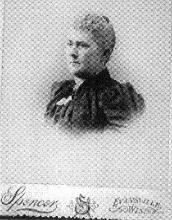
Vie Campbell
Researched and Written by Ruth Ann Montgomery
Vie was one of Wisconsin’s suffragettes, a Cooksville native and an Evansville Resident.
She was described as a lady of culture and refinement. Unlike many of her contemporaries, Vie used her own
name rather than be known as Mrs. Henry Campbell.
She helped introduce the School Suffrage bill for women in the state of Wisconsin, fought for suffrage for
women and a better life for women and children.
She was passionate about reforming temperance laws and suffrage laws. She was also passionate about the
plight of women and girls who were poor, poorly educated and in abusive relationships.
She promoted women and their work at the county and state fairs.
So where did this woman come from and who were the people who influenced her?
The Howard family came to Rock County in 1844 and Malvina A. Howard (Vie) was born in 1848, the year
Wisconsin became a state. Her father was Charles A. Howard, one of the first settlers in Cooksville. He was a
Civil War veteran. His biography in the 1889 Portrait and Biographical Album of Rock County said: “He has
always been found in the foremost part of the temperance movement and has been prominent in the promotion
of educational, social and moral interests. He feels that the struggle to be made against the liquor traffic will be
greater than the rebellion, though the weapons will be brains and the ballot. He felt that manufacture,
importation and the sale of everything that intoxicates ought to be prohibited.”
Vie's mother, Harriet, was a member of the Hoxie family. Harriet Hoxie Howard was also active in the
temperance movement.
Vie's uncles, Benjamin and Isaac Hoxie played a prominent role in the development of Evansville and were
strong supporters of the temperance movement. They encouraged Vie’s participation in organizations where
she developed skills in the promoting temperance and suffrage.
She was also influenced by area men who worked for the causes of temperance and suffrage. One was John
T. Dow, of Cooksville. He represented his district in the State Assembly and was a member of the first
Wisconsin convention for universal suffrage held at Janesville, October 9 and 10, 1867. Dow introduced a
joint resolution for universal suffrage into the legislature of 1867. The resolution passed both the senate and
the house, and was approved by Governor Fairchild, April 11, 1867.
However, Wisconsin’s constitution required that an amendment had to pass two legislatures before being
submitted the voters. The Janesville convention of 1867 was held to get public support for the bill. The
resolution was defeated in the 1868 legislature and Dow was defeated in the next election for the assembly. No
progress was made.
In the early 1860s, Vie’s family moved to Kansas where Vie began teaching at the age of 15. After the Civil
War her family moved back to Wisconsin. Vie Howard was 19 years old when she married Henry Campbell on
December 27, 1865.
Henry purchased a farm east of Evansville from Levi Leonard and the young couple moved into the house and
began their life together. It was a life filled with many challenges and opportunities.
Their first daughter, Eva, was born in 1868. Their only son, Leo was born in December 1869, and their
youngest daughter, Pearl, was born ten years later in 1879.
The couple was very active in the organization of the Grange, also know as the Patrons of Husbandry. The
Grange encouraged families to band together to promote the economic and political well-being of the
community and agriculture.
By 1873, Henry was suffering from attacks of inflammatory rheumatism and at times could not work the farm.
During Henry’s illness, members of the Evansville Grange came to help with the planting. Perhaps it was her
husband’s many bouts with illness that caused Vie to be so interested in the issues of health and a strong
body.
The Grange encouraged women to serve in offices and participate fully in its meetings. Vie served as Chaplin
of the organization in 1877. It was in encouraging women’s work in the Grange and Farm Institutes that Vie
found her voice and began her public speaking career. Working with her uncle, Benjamin Hoxie, she also
began to giving papers at the State Horticulture meetings and published articles about child rearing in farm
publications.
It was in the 1880s that Vie began her many years of active work for temperance and suffrage. One of her
speeches before the Farmer’s Institute at Cooksville in 1884 illustrates the causes that she hoped would bring
women together to improve society. She urged farmer’s wives “to unite to help, advise and strengthen each
other in fighting the evils of tobacco use, reading and circulating impure literature, gambling, and
extravagances of all kinds that took women away from improving their minds, and outdoor exercises that would
build a strong mind and healthy body.”
She was described as "an enthusiastic worker for the women suffrage cause." Vie Campbell, like many of the
women working for suffrage, was also involved in the temperance movement and held offices in both
organizations. Francis Willard, the national president of the Women’s Christian Temperance Union, (commonly
known as the W. C. T. U.) came to Evansville to help start the local club in 1883. Vie Campbell was a willing
worker.
"It may be possible--it is altogether probable that Prohibition can never be assured until women are granted the
right of suffrage," Vie wrote in 1884. She believed that women should have the vote "to save our husbands,
our sons, and our brothers, from the monster who already has his clutch upon their throats. Intemperance is a
slavery which so sacrifices the soul, that scarce a vestige of manhood remains."
Vie and Henry joined the Prohibition Party, a third political party in 1884 during the presidential election that
included the candidates, Garfield, Blaine, and John St. John. Vie Campbell helped draft the constitution for the
organization.
That same year, 1884, Vie Campbell was the state organizer for the Wisconsin Women's Suffrage Association.
She organized a group of men and women in Evansville and following the first membership meeting there were
18 people in the Evansville organization.
At the state level, Vie Campbell served as Vice-President of the Women's Suffrage Association. She set up a
booth at the Rock County Fair, but reported her disappointment in the activity: “I distributed about 250 leaflets,
secured the names of eleven women and ten men to our enrollment list. One woman, Mrs. Lizzie T. Smith, of
Milton, Wis., signed the W. S. A. constitution, payed the fee of fifty cents, thereby becoming a member of the
association. You may perhaps consider this a failure, but I deem it a signal success, from the fact that I now
see clearly, what I only dimly perceived before—the needs of Wisconsin women. We need a thorough,
sweeping revival throughout the length and breadth of the State—then organization and education. Woman's
duties, as house keeper, are of such a complex nature, that she has had little time to think of matters that are
of vital importance to her own sex. We need a good many of the awakening sort of lectures, that we may be
enabled to see wherein we stand in our own light, and how we may better our own condition. Woman's elevation
and amelioration must come through the efforts of woman. We find men, generally, wide-awake on these
matters, who tell us that the day is not far distant, when we shall no longer beg for that which is our natural
birthright—the enjoyment of the rights of American citizens.”
In her frustration at the lack of enthusiasm by other women she gave a speech at the 1886 state meeting
entitled "The Indifference of Women to Political Equality." Wherever Vie found an audience, she spoke to them
about Equal Rights, including meetings of the Grange, the Wisconsin State Horticulture Society, Suffrage
associations, W.C.T.U. meetings and Farmer's Institutes.
Through statewide contacts with other suffragettes she was able to persuade Susan B. Anthony and Wisconsin’
s Olympia Brown Willis to speak in Evansville in 1886. The cost of obtaining the speakers left the local Suffrage
association in debt and Vie made a plea for donations.
If it was difficult to promote suffrage for women, it was nearly impossible to get members of the Prohibition party
into the state legislature. Vie’s uncle, Benjamin S. Hoxie, ran for the state assembly in the fall of 1886, on the
Prohibition party ticket. He said in campaigning “I am always in the ranks of temperance workers and at one
time standing at the head of the order of the Sons of Temperance in this state and a member of the National
Division.” However the Prohibition Party only received 44 votes out of the 324 votes cast in Porter township.
One of the criticisms of women who wanted to vote was that they would neglect their homes and children. Vie
was a model for those who thought otherwise. Despite all of her activities, Vie Campbell still managed to have
an active home life. There were anniversary parties, basket picnics, and Halloween parties. Her children,
Pearl and Leo were living at home. Daughter, Eva, graduated from the Evansville Seminary in 1887 and
studied music at the University of Wisconsin Conservatory of Music. She married and moved to Tennessee.
At the 1888 Wisconsin State Fair held in Milwaukee a department for woman's work was added, with Vie
Campbell as superintendent. She persuaded Evansville’s first woman photographer to exhibit at the fair.
There were only two women photographers exhibiting at the state fair and it was considered an unusual
occupation for a woman.
Vie helped write the Wisconsin suffrage law that allowed women to vote on school issues in the late 1880s. The
W. C. T. U. also urged women to vote at school board meetings and for school board elections. Some women
tried to vote in general elections, expressing the idea that any election would relate to school issues, but they
were denied the ballot.
Vie was a strong promoter of good farming and conservation. The Campbells had one of the best farms in
Rock County. Henry Campbell loved horses and was vice-president of the Wisconsin Morgan Horse Society.
Vie was state treasurer for the Wisconsin State Horticulture Society.
In the early 1890s she continued as superintendent of the "Woman's Work" division at the Wisconsin State Fair
and in 1893, assisted her uncle Benjamin Hoxie at the World’s Fair exhibit of Wisconsin crops sponsored by the
state Horticulture Society.
By the 1890s, Vie’s leadership abilities were recognized at the local, state and national level. She was a
national delegate to W. C. T. U. conventions and Wisconsin president of the W. C. T. U. from 1892 to 1898.
Henry and Vie moved to Evansville in 1896 when their son, Leo, and his wife were married and took over the
farm. She still maintained her interest in agriculture and education of women living on farms. She helped
organize the women's meetings for the Farmer's Institutes and lectured throughout the state. In one year alone
she gave 151 lectures on temperance, suffrage, household chores, child rearing, and horticulture, while also
serving as the editor of the Wisconsin Horticulturist.
Women were continually looking for new ways to become active in local politics. Vie believed that women
needed to learn parliamentary procedure to prepare themselves for public office. Vie began to teach women
parliamentary procedure at the regional conventions held by the W. C. T. U., and at meetings of the Evansville’
s Womans Literary Club and Evansville’s Afternoon Club. When she completed her first session of the
parliamentary drills for the club, t minutes of the Womans Literary Club noted: "This was interesting and helpful
to all the members and the club is delighted with the promise of a series of these short lectures from this lady."
The Age of Consent had become an important issue for Vie. As president of the Wisconsin W. C. T. U. she
wrote an article for the Arena, a nationally circulated news letter, calling the laws reducing the age of consent
for young women from 16 to 14, “a blot upon our statute books” and “a disgrace to our boasted civilization” for
abandoning “girls who fall into that life that is worse than death.” While it was intended as an age when women
could sign contracts, it was also used to keep young women from accusing men of rape, incest, or other
abusive behavior. Wisconsin was thought to be one of the only states where the age of consent was lowered,
rather than raised. The W. C. T. U. also urged that the state create a "Reformatory for women and Girls" so
that they could be rescued from "Dens of Infamy."
Wisconsin’s W. C. T. U. established a home for unwed mothers at Eau Claire in the late 1880s and after taking
the office of President of the statewide organization, Vie Campbell served on the board of directors of the
home. The young women stayed at the home until their babies were born; received some training for future
work; and were kept occupied with sewing and other household chores until their babies were born. The
babies were put out for adoption or occasionally the girls married the baby’s father. Job training for the girls
was thought to be a very important component of their stay at the home.
In 1900, Vie was chosen the President of the Rock County W. C. T. U. The interests of that organization also
began to encompass anti-cigarette campaigns and Vie found one more subject for her lectures. She also
began organizing young women into a youth organization of W.C.T.U. workers.
At the 1901 statewide W. C. T. U. convention she took the women in the convention through a parliamentary
law drill of the complicated procedures. A reporter noted that “Mrs. Campbell steered them gracefully. She is a
charming presiding officer and the drill was one of the best features of the afternoon, being enjoyable as well;
as profitable.”
When Federated women’s clubs were organized in 1902, she continued to teach parliamentary law. Sometimes
her audience was less than enthusiastic, and in her frustration she scolded them: "Oh, ladies! You who are not
willing to vote on a woman's convention what are you going to do when a big temperance question comes along
to be voted on? These conventions are held partly for the purpose of preparing us so that we will know how to
use the right of suffrage when we secure it."
Her courses in parliamentary procedure were requested at conventions and meetings throughout the United
States. She was hired by the Mont Eagle Chautauqua near her daughter Eva’s home in Tennessee. That led
to a series of travel talks in Wisconsin called, "Travels in Dixie".
When a new suffrage bill came before a legislative committee at the state capital in Madison in March 1903, Vie
Campbell was a featured speaker. Seven women and three men spoke in favor of the bill before a joint session
of committees on privileges and elections.
The senate chamber, where the hearing was held, was crowded with women. The advocates of the bill who
spoke were Senator O'Neill, who introduced the bill. Dr. Amos P. Wilder, editor of State .Journal, and Rev
Updike, pastor of Congregational Church, Dr. Annette J. Shaw, of Eau Claire, Mrs. Catherine W. McCullough, a
Chicago attorney; Rev. Olympia Brown Willis, Racine; Mrs. Vie. H. Campbell, Evansville; Mrs. M. A. B. Smith,
Mrs. Mary Handsel of Madison; Dr. Maude Saunders, Racine. Newspapers reported that “No one had the
'hardihood’ to oppose.” However, the bill failed to gain the needed support, once again disappointing the
suffragettes.
In an effort to bring more women together to fight for equal rights, Vie joined the Federated Women's Club
movement. She began organizing regional Federated clubs and speaking at the state meetings of the
organization. In 1904, she was named a national delegate to the Federated Women's Club convention in St.
Louis.
Henry died on May 5, 1908, the very day that his father had died 48 years earlier. Vie and her daughter Pearl
continued to live in Evansville. By this time, Pearl was teaching in country schools in the Evansville area.
When Vie was named one of Wisconsin's delegates to the World W.C.T.U. convention held in Glasgow
Scotland, she and her daughter decided to make a grand tour of Europe. In 1910, Vie and her daughter Pearl
sailed on the Hamburg Steam Ship. First class passage cost $87.50. Their tour of Europe included Italy,
Switzerland, Germany, France and England. They wrote back travel logs of their journey which included Easter
in Rome and tours of Florence, the Passion Play in Germany, and tours of the Bavarian countryside.
Vie continued her travels in the work of the W.C.T.U. for the next few years. Her daughter Pearl went to South
Dakota in 1913 to teach at the St. Mary's Indian School on the Rosebud reservation.
Vie joined a new club, the Summer Club of Household Economics, similar to the Mother’s clubs that were
formed in the one-room schools to promote home economics and music and arts in schools. She held the
offices of vice-president and president of this organization. Topics of the meetings included saving time in the
home and music in the schools.
In 1916, Vie and her daughter, Pearl, moved to Milwaukee where Pearl worked for the Morehouse Publishing
Company. The house in Evansville was sold to Walter Gollmar, Sr. Once Vie moved to Milwaukee her
speaking and other activities in the temperance and suffrage organizations declined, perhaps due to health
problems.
Vie’s dream for suffrage was fulfilled when the 19th amendment was ratified in 1920. Vie died in 1922. She
was brought back to Evansville to be buried in Maple Hill Cemetery beside her husband. She was described as
"Loved, honored, and respected as one of the foremost women in the work of the W.C.T.U."
Researched and Written by Ruth Ann Montgomery
Vie was one of Wisconsin’s suffragettes, a Cooksville native and an Evansville Resident.
She was described as a lady of culture and refinement. Unlike many of her contemporaries, Vie used her own
name rather than be known as Mrs. Henry Campbell.
She helped introduce the School Suffrage bill for women in the state of Wisconsin, fought for suffrage for
women and a better life for women and children.
She was passionate about reforming temperance laws and suffrage laws. She was also passionate about the
plight of women and girls who were poor, poorly educated and in abusive relationships.
She promoted women and their work at the county and state fairs.
So where did this woman come from and who were the people who influenced her?
The Howard family came to Rock County in 1844 and Malvina A. Howard (Vie) was born in 1848, the year
Wisconsin became a state. Her father was Charles A. Howard, one of the first settlers in Cooksville. He was a
Civil War veteran. His biography in the 1889 Portrait and Biographical Album of Rock County said: “He has
always been found in the foremost part of the temperance movement and has been prominent in the promotion
of educational, social and moral interests. He feels that the struggle to be made against the liquor traffic will be
greater than the rebellion, though the weapons will be brains and the ballot. He felt that manufacture,
importation and the sale of everything that intoxicates ought to be prohibited.”
Vie's mother, Harriet, was a member of the Hoxie family. Harriet Hoxie Howard was also active in the
temperance movement.
Vie's uncles, Benjamin and Isaac Hoxie played a prominent role in the development of Evansville and were
strong supporters of the temperance movement. They encouraged Vie’s participation in organizations where
she developed skills in the promoting temperance and suffrage.
She was also influenced by area men who worked for the causes of temperance and suffrage. One was John
T. Dow, of Cooksville. He represented his district in the State Assembly and was a member of the first
Wisconsin convention for universal suffrage held at Janesville, October 9 and 10, 1867. Dow introduced a
joint resolution for universal suffrage into the legislature of 1867. The resolution passed both the senate and
the house, and was approved by Governor Fairchild, April 11, 1867.
However, Wisconsin’s constitution required that an amendment had to pass two legislatures before being
submitted the voters. The Janesville convention of 1867 was held to get public support for the bill. The
resolution was defeated in the 1868 legislature and Dow was defeated in the next election for the assembly. No
progress was made.
In the early 1860s, Vie’s family moved to Kansas where Vie began teaching at the age of 15. After the Civil
War her family moved back to Wisconsin. Vie Howard was 19 years old when she married Henry Campbell on
December 27, 1865.
Henry purchased a farm east of Evansville from Levi Leonard and the young couple moved into the house and
began their life together. It was a life filled with many challenges and opportunities.
Their first daughter, Eva, was born in 1868. Their only son, Leo was born in December 1869, and their
youngest daughter, Pearl, was born ten years later in 1879.
The couple was very active in the organization of the Grange, also know as the Patrons of Husbandry. The
Grange encouraged families to band together to promote the economic and political well-being of the
community and agriculture.
By 1873, Henry was suffering from attacks of inflammatory rheumatism and at times could not work the farm.
During Henry’s illness, members of the Evansville Grange came to help with the planting. Perhaps it was her
husband’s many bouts with illness that caused Vie to be so interested in the issues of health and a strong
body.
The Grange encouraged women to serve in offices and participate fully in its meetings. Vie served as Chaplin
of the organization in 1877. It was in encouraging women’s work in the Grange and Farm Institutes that Vie
found her voice and began her public speaking career. Working with her uncle, Benjamin Hoxie, she also
began to giving papers at the State Horticulture meetings and published articles about child rearing in farm
publications.
It was in the 1880s that Vie began her many years of active work for temperance and suffrage. One of her
speeches before the Farmer’s Institute at Cooksville in 1884 illustrates the causes that she hoped would bring
women together to improve society. She urged farmer’s wives “to unite to help, advise and strengthen each
other in fighting the evils of tobacco use, reading and circulating impure literature, gambling, and
extravagances of all kinds that took women away from improving their minds, and outdoor exercises that would
build a strong mind and healthy body.”
She was described as "an enthusiastic worker for the women suffrage cause." Vie Campbell, like many of the
women working for suffrage, was also involved in the temperance movement and held offices in both
organizations. Francis Willard, the national president of the Women’s Christian Temperance Union, (commonly
known as the W. C. T. U.) came to Evansville to help start the local club in 1883. Vie Campbell was a willing
worker.
"It may be possible--it is altogether probable that Prohibition can never be assured until women are granted the
right of suffrage," Vie wrote in 1884. She believed that women should have the vote "to save our husbands,
our sons, and our brothers, from the monster who already has his clutch upon their throats. Intemperance is a
slavery which so sacrifices the soul, that scarce a vestige of manhood remains."
Vie and Henry joined the Prohibition Party, a third political party in 1884 during the presidential election that
included the candidates, Garfield, Blaine, and John St. John. Vie Campbell helped draft the constitution for the
organization.
That same year, 1884, Vie Campbell was the state organizer for the Wisconsin Women's Suffrage Association.
She organized a group of men and women in Evansville and following the first membership meeting there were
18 people in the Evansville organization.
At the state level, Vie Campbell served as Vice-President of the Women's Suffrage Association. She set up a
booth at the Rock County Fair, but reported her disappointment in the activity: “I distributed about 250 leaflets,
secured the names of eleven women and ten men to our enrollment list. One woman, Mrs. Lizzie T. Smith, of
Milton, Wis., signed the W. S. A. constitution, payed the fee of fifty cents, thereby becoming a member of the
association. You may perhaps consider this a failure, but I deem it a signal success, from the fact that I now
see clearly, what I only dimly perceived before—the needs of Wisconsin women. We need a thorough,
sweeping revival throughout the length and breadth of the State—then organization and education. Woman's
duties, as house keeper, are of such a complex nature, that she has had little time to think of matters that are
of vital importance to her own sex. We need a good many of the awakening sort of lectures, that we may be
enabled to see wherein we stand in our own light, and how we may better our own condition. Woman's elevation
and amelioration must come through the efforts of woman. We find men, generally, wide-awake on these
matters, who tell us that the day is not far distant, when we shall no longer beg for that which is our natural
birthright—the enjoyment of the rights of American citizens.”
In her frustration at the lack of enthusiasm by other women she gave a speech at the 1886 state meeting
entitled "The Indifference of Women to Political Equality." Wherever Vie found an audience, she spoke to them
about Equal Rights, including meetings of the Grange, the Wisconsin State Horticulture Society, Suffrage
associations, W.C.T.U. meetings and Farmer's Institutes.
Through statewide contacts with other suffragettes she was able to persuade Susan B. Anthony and Wisconsin’
s Olympia Brown Willis to speak in Evansville in 1886. The cost of obtaining the speakers left the local Suffrage
association in debt and Vie made a plea for donations.
If it was difficult to promote suffrage for women, it was nearly impossible to get members of the Prohibition party
into the state legislature. Vie’s uncle, Benjamin S. Hoxie, ran for the state assembly in the fall of 1886, on the
Prohibition party ticket. He said in campaigning “I am always in the ranks of temperance workers and at one
time standing at the head of the order of the Sons of Temperance in this state and a member of the National
Division.” However the Prohibition Party only received 44 votes out of the 324 votes cast in Porter township.
One of the criticisms of women who wanted to vote was that they would neglect their homes and children. Vie
was a model for those who thought otherwise. Despite all of her activities, Vie Campbell still managed to have
an active home life. There were anniversary parties, basket picnics, and Halloween parties. Her children,
Pearl and Leo were living at home. Daughter, Eva, graduated from the Evansville Seminary in 1887 and
studied music at the University of Wisconsin Conservatory of Music. She married and moved to Tennessee.
At the 1888 Wisconsin State Fair held in Milwaukee a department for woman's work was added, with Vie
Campbell as superintendent. She persuaded Evansville’s first woman photographer to exhibit at the fair.
There were only two women photographers exhibiting at the state fair and it was considered an unusual
occupation for a woman.
Vie helped write the Wisconsin suffrage law that allowed women to vote on school issues in the late 1880s. The
W. C. T. U. also urged women to vote at school board meetings and for school board elections. Some women
tried to vote in general elections, expressing the idea that any election would relate to school issues, but they
were denied the ballot.
Vie was a strong promoter of good farming and conservation. The Campbells had one of the best farms in
Rock County. Henry Campbell loved horses and was vice-president of the Wisconsin Morgan Horse Society.
Vie was state treasurer for the Wisconsin State Horticulture Society.
In the early 1890s she continued as superintendent of the "Woman's Work" division at the Wisconsin State Fair
and in 1893, assisted her uncle Benjamin Hoxie at the World’s Fair exhibit of Wisconsin crops sponsored by the
state Horticulture Society.
By the 1890s, Vie’s leadership abilities were recognized at the local, state and national level. She was a
national delegate to W. C. T. U. conventions and Wisconsin president of the W. C. T. U. from 1892 to 1898.
Henry and Vie moved to Evansville in 1896 when their son, Leo, and his wife were married and took over the
farm. She still maintained her interest in agriculture and education of women living on farms. She helped
organize the women's meetings for the Farmer's Institutes and lectured throughout the state. In one year alone
she gave 151 lectures on temperance, suffrage, household chores, child rearing, and horticulture, while also
serving as the editor of the Wisconsin Horticulturist.
Women were continually looking for new ways to become active in local politics. Vie believed that women
needed to learn parliamentary procedure to prepare themselves for public office. Vie began to teach women
parliamentary procedure at the regional conventions held by the W. C. T. U., and at meetings of the Evansville’
s Womans Literary Club and Evansville’s Afternoon Club. When she completed her first session of the
parliamentary drills for the club, t minutes of the Womans Literary Club noted: "This was interesting and helpful
to all the members and the club is delighted with the promise of a series of these short lectures from this lady."
The Age of Consent had become an important issue for Vie. As president of the Wisconsin W. C. T. U. she
wrote an article for the Arena, a nationally circulated news letter, calling the laws reducing the age of consent
for young women from 16 to 14, “a blot upon our statute books” and “a disgrace to our boasted civilization” for
abandoning “girls who fall into that life that is worse than death.” While it was intended as an age when women
could sign contracts, it was also used to keep young women from accusing men of rape, incest, or other
abusive behavior. Wisconsin was thought to be one of the only states where the age of consent was lowered,
rather than raised. The W. C. T. U. also urged that the state create a "Reformatory for women and Girls" so
that they could be rescued from "Dens of Infamy."
Wisconsin’s W. C. T. U. established a home for unwed mothers at Eau Claire in the late 1880s and after taking
the office of President of the statewide organization, Vie Campbell served on the board of directors of the
home. The young women stayed at the home until their babies were born; received some training for future
work; and were kept occupied with sewing and other household chores until their babies were born. The
babies were put out for adoption or occasionally the girls married the baby’s father. Job training for the girls
was thought to be a very important component of their stay at the home.
In 1900, Vie was chosen the President of the Rock County W. C. T. U. The interests of that organization also
began to encompass anti-cigarette campaigns and Vie found one more subject for her lectures. She also
began organizing young women into a youth organization of W.C.T.U. workers.
At the 1901 statewide W. C. T. U. convention she took the women in the convention through a parliamentary
law drill of the complicated procedures. A reporter noted that “Mrs. Campbell steered them gracefully. She is a
charming presiding officer and the drill was one of the best features of the afternoon, being enjoyable as well;
as profitable.”
When Federated women’s clubs were organized in 1902, she continued to teach parliamentary law. Sometimes
her audience was less than enthusiastic, and in her frustration she scolded them: "Oh, ladies! You who are not
willing to vote on a woman's convention what are you going to do when a big temperance question comes along
to be voted on? These conventions are held partly for the purpose of preparing us so that we will know how to
use the right of suffrage when we secure it."
Her courses in parliamentary procedure were requested at conventions and meetings throughout the United
States. She was hired by the Mont Eagle Chautauqua near her daughter Eva’s home in Tennessee. That led
to a series of travel talks in Wisconsin called, "Travels in Dixie".
When a new suffrage bill came before a legislative committee at the state capital in Madison in March 1903, Vie
Campbell was a featured speaker. Seven women and three men spoke in favor of the bill before a joint session
of committees on privileges and elections.
The senate chamber, where the hearing was held, was crowded with women. The advocates of the bill who
spoke were Senator O'Neill, who introduced the bill. Dr. Amos P. Wilder, editor of State .Journal, and Rev
Updike, pastor of Congregational Church, Dr. Annette J. Shaw, of Eau Claire, Mrs. Catherine W. McCullough, a
Chicago attorney; Rev. Olympia Brown Willis, Racine; Mrs. Vie. H. Campbell, Evansville; Mrs. M. A. B. Smith,
Mrs. Mary Handsel of Madison; Dr. Maude Saunders, Racine. Newspapers reported that “No one had the
'hardihood’ to oppose.” However, the bill failed to gain the needed support, once again disappointing the
suffragettes.
In an effort to bring more women together to fight for equal rights, Vie joined the Federated Women's Club
movement. She began organizing regional Federated clubs and speaking at the state meetings of the
organization. In 1904, she was named a national delegate to the Federated Women's Club convention in St.
Louis.
Henry died on May 5, 1908, the very day that his father had died 48 years earlier. Vie and her daughter Pearl
continued to live in Evansville. By this time, Pearl was teaching in country schools in the Evansville area.
When Vie was named one of Wisconsin's delegates to the World W.C.T.U. convention held in Glasgow
Scotland, she and her daughter decided to make a grand tour of Europe. In 1910, Vie and her daughter Pearl
sailed on the Hamburg Steam Ship. First class passage cost $87.50. Their tour of Europe included Italy,
Switzerland, Germany, France and England. They wrote back travel logs of their journey which included Easter
in Rome and tours of Florence, the Passion Play in Germany, and tours of the Bavarian countryside.
Vie continued her travels in the work of the W.C.T.U. for the next few years. Her daughter Pearl went to South
Dakota in 1913 to teach at the St. Mary's Indian School on the Rosebud reservation.
Vie joined a new club, the Summer Club of Household Economics, similar to the Mother’s clubs that were
formed in the one-room schools to promote home economics and music and arts in schools. She held the
offices of vice-president and president of this organization. Topics of the meetings included saving time in the
home and music in the schools.
In 1916, Vie and her daughter, Pearl, moved to Milwaukee where Pearl worked for the Morehouse Publishing
Company. The house in Evansville was sold to Walter Gollmar, Sr. Once Vie moved to Milwaukee her
speaking and other activities in the temperance and suffrage organizations declined, perhaps due to health
problems.
Vie’s dream for suffrage was fulfilled when the 19th amendment was ratified in 1920. Vie died in 1922. She
was brought back to Evansville to be buried in Maple Hill Cemetery beside her husband. She was described as
"Loved, honored, and respected as one of the foremost women in the work of the W.C.T.U."